
CHAPTER 5: THE PAPER TRAIL IN THE CONDUIT
Officer Miller crouched by the grey metal casing of the electric meter, his heavy leather duty belt creaking as he rested his forearms on his knees. He didn’t touch the yellow paper immediately. He pulled a fresh pair of blue nitrile gloves from his tactical pocket, snapping them over his fingers with a sharp, rubbery sound that carried up toward the lower roof.
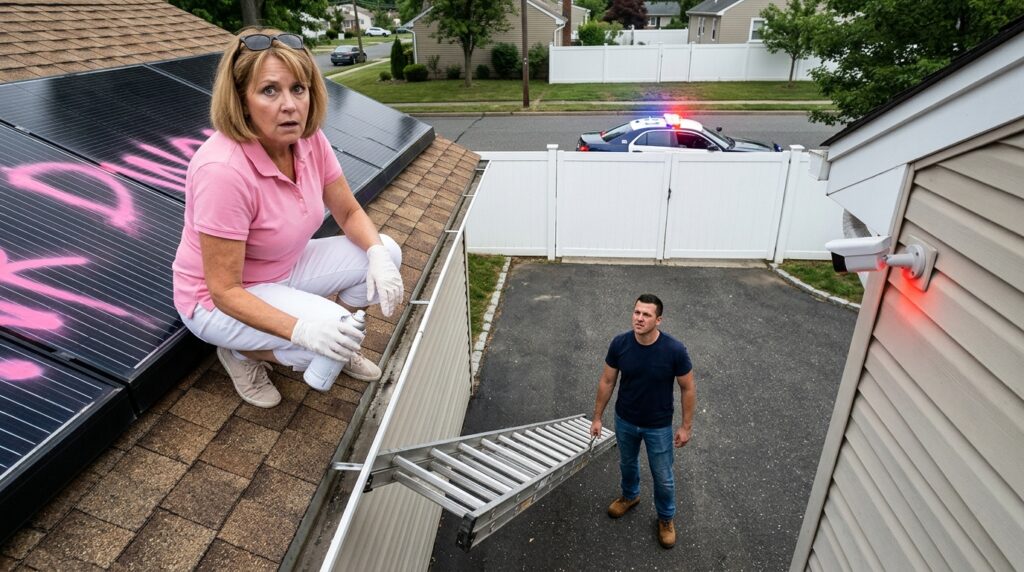
Above them, Brenda shifted her posture again, her sneakers squeaking against the grit. Her face was slick with sweat, her oversized sunglasses dangling by one earpiece from her left ear. “Miller, don’t you touch that! That is board property! It’s an administrative record!”
“It’s stuffed behind a residential utility box inside a marked crime scene, Brenda,” Miller said without looking up. He reached out with two gloved fingers, pinching the exposed corner of the yellow document.
Mark stepped closer, his heavy work boots stopping two inches from the yellow police tape. The afternoon heat radiating off the garage siding smelled of hot cedar and dry dust. “She put it there right before she set up the ladder, Miller. I saw her hand come back from that corner when I walked out of the garage.”
Miller pulled slowly. The paper gave a stiff, dry rasp as it slid out from the narrow gap between the galvanized steel conduit and the cedar boards. It wasn’t just a single sheet. It was a four-part carbon document, faded to the color of corn husks, stiffened by age and heat.
Miller unfolded it on his knee. The top banner was stamped in dark blue ink: OAKRIDGE ESTATES ARCHITECTURAL REVIEW BOARD – SPECIAL ENFORCEMENT NOTICE.
“Look at the date line,” Mark said, leaning over the tape. His eye caught the dark, typewriter-pressed numerals. “Look at the year.”
Miller ran a blue-gloved thumb along the top margin. “October 14, 1998. Provision 4-B: Mandatory Removal Order for Non-Compliant Exterior Reflective Structures.” Miller paused, his eyes flicking up to the electric meter, then to the house itself. “Mark, when did you say this lot was surveyed?”
“Platted in 2001. Foundation was poured in March of 2002,” Mark said, his voice dropping into a low, hard rasp. “This house didn’t exist in ninety-eight. This whole subdivision was still an oak grove owned by the county rail authority.”
“That’s a master charter clause!” Brenda shouted down, her voice thin and ragged, vibrating with a panic that was no longer about the twelve-foot drop to the driveway. “The 1998 charter covers the entire regional tract! It carried over when the developer bought the parcel!”
“No, it didn’t,” Miller said softly. He turned the document over. On the back of the third carbon page, stamped in faint red ink that had faded to rust, was a municipal seal: REPEALED – TOWNSHIP ORDINANCE 402-A – JANUARY 2004.
Mark felt a cold, sharp focus settle behind his ribs. The math of the situation wasn’t just about an entitled neighbor throwing a fit over glass panels on a roofline. It was a calculated, pre-printed paper setup. Brenda hadn’t pulled a random notice out of her house this morning. She had gone into an old archive, pulled a voided, twenty-eight-year-old carbon form that had been legally dead for over two decades, signed her own name at the bottom under ACTIVE ENFORCEMENT OFFICER, and wedged it into his meter box before climbing the roof with a spray can.
She was intentionally creating a legal record of long-term non-compliance—a paper trail designed to make it look like Mark had ignored decades of board notices.
“Why?” Mark asked, looking up directly into Brenda’s eyes.
Brenda pulled her knees in tight against her chest, her pink polo shirt ruined with bright pink paint smears across her stomach. She didn’t answer. She turned her head away, staring out toward the curb where Sarah Jenkins and old man Henderson were watching every movement through the lens of a smartphone camera.
“If an HOA places three consecutive uncorrected structural violation notices on a property deed in this township,” Miller read slowly from the notes at the bottom of the form, “the board gains the right to file an automatic lien for architectural remediation… and attach daily compound fines to the property tax assessment.”
Mark looked at the yellow paper in Miller’s hand, then back up at the roof. “A lien. She wasn’t trying to make me take the panels down. She was trying to build a foreclosure file.”
Miller carefully folded the carbon form along its original creases, slipped it into a clear plastic evidence bag, and sealed the top with a strip of red tape. He stood up, his face grim as he looked up at the lower eave.
“Brenda,” Miller said, his tone no longer that of a friendly neighborhood officer, but of an arresting deputy laying down a federal chain of custody. “Code Enforcement is turning onto the street right behind the fire truck. When you come down off that roof, you’re not going home to write fines. You’re coming to the station for fraud, forgery, and felony property destruction.”
Brenda’s mouth opened, but no sound came out. The aerosol can slipped from her limp, white-gloved fingers. It hit the asphalt shingles with a dull thud, rolled down the five-foot slope, and plunged off the edge, crashing onto the concrete driveway right at Mark’s boots with a sharp, metallic ring.
A single drop of bright pink paint splattered across the toe of Mark’s work boot. He didn’t step back. He stood his ground, watching the fire truck’s heavy folding ladder begin to uncoil over the fence.








