
CHAPTER 4: THE WITNESSES AT THE CURB
The low, hydraulic groan of air brakes vibrated through the soles of Mark’s boots before the engine even turned the corner.
Station Two’s pumper truck rounded the bend of Elmwood Avenue, its yellow enamel cab glinting through the heat shimmer rising off the asphalt. It rolled to a heavy crawl behind Officer Miller’s cruiser, its diesel idle chugging like a freight train idling on a siding. Behind it, two more cars slowed along the curb—a silver minivan driven by Sarah Jenkins from number 1408, and a rusted pickup with a mower trailer belonging to the lawn crew Brenda had hired three weeks ago to measure fence heights.
The quiet of the cul-de-sac collapsed into the raw friction of public exposure.
On the front lawn across the street, old man Henderson stepped down off his porch, his wooden cane thumping against the sun-baked turf. He didn’t cross the property line, but he didn’t stay back either. He stood right at his mailbox, leaning his elbows on the cedar post, his faded eyes locked on Brenda’s crouching form twelve feet up on the roof edge.
“Mark!” Sarah called out through her open minivan window, her phone held shoulder-high, the black glass screen reflecting the noon glare. “Is she… is she spray-painting your solar array?”
Mark didn’t look back at the street. His gaze remained pinned to the roofline, his boots firmly gripping the driveway concrete. “Ask her, Sarah. She brought the Krylon.”
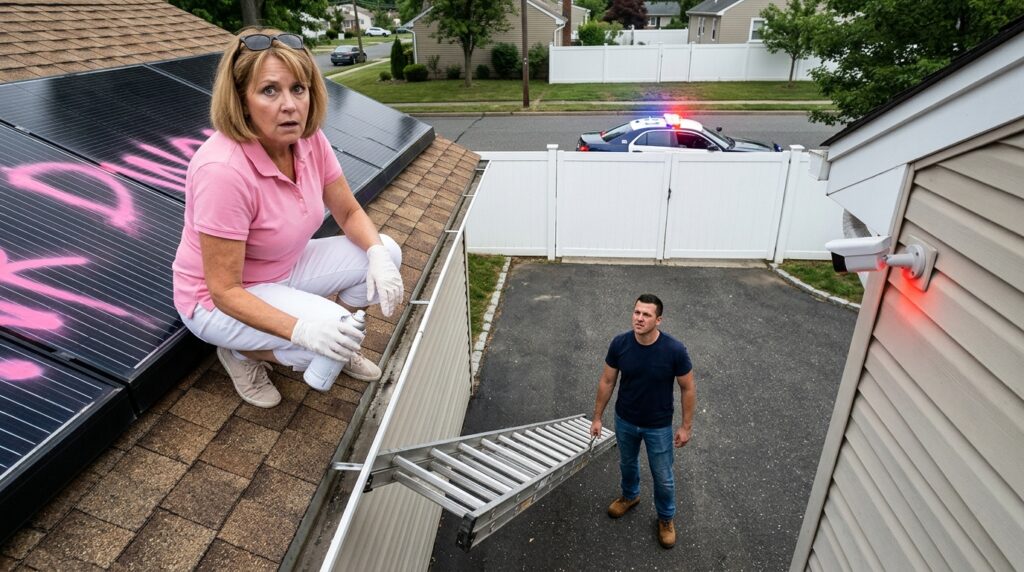
Brenda shrank back three inches, her knees digging into the hot asphalt shingles. The oversized sunglasses slipped lower down her nose, revealing pale, wet skin around her eyes. She gripped the aerosol spray can against her pink polo shirt, trying to slide it behind her back, but the bright pink paint wet on her white latex gloves smeared across her midsection, leaving a stark, bloody-looking drag mark across the fabric.
“Don’t you record me, Sarah!” Brenda shrieked, her voice cracking against the rumble of the fire truck’s idling diesel. “I am conducting an official architectural inspection under authority of the executive board! Turn that camera off!”
“You’re on my property, Brenda,” Sarah called back, her thumb clicking the record button. Her voice carried the tight, built-up venom of three years’ worth of fifty-dollar fines for trash cans left out two hours past sunset. “And you’re standing on Mark’s roof in white gloves like a burglar! What executive board? The annual meeting isn’t until November!”
Officer Miller stepped back toward the middle of the driveway, waving his hand to direct the engine to hold its position near the hydrant. The driver, a thick-necked lieutenant named Davis, leaned out his cab window, taking in the scene with a slow, disbelieving shake of his head.
“Unit Four,” Davis shouted down over the diesel thrum. “You need a basket, or can we just pitch a ten-foot folding ladder against the fascia?”
“Don’t pitch anything against my gutters, Davis,” Mark said, his voice cutting clean and flat through the noise. “She brought her own extension ladder. It’s lying right there by the woodpile. She can use her own gear when she comes down into cuffs.”
“Cuffs?” Brenda’s head snapped toward Lieutenant Davis, her chin quivering. “Lieutenant! Tell them! I am the vice president! I have administrative immunity for code enforcement!”
Davis snorted, pulling his sunglasses down to his neck. “Brenda, the fire department doesn’t enforce HOA rules, and we don’t rescue people who climb onto private roofs to do graffiti. You want down, you talk to Miller.”
Miller didn’t engage in the shouting. He pulled a yellow roll of heavy plastic crime scene tape from his trunk, tied one end to the wooden fence post by Mark’s driveway apron, and walked the bright yellow band across the concrete to the corner of the garage.
The tape snapped tight in the hot breeze—POLICE LINE DO NOT CROSS—barricading Brenda’s ladder, Mark’s electric meter, and the base of the garage wall inside a formal perimeter.
A collective murmur drifted over from the curb. Three more neighbors had gathered near Henderson’s mailbox—the young couple from 1416 who Brenda had cited for having a toddler’s plastic sandbox in their fenced backyard, and the retired mechanic from the corner lot whose vintage truck had been fined as an ‘unlicensed visual nuisance.’ They didn’t shout. They just stood shoulder-to-shoulder in the heat, watching the white-gloved enforcer of Oakridge Estates sweat on an open roof in front of an active police tape.
Brenda looked at the yellow tape, then down at Miller’s steady, unblinking glare. Her shoulders slumped. The arrogant, upright posture that had dominated every neighborhood assembly for a decade seemed to deflate, leaving her looking small, frail, and utterly stranded under the brutal August sun.
“Mark,” she whispered, her voice dropping into a desperate, hollow rasp that barely reached the driveway. “Please. Just put the ladder up. My knees are going out. We can talk about the panels in private.”
Mark took half a step forward, his work boots stopping precisely one inch short of the yellow police tape. He didn’t look at her face; he looked at the wet pink streaks drying into a rubbery ruin over four thousand dollars’ worth of clean-energy glass.
“We’re not talking in private anymore, Brenda,” Mark said softly. “The whole block is watching.”








