
CHAPTER 2: DEAD WEIGHT ON THE CONCRETE
“Mark! You put that aluminum back against this eave or I swear to God I’ll have the sheriff put you in cuffs before dinner!”
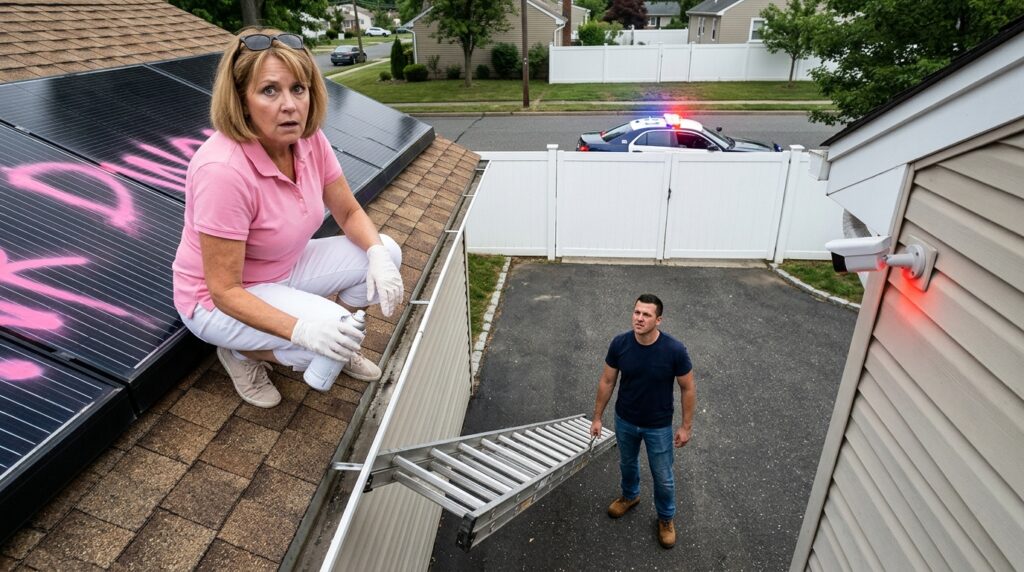
Brenda’s voice didn’t carry the sharp, clipped authority she used at the annual community association meetings. It rattled. Her white latex gloves gripped the edge of the aluminum drip edge so tight the rubber stretched thin over her knuckles, picking up grey oil and grit from the thirty-year-old asphalt shingles. On her knees, two feet from the gutter, she looked smaller, her stiff blonde bob flattened against her forehead by the August humidity.
Mark didn’t raise his eyes from the base of the ladder. He kicked the lower rung with the steel toe of his work boot, making the heavy double-extension frame settle flat against the foundation line, wedged between two concrete cinder blocks and his stack of dry oak firewood.
“Cops are already turning onto the avenue, Brenda,” Mark said. His voice was a flat, low hum, the same voice he used when a spindle on the lathe ran three-thousandths off tolerance and needed to be scrapped. “You’re twelve feet up. Roof’s hot. Paint’s wet. I’d sit real still if I were you.”
“You dragged a ladder out from under a woman on private property!” Her voice hit a high, screeching register that made old man Henderson pause on his porch two doors down. He adjusted his straw hat, leaning over his porch rail to get a clearer view through the gap in the privacy fence. “That’s assault! That’s reckless endangerment!”
“You’re on my deed, Brenda. The city inspector stamped the solar permit last Thursday. It’s taped right inside the side garage window.” Mark gestured with a thumb toward the glass pane six inches from where the ladder had been resting. “Permit’s legal. State statute seven-twelve says no neighborhood board can block residential clean energy upgrades.”
“That statute doesn’t apply to historic overlay zones!” She shifted her weight, the rubber soles of her white sneakers squeaking against the hot granules of the shingles. The white aerosol can in her hand gave a soft, metallic rattle as her fingers twitched around the cap. Fresh pink foam bubbled from the tip, dripping once, twice, onto the dark tempered glass of the middle panel. “We passed the amendment in ’98! No glass reflective surfaces visible from the public thoroughfare!”
Mark crossed his arms. The heat off the driveway asphalt was rising through the soles of his boots, baking the denim of his jeans. “This street wasn’t platted until 2002, Brenda. There was no ’98 amendment for this section.”
Brenda’s mouth opened, then snapped shut like a spring-loaded latch. For a fraction of a second, her eyes darted toward the side of the house—not toward the street where the red-and-blue strobe lights were now painting the dry leaves of the oak tree, but down toward the electric meter box mounted beside the garage side door.
Mark caught the look. He didn’t move toward the meter, but his mind flagged the quick, guilty tilt of her chin.
Beside the grey metal meter enclosure, tucked deep into the narrow gap where the conduit pipe met the cedar siding, a folded strip of yellow carbon paper stuck out an inch into the sunlight. It wasn’t the standard white city inspection card. It was old, yellowed at the edges, folded four times into a tight square.
“I have the authority,” Brenda stammered, her voice dropping a full octave as the low, heavy rumble of a Ford Crown Victoria engine slowed at the mouth of his driveway. The tires crunched over the loose gravel near the curb. “The board signed the order yesterday. We have a mandate to protect property values on this block. Do you have any idea what these… these industrial monstrosities do to the appraisal floor?”
“Appraisal floor?” Mark let out a short, dry sound that wasn’t quite a laugh. “My property tax went up six hundred bucks last spring because you voted to widen the drainage ditch behind your lot. My panels cut my electric bill eighty percent. That’s math, Brenda. Not appraisal talk.”
The police cruiser stopped ten feet short of the driveway apron, its engine idling with a deep, mechanical thud. Through the windshield, Officer Miller—a guy Mark knew from the local hardware store’s Saturday morning contractor counter—looked up through the driver’s side glass, his brow furrowed as he took in the scene.
The black photovoltaic array slashed with neon pink.
The white-gloved woman crouched on the roof edge with an aerosol can.
The heavy extension ladder laid flat on the concrete out of reach.
And Mark, standing in his navy work shirt, arms folded, unmoving as a fence post.
Officer Miller killed the siren, cut the engine, and opened his door. The heavy latch clicked in the silent driveway.
“Mark,” Miller called out, resting one hand on the frame of his open door, his eyes scanning the eave. “Looks like you got a bird stuck up on your roof.”
“Not a bird, Miller,” Mark said, not taking his eyes off Brenda. “Just an unapproved inspector.”
Brenda leaned forward over the gutter, her face flushed red under her oversized sunglasses. “Officer! Officer, arrest this man immediately! He trapped me up here! He pulled the ladder away while I was performing official community maintenance!”
Miller stepped out into the dust of the driveway, his boots crunching on the gravel. He didn’t draw his belt, but he didn’t smile either. He looked at the ladder flat against the woodpile, then up at the glowing blue eye of Mark’s security camera on the fascia.
“Official maintenance with a can of pink Krylon, Brenda?” Miller asked softly, pulling his notebook from his breast pocket. “You want to tell me how that works before I call the ladder truck?”








