
CHAPTER 3: THE GLASS AND THE CAMERA
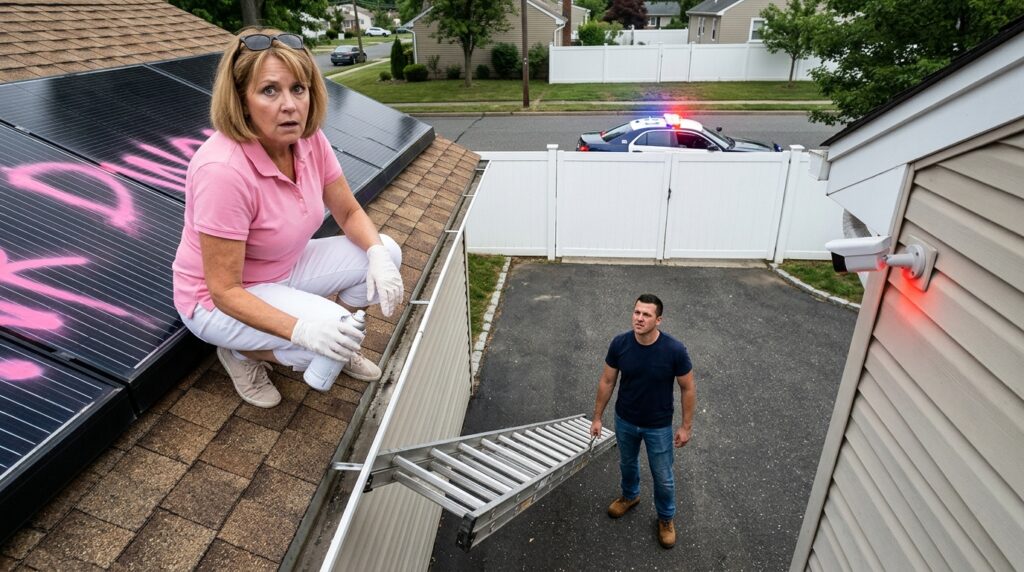
“Official maintenance?” Officer Miller walked past the front bumper of his cruiser, his heavy leather duty belt creaking against the starched polyester of his uniform. He stopped at the edge of the concrete pad, taking in the full arc of the damage—the bright pink Krylon enamel drying into tacky, plastic skin across four hundred square feet of black solar glass. “Brenda, I’ve lived in this county forty-two years. I haven’t seen the HOA board do emergency maintenance on a man’s roof since the eighty-nine hail storm, and even then they didn’t bring spray paint.”
“He altered the architectural footprint without prior committee review!” Brenda’s voice cracked higher, her white-gloved hand tightening so hard around the aerosol can that the thin metal rim creaked. “The color code for roof-mounted fixtures in Sector Four is dark bronze or matte charcoal! Look at those frames! They’re anodized silver!”
“They’re standard aluminum, Brenda,” Mark said, his tone low and unhurried. He didn’t shift his stance. His boots stayed planted three inches from the garage wall, keeping his body positioned squarely between the roofline and the flattened ladder on the woodpile. “Factory anodized. Grounded to county electrical code. The city building inspector passed the bonding wire two hours after the racking was bolted down.”
“City code doesn’t override restrictive covenants!” Brenda leaned forward over the gutter, her white pants smearing fresh grey grit off the asphalt shingles. “Officer, tell him! Tell him he has to put the ladder back! My blood pressure is spiking! If I faint up here and fall, his insurance won’t cover a dime—I’ll sue his estate into probate!”
Miller didn’t reach for the ladder. Instead, he pulled a small black digital camera from his utility belt, flicked the lens cover open, and aimed it straight up at the eave. The shutter clicked three times in rapid succession—the sharp, artificial sound cutting through the humid afternoon silence.
“You’re not falling, Brenda. Not unless you keep bouncing around on those fifteen-year-old architectural shingles,” Miller said, taking two steps toward the side of the garage to get a wider angle on the roof. “And far as the ladder goes, Mark didn’t push you up there. You brought it, set it on his private driveway, and climbed it without a permit or a warrant. That makes it a tool of trespass.”
“Trespass?” Brenda gasped, her oversized sunglasses sliding down the bridge of her nose. Behind the tinted plastic, her eyes were bloodshot, surrounded by deep, dark circles that her foundation couldn’t quite mask. “I am the vice president of the Oakridge Estates Property Owners Association! I have an easement right!”
“Utility easement extends five feet from the curb line,” Mark said, pointing a grease-stained finger toward the green transformer box sitting near the sidewalk. “You’re twenty-two feet inside my boundary line, standing on my rafters.”
Miller unclipped a small microphone from his shoulder, pressed the talk button, and spoke in a low, even cadence. “Dispatch, this is Unit Four. I’m on scene at 1412 Elmwood. Requesting a ladder unit from Township Fire Station Two for a non-injury removal at roof height. Also notify Code Enforcement—got a willful criminal mischief in progress involving property damage over fifteen hundred dollars.”
“Criminal mischief?” Brenda’s voice lost its sharp edge, dropping into a panicked, breathy squeak. “Miller! Bob Miller! I’ve known your mother for thirty years! We were on the library committee together!”
“And my mother pays her property taxes and doesn’t climb onto her neighbor’s roof with a can of paint, Brenda,” Miller replied, his pen moving smoothly across the yellow grid of his field notepad. He didn’t look up from his writing. “You’re over the state felony threshold for malicious destruction of property the second that paint hit the tempered glass. Those panels aren’t cheap.”
“Nine hundred apiece,” Mark added quietly. “Four panels impacted. Plus labor, mounting rails, and re-wiring if the solvent ate through the junction seals on the backboards.”
Brenda’s jaw worked silently. Her eyes flicked frantically from Miller’s pen down to Mark’s face, then landed once more on the side wall of the garage—specifically on the electric meter box where the faded yellow strip of carbon paper remained wedged behind the conduit. Her knee twitched, a nervous, involuntary jerk that sent a small shower of loose roof granules skittering down the incline and splashing into the plastic gutter.
Mark caught the movement. While Miller stepped back toward the cruiser to talk to the fire dispatch, Mark took a slow, deliberate step toward the side door of the garage, as if adjusting his posture. His eyes narrowed on the yellow paper.
It wasn’t a standard city notice. The paper was dry, brittle, and faded to the color of old straw, but he could clearly see three red stamp marks on the exposed edge: SUB-COMMITTEE ACTION, followed by a handwritten date that looked like OCT 14 1998, and a bold, black signature in the bottom corner that matched the looping handwriting on the handwritten notes Brenda had been dropping in his mailbox for the past two weeks.
A 1998 sub-committee notice. Placed on a house that wasn’t built until four years later.
Mark’s mind began calculating the mechanical line of it. Brenda hadn’t just come here in a sudden burst of self-righteous neighborhood anger over solar panels. She had brought a pre-dated, long-repealed charter clause, printed on obsolete multi-part carbon forms, and hidden it behind his own electric meter before climbing his roof. She was creating a paper trail—a fake record of long-term non-compliance.
“Miller,” Mark called out softly, not taking his eyes off the yellow paper.
The officer looked over from the driver’s door of his car. “Yeah, Mark?”
“When the fire truck gets here, tell ’em to park in the street. I want Code Enforcement to take a real close look at my meter base before anybody touches this side of the house.”
Brenda’s head snapped toward Mark, her face draining of what little color remained under her tan. “That’s private board correspondence!” she yelled, her voice trembling now with genuine, unscripted fear. “You have no right to tamper with association records!”
“It’s on my meter base, Brenda,” Mark said, his voice dropping into that cold, unyielding register that meant the lathe was set and the cut was already under way. “And anything attached to my house belongs to the investigation now.”








