
CHAPTER 5: THE CONCRETE LINE
The dark glass screen of my phone did not reflect the midday sky; it reflected the precise, unblinking gray silhouette of Mildred’s tailored business suit standing behind the sedan’s hood. The amber warning text blinked twice, a slow digital pulse that matched the mechanical click of Deputy Miller’s handcuffs swinging from his thumb loop.
“The infrastructure feed doesn’t rely on the gate port, Arthur,” she said, her voice dropping down into a dry, flat rasp that felt as old as the weathered cedar fence posts along the tree line. Her fingers didn’t shake as she closed the split cardboard sleeve of her folder. “The neighborhood council authorized the perimeter line maintenance three days ago. If your private contractor ran secondary low-voltage lines through the primary utility easement without an approved county trench permit, the clearance crew has a standing directive to restore the sightline threshold.”
I looked down at the gray concrete between our boots. The severed end of the cat-six cable didn’t look like an accident. The outer sheath was sheared off at a clean forty-five-degree angle, the eight tiny copper filaments inside glinting like split wires under the heavy white glare of the noon sun. This wasn’t a clearance crew’s error. This was tactical sabotage, executed forty-eight hours before she ever marched onto my aggregate to drag the limestone block. They needed the digital line dark because they knew what the camera would capture when the utility trucks rolled past the circle.
“The line isn’t routed through the easement, Mildred,” I said. My voice sounded distant to my own ears, slowed down by the heavy, humid compression of the air. “It’s drilled through four inches of solid foundation concrete inside my deeded boundary. The crew didn’t clear an obstruction. They reached over a locked iron gate with a pair of long-handled wire cutters.”
I didn’t tell her about the secondary storage drive. In a development built on constant surveillance, you don’t keep your data on a single local terminal. You build a redundant bridge. The industrial PoE unit on the column didn’t just stream to the crawlspace box; it mirrored its encryption key to a subterranean fiber link buried six feet below my garden plot—well outside the twelve-foot right-of-way that her husband’s committee had spent twelve months trying to redefine.
I reached into my slacks, my thumb finding the secondary network interface app on my backup key fob. It didn’t need the local gateway. It bounced a low-frequency signal off the auxiliary array mounted to my well-house roof. Three short vibrations against my palm confirmed the connection. The file was intact. The real-time playback from 10:14 AM was already cached in a secure off-site ledger.
Deputy Miller shifted his weight, his heavy leather duty belt groaning as he stepped over the torn yellow carbon copy sheet. He didn’t look at the severed line. He looked at Mildred, his campaign hat tilting down until the shadow of the stiff brim completely covered her gray shoulder padding. “Mildred,” he said, his drawl losing its nasal flat tone, turning into something heavy and structural. “That wire belongs to a federally registered security link. Arthur’s parcel is listed on the regional grid mapping as a priority defense line for the state water corridor. Your husband’s board doesn’t have the legal capacity to authorize an uncoupling of a utility asset on this specific coordinate.”
The enforcer’s composure didn’t just crack; it dissolved into the dry heat haze coming off the asphalt loop behind her. Her clipboard slipped sideways against her arm, the heavy leather strap of her shoulder bag cutting into the pale fabric of her blouse. “The commercial utility developer needs the driveway clear by the twenty-sixth, Deputy,” she whispered, her voice losing its civic mask entirely, revealing the raw, frightened engine of a woman who had leveraged her entire domestic estate on a hidden promise. “The high-voltage transmission extension cannot bend around his brick columns. If the easement isn’t cleared before the county commission votes, the entire development loses its infrastructure valuation. The board… my husband… we already signed the assignment deeds.”
The ultimate reality came down on the concrete floor like the drop of a hydraulic gate. This wasn’t a petty aesthetic dispute about a visiting relative’s blue sedan. It wasn’t even a local board trying to flex its unwritten rules over an unvetted guest. The neighborhood association wasn’t protecting the street’s value; they were selling it out from under us. They had partnered with a commercial energy developer to systematically devalue and reclaim the border zones of the outer parcels, using arbitrary compliance notices to force the homeowners into a structural retreat before the high-voltage lines could be legally anchored to our land.
“The assignment deeds are fraudulent, ma’am,” Miller said, his steel hinges clicking open with a final, metallic snap that ended the argument. He reached out, his thick fingers taking the yellow compliance folder from her arm before she could clamp her hand down on the papers. “The state attorney general issued a freeze on all utility corridor reclaims in this district at eight o’clock this morning. Your husband’s planning office received the notice three hours ago. If he didn’t call you before you came down here with that limestone block, it means he’s currently sitting in a deposition room six miles down the highway.”
He didn’t put her in the car. He didn’t have to. He simply took his grease pencil, drew a heavy, unbroken line across the bottom of his scene diagram, and handed me the blue carbon copy of the state property damage record.
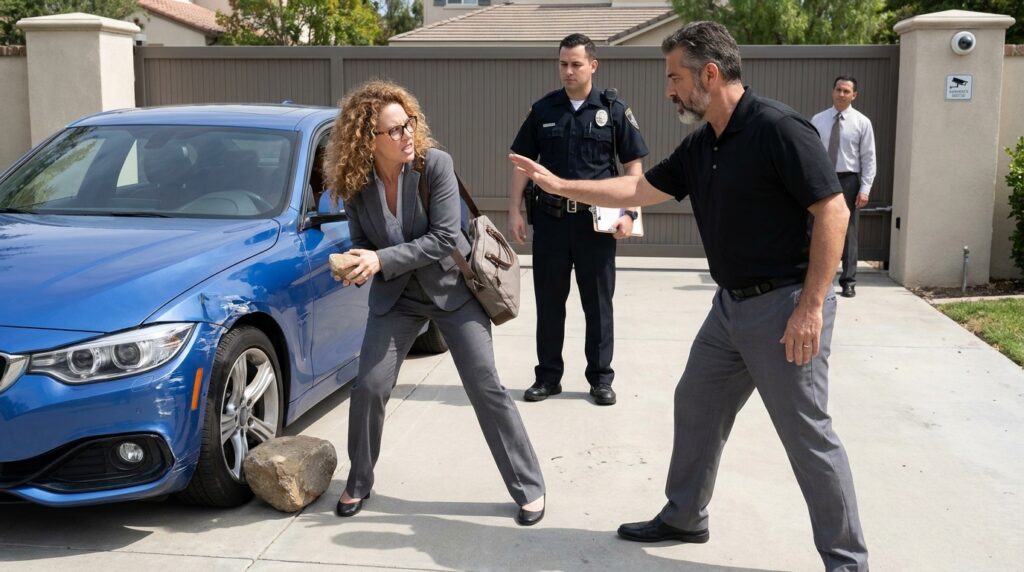
Mildred stood entirely still against the hood of the blue luxury sedan, her tan heels frozen on the boundary line between my turf and the public asphalt. Her oversized designer glasses had slid all the way down to her lip line, her eyes wide and blank as she watched a silver utility truck slow down at the entrance of the cul-de-sac, its passenger-side window rolling up as it saw the white municipal cruiser parked across my entrance.
“Move your stone off my concrete, Mildred,” I said, my hand closing around the cool aluminum hose nozzle on the grass.
She didn’t answer. She took three slow, uncoordinated steps backward into the public street, her gray business suit looking small and wrinkled under the vast, unyielding glare of the mid-summer sun. The silent associate was already a mile away down the avenue, his silk tie invisible against the long, uniform line of identical maple trees that led out of the enclave.








