CHAPTER 2: THE ANATOMY OF SURVEILLANCE
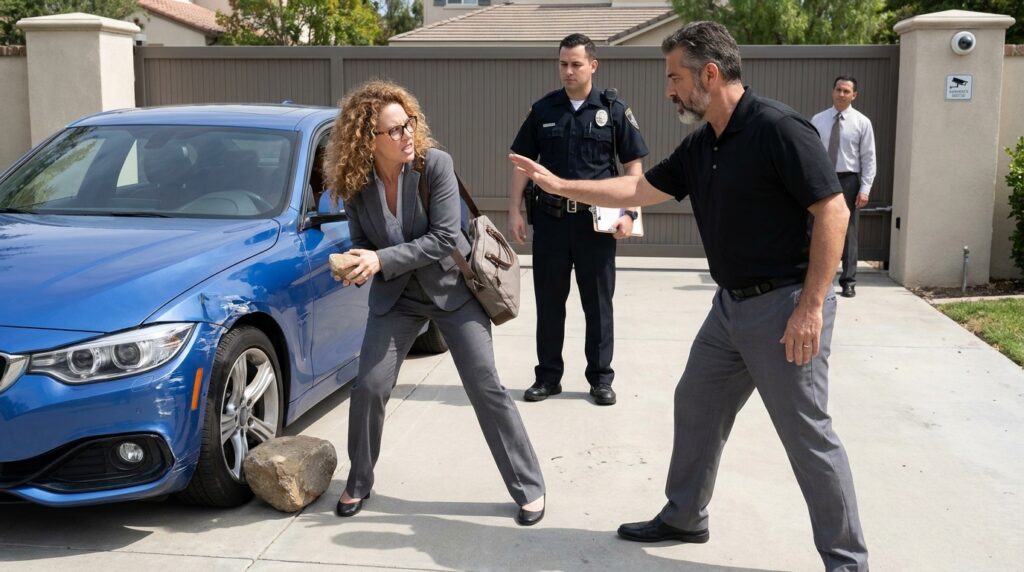
The silence that follows the word property damage doesn’t drop cleanly; it hovers over the sun-baked concrete like the exhaust of a diesel engine idling at the curb. The phone in my hand remains level, its digital iris capturing the micro-tremor in her lower eyelid. Her gray business suit jacket seems to stiffen under the midday heat, the fabric straining against her shoulders as she shifts her weight back from the blue sedan’s crumpled perimeter.
For three years, this driveway has been less of an entryway and more of a ledger. Every square foot of this aggregate concrete has been measured, signed for, and defended against the low-grade friction of the local aesthetic board. When you buy a parcel on the outer ring of the development, where the manicured berms give way to the low, rusted wire fencing of the old county line, you learn to look at every truck, every drone, and every clip-bearing neighbor as an actuarial risk.
Her fingers tighten on the plastic lip of her compliance folder. The cardboard edge is frayed from handling, its cheap black spine split to reveal the gray corrugation underneath. From my angle, two inches above her shoulder line, a single sheet of yellow carbon-copy paper slips sideways against her thumb. It isn’t the standard cream-colored neighborhood association violation notice. It is thicker, rougher, stamped at the top margin with a faded purple circular seal from the County Clerk’s Office—the specific legal watermark used for structural variances and utility grid access. A corner of a bolded number is visible: Grid-Expansion Section 4B.
“This isn’t about property damage, Arthur,” she says, her tone dropping out of its high civic trill into a dry, defensive rasp that smells faintly of cold coffee. Her glasses slide down the bridge of her nose, the thick plastic frames casting double shadows across her cheekbones. “This is an active access lane. The association has right-of-way jurisdiction over the first twelve feet from the public curb. If your guest parks a non-conforming, high-clearance foreign vehicle within the peripheral sightline of the intersection, the safety threshold is breached.”
“The sedan is ten feet inside the survey stakes,” I say. My thumb stays locked on the shutter button, the screen tracking her partner near the curb.
The associate has completely checked out of the tactical formation. His leather portfolio is tucked into the small of his back now, his fingers drumming against his thighs as he watches a crow pick at a dried grass snake near the storm drain. He knows the math. He knows that an association fine is a civil matter settled over certified letters, but a deep gouge through three panels of custom paint is a misdemeanor charge that moves through the county municipal court six miles down the road, where the benches are rusted iron and the judges don’t care about neighborhood lawn heights.
“We have the variance paperwork pending,” she shifts, her hand masking the yellow paper, pushing it deeper into the split sleeve of her folder with a quick, dry rustle of old pulp. Her tan heels grind against the edge of the turf, dislodging a small clump of dry gray earth that rolls across the concrete. “The board doesn’t need your permission to clear obstructions from the utility margins. Look at the curb line, Arthur. The iron on your mailbox is already flaking into the ditch. It’s an eye-sore. It’s a liability for the entire block.”
I don’t look at the mailbox. I know the iron is pitting; the salt from the winter treatment trucks eats through the zinc coating every December, leaving a dull, orange-brown crust along the hinges that no amount of industrial primer can permanently seal. That rust is a chronological record of how long I’ve spent keeping this half-acre from being swallowed by the soft, bureaucratic grayness of the surrounding development.
Every morning at five, before the commuter traffic starts its low roar toward the bypass, I check the gate camera logs. For fourteen months, the metadata has shown the same thing: a silver utility crossover slowing down near my property line at 5:14 AM, its passenger side window lowering just enough for a high-intensity spotlight to sweep the fence line where my acreage meets the old pine timber. They weren’t looking for unclipped hedges. They were measuring the distance between my brick columns and the county power poles that run parallel to the ditch—the ones with the weathered green porcelain insulators that haven’t been replaced since the late seventies.
She knows that history, too. Her husband sits on the regional planning commission, his name signed to the dry, single-spaced annexations that turn family timberland into uniform cul-de-sacs with French names. Her business suit isn’t for a corporate office; it’s the uniform of an advance scout who thinks a clipboard can substitute for a title deed.
“You’re thirty-four minutes late for your committee walk,” I say, my voice steady enough to make the associate look up from the storm drain. I glance at the dashboard clock visible through the blue sedan’s driver-side window. “The deputy dispatcher said five minutes. That was six minutes ago. If you want to pull that yellow variance out of your folder and show me the county signature before he gets here, I’ll log it as a civil dispute. Otherwise, stay right where the camera can see your hands.”
Her face doesn’t go red; it turns a hard, chalky white that makes the blue frames of her glasses look massive. Her fingers twitch against the clipboard, her manicured nail catching on the corner of the yellow paper, tearing a tiny triangle of the carbon sheet away. It drops down, a small yellow leaf drifting onto the gray aggregate between our boots, the letters E-A-S-E- visible on the scrap before her shoe moves to cover it.
A block away, down the long, straight asphalt of the avenue where the identical maple trees cast short, circular shadows, a low, mechanical whine begins to grow. It isn’t a resident’s vehicle; it has the heavy, unhurried rumble of an public service engine with an ungreased suspension arm. The flash of a single, non-emergency blue light reflects off the distant neighborhood entry sign.
The associate near the curb takes another step toward the public pavement, his hand completely releasing the portfolio as he clears his throat. “Mildred,” he says, his voice thin and dry like split cedar. “The county car is coming around the circle.”
Mildred doesn’t move her foot from the torn yellow scrap. Her shoulder bag slips down her forearm, the heavy leather strap cutting a deep red line into her wrist as she forces her chin up, her gaze fixing on the unblinking black glass lens mounted on the brick column above my head.