CHAPTER 3: THE DEPUTY ON THE BOUNDARY
The tires of the Ford Crown Victoria hummed against the new asphalt of the main loop before hitting the gravel-pocked transition of my private entrance. The sound was a heavy, low-frequency thud that vibrated through the concrete soles of my work boots. The car was white, stripped of municipal decals except for a faded green shield on the front door panel and a dual-beam halogen bar that sat dark against the roofline.
It stopped dead at the curb line, exactly parallel to where the silent associate stood shivering in his silk tie. The driver’s side door swung open with a dry metallic pop—the hinge spring was completely shot, a common failure in the county fleet after ten years of tracking lime-dust roads along the western transmission lines.
The deputy who stepped out didn’t look like an arbitrator. He was early 30s, lean through the hips but thick-shouldered under the dark wool blend of his municipal utility uniform. His duty belt creaked as he shifted his weight, the leather split at the belt loops from years of carrying a full iron mag-light and a heavy steel Smith & Wesson frame. He didn’t take off his broad-brimmed campaign hat; the shadow of the stiff straw brim cut straight across his cheekbones, hiding his eyes until he stepped into the white glare of my driveway.
“Afternoon, Mildred,” the deputy said. His voice was low, carrying the flat, nasal drawl of the county’s third district. He didn’t offer a hand. He stood near the rusted post of my mailbox, his boots kicking up a faint puff of yellow limestone dust from the shoulder. “Arthur.”
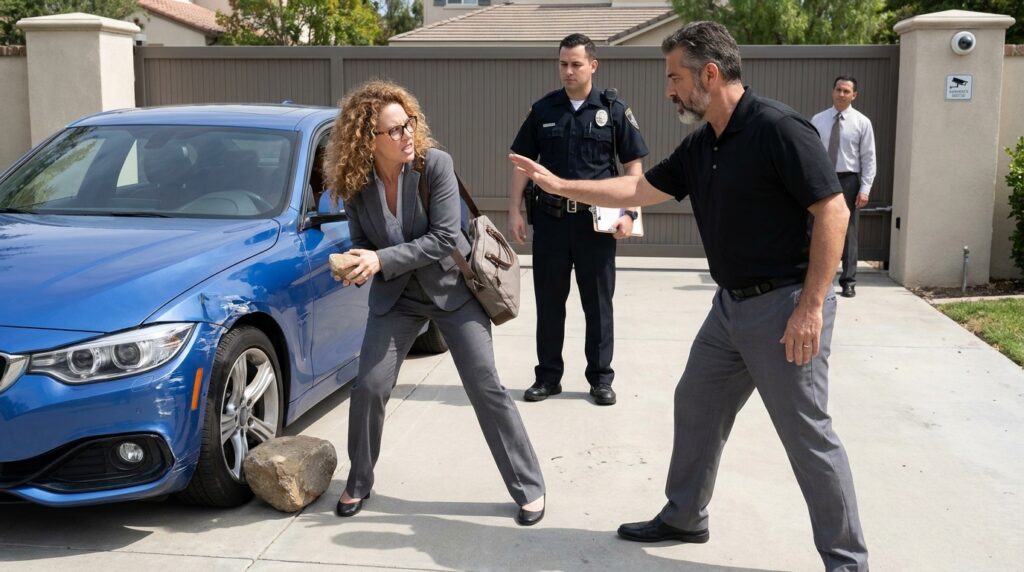
Mildred didn’t look back at the torn yellow scrap beneath her heel. She adjusted her shoulder bag with a short, aggressive jerk of her arm that rattled the gold-plated rings on her fingers. “Deputy Miller, thank goodness you’re around the loop. I am actively executing a compliance assessment under Section 4. This vehicle has been placed within the peripheral sightline margin, and as the standing representative of the neighborhood infrastructure council—”
“The vehicle’s inside the stakes, Miller,” I interrupted. I kept my hand low, the smartphone screen still live and processing the video file into the cloud buffer. “She dragged a sixty-pound limestone boundary marker across four feet of turf to gouge the front panel. It’s an intentional property strike under Title 7.”
The deputy didn’t answer either of us. He walked two slow steps forward, his boots crunching on the dry aggregate until he was standing directly over the front-left wheel well of the blue luxury sedan. He bent at the waist, his leather duty belt groaning under the strain. With one short, thick thumb, he traced the edge of the paint score. A tiny flake of the metallic clear coat detached under his nail, dropping down into the fresh white powder left by the stone.
He looked at the limestone block. He looked at the deep green skid marks through the turf where Mildred’s heels had torn into the grass roots to find leverage. Then, slowly, he tilted his head back, his chin lifting until his gaze settled on the brick gate column behind me. The black-cased security lens was still whirring, its internal cooling fan making a thin, high-pitched whistle against the heat of the brickwork.
“That thing functional, Arthur?” Miller asked.
“It logs twenty-four frames a second to a hard drive in my crawlspace,” I said. “The lens has a polarized filter. It captures the texture of a gray wool suit at forty yards.”
Mildred’s clipboard clicked against her side jacket. “Captain Scott explicitly stated during the May session that unvetted surveillance installations along the public frontage would be subject to removal if they—”
“Captain Scott is a civil administrator for the town council, Mildred,” Miller said, his voice flat as he straightened up. He reached into his breast pocket and pulled out a narrow, metal-backed incident booklet. A small grease pencil was clipped to the top margin, its tip worn down to a blunt, black wedge. “Out here, past the second creek bed, this is county grid line. The township boundaries stop at the black-top.”
He flipped the top page of the booklet over. I could see the document underneath—it wasn’t a standard traffic ticket. It was a grid map of the sector, the individual parcels blocked out in thick black ink, but across my western border, someone had drawn a series of diagonal red hash marks with a grease pencil. The marks didn’t follow the property lines; they cut straight through the middle of my driveway, tracking the path of the old green porcelain power lines that bordered the pine timber.
Mildred saw the map. Her hand went to her pale blouse, her fingers tightening on the small gold chain around her neck. “The variance is already through the planning office, Deputy. My husband verified the signatures on Monday morning. The utility expansion requires—”
“The variance isn’t signed until the county board holds the public hearing on the twenty-sixth,” Miller said. He didn’t look up from his booklet as he began to draw a small, precise diagram of the driveway geometry with his blunt pencil. The lead rasped against the rough paper like a match striking wood. “Until that gavel drops, this concrete belongs to the deed-holder. And right now, the deed-holder has a sixty-pound piece of county-maintained decorative stone pinned against three thousand dollars worth of imported clear coat.”
He turned his head slightly toward the sidewalk, where the associate was trying to disappear behind the shadow of a young maple tree. “Todd,” Miller called out. “You’re the secretary for the association walk today, aren’t you?”
The associate cleared his throat, his silk tie twitching against his collar. “I’m just documenting the parking logs, Deputy. I didn’t have anything to do with the physical adjustment of the markers. I told Mildred we should wait for the legal surveyor’s stakes to be dropped next month.”
“Then you’d better start walking back toward the main road,” Miller said, his pencil never stopping its methodical rasp against the page. “Because if I have to file a misdemeanor property damage report with the district clerk, your name is going down as the secondary witness on the initial scene assessment. I don’t think your firm likes its junior partners listed on criminal dockets before the grand jury convenes.”
The associate didn’t say another word. He turned on his heel, his leather shoes clicking a fast, uneven rhythm against the clean asphalt as he headed toward the entrance of the cul-de-sac without looking back once at the woman in the gray business suit.
Mildred watched him go, her lower lip finally dropping into a hard, rigid line of pure fury. Her foot shifted, and for the first time, the torn edge of the yellow carbon copy document lay exposed between us on the hot gray concrete.