CHAPTER 7: THE LOGGING INDEX
The brass house key hit the flat steel of the cruiser’s hood with a high, thin ping that cut right through the diesel rattle. It slid three inches through the white layer of limestone dust, leaving a dark, narrow track before it stopped against the base of the windshield wiper arm.
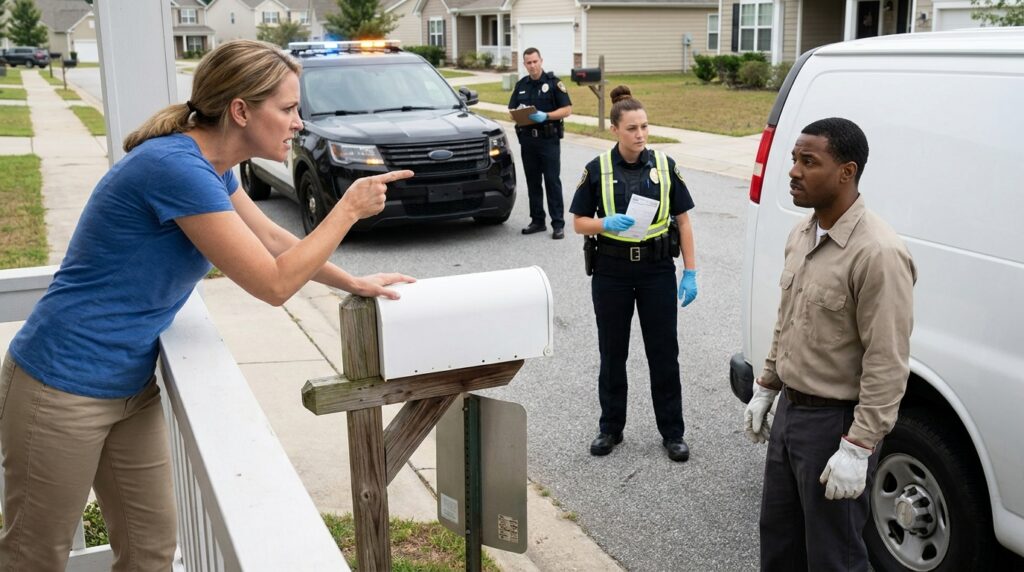
Elena did not reach down to pick up her letters from the yellow clay. Her fingers were still clamped to the split trunk of the cedar post, her nails digging into the damp, stringy bark where the trunk met the sheared iron of the bracket. The heat off the van’s front quarter panel was thick enough to make the air between her and the primary officer shimmer, heavy with the sharp reek of grease and old cabin wool. She watched the second officer’s thumb slide the silver clip of his terminal downward, locking the worker’s registration line into the county pool terminal.
“The key for the ignition box,” the primary officer repeated, her blue gloves remaining flat against the worker’s beige shoulder line. She didn’t press him down this time, but her boots were anchored into the edge of the asphalt so firmly her laces didn’t shift in the wind. “Not the gate set. The heavy iron tag on the master ring.”
The worker’s cotton gloves peeled away from the rust-flecked rim of the van door, the white fabric grayed across the palms from years of steering oil. He reached into his dark trousers pocket, his wrist jerking twice before he hauled out a thick ring of square-cut brass blanks. Tucked between two master keys was a flat, unplated strip of lead alloy, its surface hand-stamped with a five-digit sector reference that matched the number on the fresh galvanized plate bolted below her mailbox.
“The county asset pool cleared the chassis transfer,” the worker muttered, his eyes tracking the neighbor’s phone camera across the lane. He didn’t drop his chin; his neck stayed thick and rigid against his collar, his voice holding the low, stubborn drone of a man who had already been paid half his fee in cash. “The timber tract behind her wire has been landlocked since the creek crossing washed out in the flood. The county has a structural obligation to provide an alternate clearance road if the primary easement becomes impassable.”
“The county didn’t buy that timber tract,” Elena said. Her voice didn’t rise, but it carried the flat, hard clarity of the unpainted fence lines behind her barn. She pointed her thumb toward the blue folder the officer was still holding against her vest. “The Miller family split that five-acre section into three private plots back in ninety-eight. They sold the timber rights to a developer out of the city who couldn’t get his trucks through because my grandfather refused the right-of-way.”
The primary officer flipped the blue folder open again, her blue-gloved thumb catching the lower margin of the 2011 draft sheet. Beneath the black marker line where the corporate stamp had been blurred out, the paper had thinned, the bright glare of the afternoon sun passing through the fiber until a faint, hand-written signature became visible from the reverse side: G. Miller—Deputy Registrar.
The second officer looked up from his silver screen, his face hardening as he looked across the road toward old man Miller’s empty driveway. “George Miller was the clerk’s assistant before the county automated the deed index,” he said, his stylus striking the metal edge of his clipboard with a short, metallic tick. “He signed off on three obsolete draft maps before his retirement went through. This layout never went to the board for ratification, Sarah. It’s an unindexed private survey that was pulled from the cellar boxes after the family sold the timber parcel to the commercial trucks last winter.”
The worker didn’t move his boots. His mouth remained slightly open, his sunglasses crooked across his nose as the first large drop of rain from the western ridge hit the hot iron of the van’s hood, sizzling into a tiny gray circle of steam. He wasn’t looking at the officers now; his gaze had traveled past Elena’s shoulder to the back of her lot, where the rusted wire fence ran straight into the dense growth of the old willow grove.
Elena felt the cold grit of the limestone dust settle against the small cut on her thumb, the iron burr of the sign plate catching the skin whenever she shifted her balance. The tactical deception of the drainage code had been completely dismantled on her curb, but the real weight of the street’s history was still dropping into place. The confrontation wasn’t about a parking notice or a six-foot easement clearance; it was a private, multi-generational overreach that had used a stolen municipal truck to turn an illegal commercial road into an official public necessity before the neighborhood could check the deed.
“The vehicle remains under civil seizure,” the primary officer said, her hand coming down hard on the blue folder as she closed it against her chest. She turned her back to the worker, her blue gloves directing the second deputy to line the chocks behind the rear tires. “Get your clipboard, resident. We’re going to the house line to sign the formal boundary protection order.”
Down the street, the neighbor with the phone didn’t turn off his screen. He stood by his gravel culvert, his face perfectly still in the blue light as the white van’s engine gave one final, wet shudder and died under the officer’s hand.