CHAPTER 6: THE BLUEGLOVED VERDICT
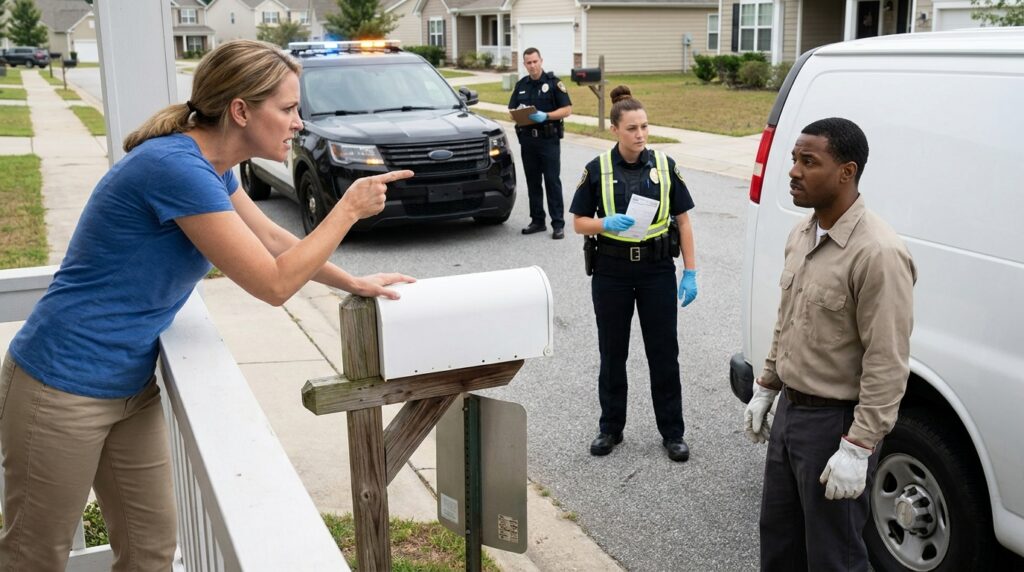
The blue-gloved hand stayed planted against the worker’s starched collar, the fabric bunching into a tight knot of wrinkled beige under the officer’s knuckles. The white van’s chassis jarred against the curb as the worker’s boots scrambled for traction on the grease-softened asphalt lane.
Elena did not drop her arms. Her right palm was still pressed flat against the raw, split heartwood of the cedar post, feeling the vibration of the hollow timber where the rotten upper joint had just sheared away. The three dropped letters sat motionless in the yellow clay of the ditch, their white envelopes absorbing the dark water pooling at the base of the concrete culvert. Her heart thrummed against her ribs, thick with the chemical taste of diesel soot and adrenaline, but her eyes never left the faded blue folder resting on the cabin console.
“I need the document that matches the index number on that plate,” the primary officer said, her voice dropping another octave, turning cold and completely unyielding. She didn’t shake him; she simply held him locked against the iron door panel by his own momentum. “Not the retired database name. The active work order with a county manager’s barcode.”
The worker’s breathing was shallow, his sunglasses sliding further down his nose until the white glare of the sky caught the red, salt-bitten skin around his eyelids. His white cotton gloves twitched against the rust-flaked handle of the door. “The barcode is on the interior sheet,” he rasped, his eyes darting toward the second officer, who was now leaning through the passenger window of the cruiser to cross-reference the van’s vehicle identification number. “The regional desk runs the old series for Sector Four because the grid boundary hasn’t been remapped since the sewer bond failed. Ask Miller. He knows where the line sits.”
Down the road, old man Miller’s aluminum walker clicked against the hard edge of the concrete apron. He didn’t answer the worker’s call. He kept his chin tucked down into his collar, his old hands trembling as they clamped onto the foam grips of his frame, his body turning away from the light toward the shade of his own garage.
The second officer stepped back out of the cruiser cab, the silver frame of his terminal reflecting a sharp bar of white into the shade of the willow trees. He shook his head once, his face flat and hard as a paving stone. “The pool vin matches an inactive city asset scheduled for the scrap auction in June,” he said. He tapped the digital stylus against the corner of his screen with a dry, hollow snap. “The plate on the post doesn’t exist in the county transit registry. The index number is a dead entry from the old township ledgers before the incorporation.”
The primary officer’s fingers didn’t loosen on the worker’s shirt. She used her left hand to reach past his hip, her blue gloves snagging the edge of the blue folder from the console with a single, practiced sweep. The thick cardboard folder was heavy, the surface marked by oil circles from grease-smeared fingers and the dark, red smudge of old cellar mold.
Elena watched the folder split open between them. There were no municipal watermarks on the interior sheets. The top page was a hand-drawn blueprint, the ink faded into a dull charcoal gray that showed an unsigned road expansion cutting straight through her mailbox post, across her clover patch, and directly into the five-acre timber lot that sat locked behind her grandfather’s back fence line.
“This isn’t a county grading plan,” Elena said, her voice scraping dry against the rattle of the idling engine block. She pointed her thumb toward the blueprint’s margin, where a private corporate stamp had been blurred out with black marker. “That’s the access road proposal from the commercial logging outfit that tried to buy the timber lane back in eleven. The county turned them down because they didn’t have the drainage clearance.”
The worker didn’t argue the point. His mouth stayed open, his teeth dry and coated in yellow nicotine film behind his split lip. He didn’t look at Elena; his eyes stayed locked on the second officer’s silver terminal as the red light of the battery warning began to pulse against the glass.
The primary officer turned the blueprint over, her blue gloves tracing the edge of an obsolete county survey seal that had been cut out from another document and pasted onto the header line with dry rubber cement. The fraud was crude up close, built for the low visibility of a hurried afternoon dispute at the property line where an uneducated resident would stumble over the legalistic jargon and clear the way without checking the stamps.
“The vehicle remains on the lane as an evidentiary impound,” the officer told the worker, her voice thin and sharp as a razor blade through leather. She let her hand drop from his throat, but she didn’t step back from his shoulder line. “Take your gloves off and drop your pocket keys onto the hood of the cruiser.”
The neighbor across the street didn’t lower his phone. He took two steps closer to the curb line, his boots crunching loud against the loose gravel as the blue roof lights caught the glass of his lens. The entire block was watching the worker’s massive authority turn into a common city garage theft in the middle of a Tuesday afternoon. The decoy secret of the drainage expansion had just broken apart under the officer’s terminal light, but the ultimate final reality of the timber lot access was still locked behind the old name hidden in the draft’s small print.