
CHAPTER 5: THE BLUE LIGHT AMBUSH
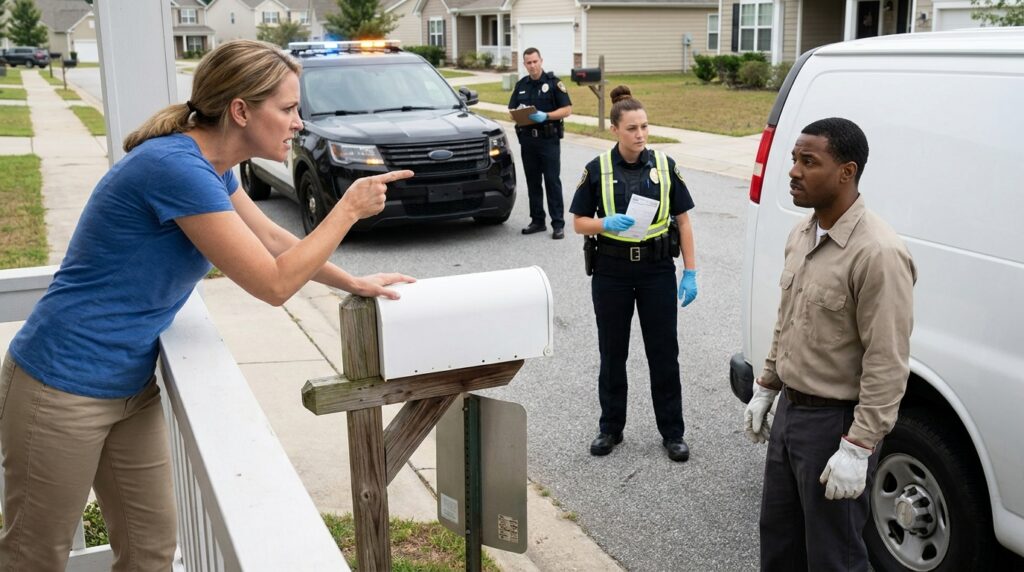
The first stroke of the roof lights didn’t hit the white van; it sliced clean through the willow branches, casting long, rhythmic bars of blue across Elena’s unwatered grass. The light didn’t feel like a relief. It felt heavy, cold, and transactional, reflecting off the oily surface of the asphalt until the whole ditch line seemed to pulse with a low, mechanical warning.
Elena didn’t pull her boots back from the clover. Her skin was cold despite the rising grease-heat from the idling van engine, and her thumb stayed locked against the raw cedar fiber, right where the zinc screws had bitten through her skin. She watched the male officer move to the front of the cruiser, his shadow lengthening across her driveway until it met the front wheel of the white service van.
“State your dispatch number,” the primary female officer said, her voice remaining low but cutting beneath the rattle of the diesel exhaust. She didn’t look up at the worker’s sunglasses. Her blue-gloved hand remained open, waiting an inch from the aluminum edge of the clipboard.
The worker didn’t move his arm. The starch in his beige shirt seemed to stiffen his posture, holding him rigid against the cab door frame. “I told you, it’s an internal maintenance pull,” he muttered, his gloved fingers tightening on the leather-bound book until the hide puckered. “The regional desk cleared the sector by phone before the six-hundred shift. If you have an issue with the layout, you need to verify it with Supervisor Vance on Fourth.”
“Vance retired in October,” the second officer said from behind the van. He didn’t raise his voice, but the sound of his digital stylus tapping the screen was a sharp, rhythmic click that sounded like an iron rod hitting a small anvil. “The regional desk hasn’t run an internal pull on Sector Four since the winter main split. I’m looking at the county grid right now. This lane is marked clear for five houses in either direction.”
The worker’s jaw tightened, the skin along his cheek turning a dry, pale gray that looked like salt crust. He didn’t drop his boots to the asphalt, but his weight shifted backward into the cab, his right elbow nudging the center console where a faded blue folder lay tucked under an obsolete mapbook.
Elena noticed the movement. Through the open window, the folder looked thick, its edges yellowed and frayed from years in a damp basement rather than a clean county bin. On the tab, written in faded black ink that had turned the color of dried iron rust, was the name Miller Lane Extension—Draft 2011.
“He’s not logging an internal pull,” Elena said, her finger pointing straight through the cabin glass toward the blue folder. “Look at the year on that file, Officer. That’s the old drainage easement map from before the county abandoned the back lot project. He’s using the obsolete ledger numbers to make it look like he has a legal right to clear my post.”
The female officer didn’t lean into the window, but her head tilted just enough to catch the reflection of the folder against the chrome trim of the dashboard. Her hand dropped from her vest, her blue-gloved fingers coming to rest light and steady against the top latch of her utility belt, right over the heavy black polymer casing of her radio.
“Hand over the logbook,” she said, her tone flat, stripped of everything but the hard logic of the street line. “Now.”
“It’s private county property,” the worker hissed. He took a sudden, lunging step down from the running board, his boots hitting the hard edge of the concrete apron with a dull, rubbery thrum. He didn’t move away from her, but he threw his wide shoulders forward, trying to wedge his mass between the officer’s belt and the leather book on the seat. “You don’t have the clearance to pull internal agency logs without a division signature from the hall.”
The movement was too fast for the tight space. His heavy shoulder caught the edge of the wooden mailbox post, the sudden friction jar for the cedar timber making the rotten upper joint give way with a dry, hollow crack. The white mailbox tilted, its metal latch popping open to drop three unopened letters into the yellow clay of the ditch.
The primary officer didn’t draw her weapon, but her left hand shot forward like a mechanical piston, her blue gloves catching the worker’s beige collar right at the throat line. With a single, controlled twist of her wrist, she checked his momentum, forcing his hips back against the flaking iron panel of the van door before his weight could carry him into Elena’s space.
“Keep your boots on the asphalt,” the officer commanded, her face inches from his sunglasses, her voice thin and sharp as a razor blade through leather. “You don’t touch the resident, and you don’t touch the perimeter landmarks while I’m standing on the lane.”
Behind them, old man Miller had stopped his walker at the very edge of the grass, his fingers gripping the oxidized aluminum tubes so hard his knuckles were white. On the other side of the road, the neighbor with the unpainted porch stepped down into his gravel ditch, his phone held steady at chest height, the lens catching the blue pulse of the roof lights. The street was no longer silent; the wet sound of the creek runoff seemed to grow louder as the absolute failure of the worker’s authority became visible to the entire block.
The second officer stepped around the rear fender of the van, his clipboard locked under his elbow as his hand reached for his belt. “We have an unverified plate installation and a property damage event on site,” he said, his stylus tracking the split wood at the base of the mailbox. “He’s not in the system, Sarah. The plates are registered to an inactive vehicle out of the county garage pool.”
Elena felt the wind drop, the heavy grease-smell of the diesel exhaust settling over her face like a damp cloth. The worker was pinned against his own truck, his white gloves shaking against the rust-flecked iron door panel, but his eyes were still locked on the blue folder inside the cab—the decoy secret had just split wide open under the officer’s light, but the ultimate final reality of who had put him on her street was still buried behind the old paper in the dark.








