
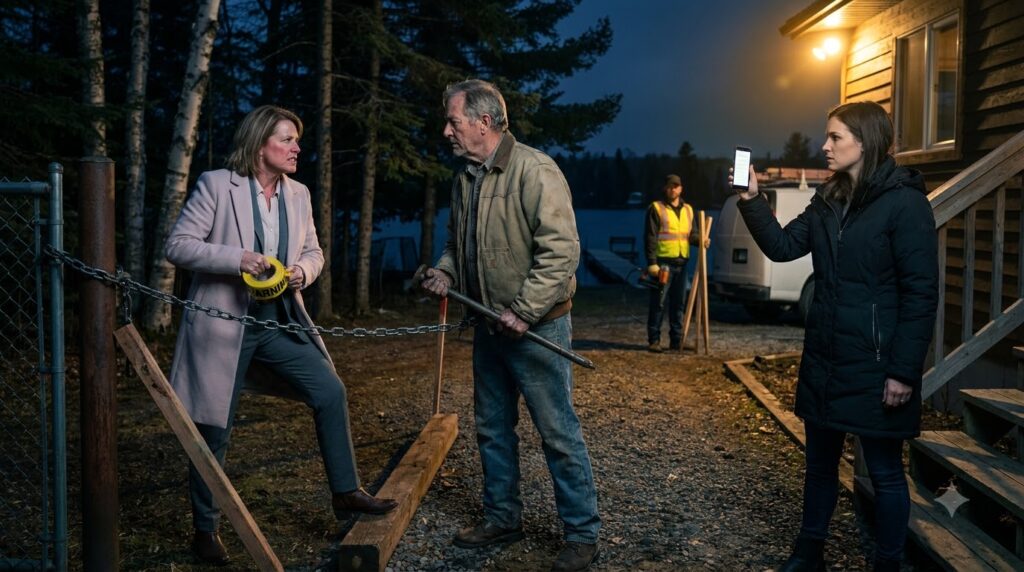
CHAPTER 4: The Ledger and the Lease
The shadows in the workshop lengthened as the single overhead lamp hummed against the timber joists, throwing harsh amber light across the open pages of the surveyor’s ledger. Arthur didn’t reach for a weapon, nor did he stand up to block the doorway. He simply let his thumb rest against the yellowing crease of the 1976 property map, his eyes fixed on the young assistant manager who had just walked uninvited into his sanctuary.
Maya Lin didn’t flinch under his gaze. She closed the heavy oak door behind her with a soft, decisive click that muffled the distant hoot of an owl from the timberline. Her fingers were tucked deep into the pockets of her winter coat, but her eyes were alive with the restless calculation of someone who had spent too many hours balancing books that didn’t add up.
“You leave your gate unlatched on a Tuesday night, Mr. Hayes,” Maya said, her voice dropping into a low, controlled register that carried no trace of retail customer-service cadence. “For a man who values his privacy, you’re remarkably careless with your hardware.”
“The gate latch is rusted. Takes two hands to drop the pin,” Arthur replied, his voice a steady gravel rasp. “If someone wants in bad enough to work for it, a pin won’t stop them. You didn’t drive five miles out of town after closing just to talk about gate maintenance.”
Maya walked slowly toward the workbench, her boots clicking against the bare pine planks. She didn’t look at the tools or the stacked spare parts; she looked straight down at the open ledger, her gaze pausing on the red ink notations and the faded boundary markers drawn by his uncle’s hand.
“Brenda Vance wasn’t running a bake sale today,” Maya said quietly. She pulled a folded sheaf of papers from her coat pocket and tossed them onto the workbench beside the ledger. They slid across the scarred wood and came to a stop against Arthur’s coffee mug. “She was running an audit. Not for the community hall, and not for youth athletics. The municipal development board filed a commercial right-of-way petition three days ago. They need a forty-foot access corridor running straight through the western corner of Lot 91 down to the public boat launch.”
Arthur didn’t touch the papers. He already knew what they said; the yellow survey tag in his pocket felt heavy and hot against his lining. “Greenfields Market isn’t a municipal office.”
“No, but the plaza property is owned by a shell corporation registered to Brenda’s husband,” Maya said, her tone sharpening with an edge of quiet frustration. “And the regional commercial zoning permit depends entirely on the town council approving the new parking corridor expansion. An expansion that requires carving up unceded private lots to bypass the state forest restriction.”
Arthur looked up from the ledger, his heavy brows lowering over his spectacles. “And you’re telling me this because?”
“Because I spent six years watching my older brother lose his farm to the exact same crowd of civic improvement boards who used eminent domain loopholes and fabricated easement claims,” Maya said, her chin lifting slightly. “Brenda thought she could bully you out of line at register four to establish a public-use precedent. If you yield an inch of that access path under pressure, their legal team uses your compliance as proof of a permissive right-of-way. In two months, county bulldozers are clearing a commercial parking access right across your dock.”
The room grew very still. The hum of the single overhead lamp seemed to drop an octave, vibrating through the floorboards. Arthur stared at the young woman, seeing past the retail name tag and the corporate uniform to the cold, hard logic of someone who had decided to cross the line because she was tired of watching people get ground down by institutional machinery.
“You took a risk coming out here, Maya,” Arthur said softly. “Brenda’s husband sits on the town planning commission. If they trace this visit back to you, you won’t just lose your job at Greenfields. You’ll find every health inspector and code enforcement officer in the county auditing your apartment by Friday.”
“Let them try,” Maya said, her eyes flashing with a sharp, cold resolve. “I kept the security footage from register four. The unedited version where Brenda shoves her cart into your hip and explicitly threatens your property access. It’s sitting on a thumb drive in my glove box right now.”
Arthur reached out, his grease-stained fingers finally picking up the municipal papers on the workbench. He flipped them open, scanning the signatures at the bottom. There was Brenda’s looping, aggressive handwriting, alongside a signature he recognized from the county tax assessor’s office—the exact same office where the unmarked county truck had originated that afternoon.
“Paperwork,” Arthur muttered, shaking his head. “Always starts with paper before it ends with iron.”
“Paper can be answered,” Maya said, leaning forward against the edge of the workbench. “Especially if you have the right tool to tear it up.”
Before Arthur could answer, a sharp, metallic ring cut through the silence of the cabin—the brass ship’s bell hanging by the lakeside gate, echoing down the birch path with a single, clear, undeniable note.








