CHAPTER 2: The Plat Beneath the Clipboard
The flash of the phone screen was a sharp, digital prick in the flat fluorescent glare of register four. Arthur didn’t blink. He watched the red indicator light pulse once, twice, recording his silence like a ledger entry waiting to be audited. Behind Brenda Vance, the young cashier looked down at his belt mechanism as if hoping the conveyor would simply open up and swallow the entire register bay.
“You’re making a record of the wrong thing, missus,” Arthur said. His voice was a slow, flat scrape of gravel, untouched by the panic Brenda clearly expected to extract.
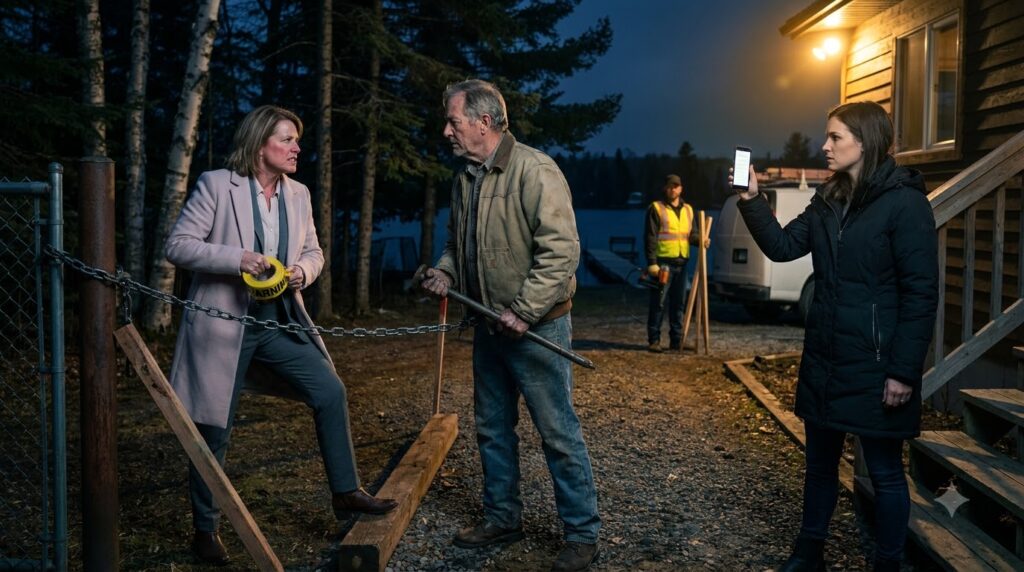
Brenda lowered the phone four inches, her hand trembling slightly with the tight, coiled energy of a woman whose authority had never been publicly questioned by someone wearing a grease-stained jacket. Her nostrils flared, catching the scent of the cool air drifting from the dairy bunkers twenty feet away. “This isn’t a record, Mr. Hayes. This is accountability. When the association reviews the commercial easement access logs next Tuesday, they’ll see exactly who chose to obstruct community infrastructure.”
Arthur shifted his weight half an inch. Underneath his thumb in the pocket of his canvas jacket, his truck key felt cold and heavy against his thigh. He caught a flash of white paper wedged into the pocket of Brenda’s starched clipboard—not a grocery list, not a bake sale roster, but a folded municipal plat diagram with red ink notation circling the western border of Lot 91. The same western border where his uncle’s old logging road met the county right-of-way.
“Easement’s four miles north past the old mill,” Arthur said evenly. “You’re standing on aisle four.”
“For now,” Brenda snapped, her composure fracturing at the edges into sharp, glassy splinters. She turned her back abruptly, her pastel blazer stiffening as she yanked her heavy cart away from the conveyor with a screech of rubber wheels against linoleum, abandoning her artisanal cheeses and organic flour right where they sat. She didn’t march toward the exit; instead, she veered toward the customer service counter where Maya Lin was still sorting manifest forms, her voice rising immediately in a high, carrying pitch. “Maya! I want this individual’s vehicle license number logged for corporate review. He is operating an unpermitted blockade on common access paths.”
Maya didn’t look up from her papers right away. She finished writing a line, capped her pen with a crisp click, and finally raised her eyes. The silence in the aisle had shifted from rubbernecking curiosity to a heavy, waiting stillness. Shoppers in adjacent lines lowered their bags, their attention hooked by the raw friction of an institutional bully losing her grip on the room.
Arthur reached out, lifted his carton of eggs and his single loaf of sourdough, and placed them into his wire basket. He didn’t rush. Every movement was economic, stripped of wasted motion, shaped by decades of repairing heavy iron in sub-zero sheds where haste only broke knuckles.
As he walked past the service counter toward the sliding glass exit doors, Brenda was leaning over the high laminate counter, her finger jabbing at a laminated store policy sheet. “The municipal development board has a vested interest in unhindered circulation,” she was telling Maya, her voice dropping into a conspiratorial hum that was meant to sound official. “If Greenfields wants its commercial zoning permits renewed next quarter, management needs to understand who actually represents the property owners around this lake.”
Arthur paused just before the automatic doors parted. He didn’t look back at Brenda, but he saw the reflection in the glass: Maya Lin standing completely still behind the counter, her expression hardening into a sharp, unreadable mask as she stared down at the municipal plat snippet now visible on the edge of Brenda’s clipboard.
The glass doors slid open with a pneumatic sigh, letting in a sudden breath of dry, late-afternoon wind that smelled of hot asphalt and distant pine resin. Arthur stepped out into the gravel parking lot, his boots crunching down with familiar, rhythmic weight. Across the asphalt, Brenda’s beige SUV sat idling, its exhaust pipe puffing thin grey rings into the heavy air. But as Arthur reached his truck and tossed his basket onto the passenger seat, he noticed a second vehicle parked two stalls down—a clean, unmarked pickup with county surveyor plates resting flat against the dashboard.
The driver wasn’t looking at him. He was looking at a folded map spread across the steering wheel, tracing a red line that ran straight from the municipal office down to the water’s edge.