
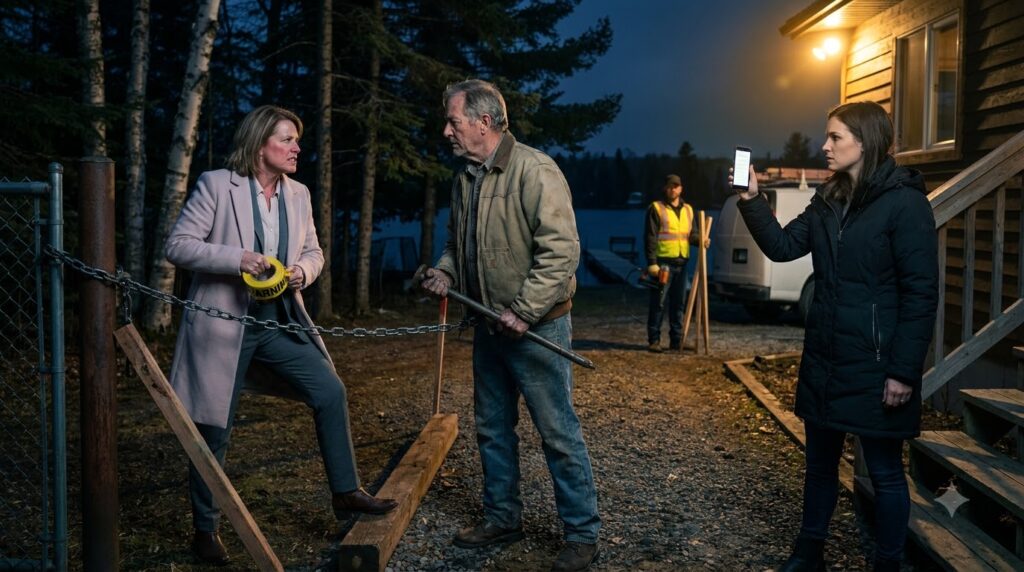
CHAPTER 1: The Weight of Steel and Pastel
The fluorescent lights at Greenfields Market hummed with a dry, persistent frequency that Arthur Hayes had learned to tune out thirty years ago on factory floors. To him, the store was simply a coordinate on a weekly map—get the eggs, get the sourdough, get back to the gravel silence before the afternoon wind came down off the ridge. His hands, deep in the pockets of his canvas jacket, still carried the faint, ingrained blue of old diesel stains beneath the thumbnails. He stood at register four, his wire basket resting quietly on the worn rubber belt, waiting for the register to clear.
Then came the scuff of leather heels against linoleum, sharp and rhythmically forced, like a drill instructor measuring cadence on a parade ground.
A heavy cart loaded with artisanal cheese wheels and oversized boxes of organic flour nudged hard against his right hip. Arthur did not turn his head immediately. He felt the dull press of wire against canvas, felt the deliberate intrusion of space that belonged to no one but the person standing inside it.
“Excuse me,” Brenda Vance said. Her voice carried the bright, artificial resonance of a woman accustomed to speaking into committee microphones without amplification. “Some of us have actual responsibilities to coordinate for the community hall in twenty minutes. If you could slide that basket down to the express lane on the far side, it would save everyone a great deal of unnecessary friction.”
Arthur turned his head slowly through the thick lenses of his spectacles. Brenda stood framed in pastel coral, her blazer stiff with starch, her chin lifted at an angle that assumed compliance was a natural law of the municipality. Her fingers gripped a clipboard handle as if it were a field marshal’s baton.
“The express lane is twelve items or fewer, ma’am,” Arthur said. His voice was a low, gravel-lined scrape that barely rose above the hum of the dairy coolers. “This is register four. My turn is next.”
Brenda’s smile did not reach her sunglasses. It tightened into a porcelain line, brittle and defensive. “I am well aware of what register this is. However, our volunteer coalition has a standing priority arrangement with store management for Wednesday staging. Surely a local resident wouldn’t want to hold up youth athletics over a loaf of bread.”
“I’m not holding up anything,” Arthur said, his posture settling another fraction of an inch into the concrete floor. “I’m standing in line.”
The cashier, a young man with a name tag askew and eyes fixed firmly on the belt mechanism, swallowed hard and tapped his screen, pretending the air between them was entirely transparent. Brenda raised her register voice half an octave, ensuring the shoppers browsing the magazine racks thirty feet away caught the frequency.
“It is this exact kind of stubborn disregard for collective harmony that makes town errands so exhausting,” she announced to the open aisle. “Some of us actually contribute to this community instead of just taking up space.”
A murmur drifted from register five. A woman in a matching volunteer visor offered a sharp, sympathetic head-shake toward Brenda’s cart, while two college students near the display tables drifted closer, hands sliding into their pockets to ready their phones. The air in the aisle grew heavy with the specific, metallic taste of public theater. Brenda reached out with a manicured nail and tapped twice against the wire rim of Arthur’s basket.
“Just move it down one slot, sir,” she whispered, her tone dropping into a poisonous intimacy. “It isn’t difficult to be a neighbor.”
Arthur did not move his basket. He kept his hands in his pockets, feeling the solid weight of his truck keys against his thigh. He looked past Brenda’s shoulder toward the service desk, where Maya Lin was currently leaning over a stack of manifest forms, her expression flat and observant.
“My basket stays right where it is,” Arthur said quietly. “If you’ve got business with the manager about lane scheduling, I suggest you take it to the office instead of leaning on my groceries.”
Brenda’s face flushed a mottled, angry pink, the color rising straight from her starched collar. “I am documenting this obstruction right now,” she snapped, whipping her phone from her pocket and raising the lens. “Let’s see how cooperative you feel when the merchant association hears about this kind of aggressive behavior in a family market.”
Arthur watched the glass of the phone lens catch the harsh overhead glare, wondering silently what kind of man spent his life trying to manage other people’s grocery carts, and what secret erosion made them need it so badly.








