
CHAPTER 3: The Cold Iron of the Threshold
The gravel lot of Greenfields Market was cooling as the sun dipped behind the timberline of the ridge, casting long, bruised shadows across the rows of parked sedans. Arthur did not linger by the bed of his truck. He slid behind the wheel, turned the ignition, and let the old diesel settle into its familiar, rhythmic deep-throat thrum. The engine vibration traveled up through the floorboards, steady and unhurried, reassuring him of mechanical certainty in a world suddenly cluttered with paper documents and red ink lines.
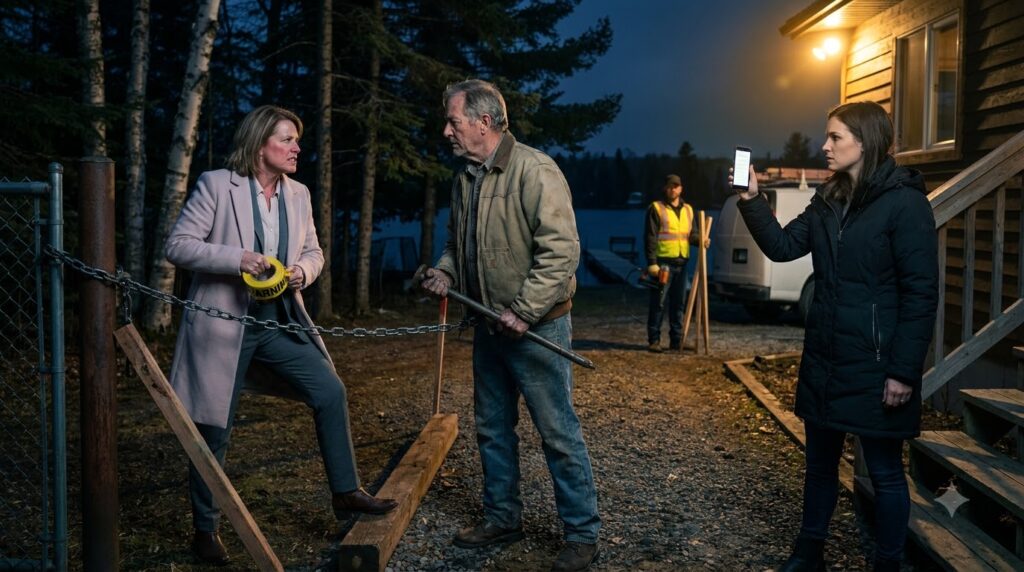
As he pulled out onto the county road, turning south toward the lake, his eyes flicked once to the rearview mirror. The unmarked county pickup remained parked two stalls down, its driver still leaning over the steering wheel, head bowed toward the spread of the map. Arthur’s jaw tightened. Municipal surveyors didn’t spend three hours staring at plats for a simple grocery lane dispute unless the lane wasn’t a grocery lane at all.
The drive home took twelve minutes. The road narrowed as it wound away from the asphalt grid, turning into packed dirt and crushed stone that hugged the western boundary of the state forest. By the time Arthur cut the engine beneath the thick pine canopy of Lot 91, the air had taken on the sharp, metallic chill of early evening.
He didn’t go inside the cabin immediately. Instead, he walked the perimeter of the gravel drive, his boots sinking slightly into the damp moss at the edge of the tree line. His uncle had laid down heavy cedar ties along this western edge back in seventy-four, marking the legal boundary of the homestead before the county carved out the upper access road. Everything inside those ties was private, unencumbered land—or so the deed in his trunk had stated when he signed the probate papers two years ago.
Yet, hanging from a low-hanging pine branch just three feet inside his property line, a small yellow tag fluttered in the evening breeze.
Arthur stopped. He reached out with grease-darkened fingers and plucked the tag from the twig. It was a standard municipal survey marker, stamped with a serial number and a handwritten notation in faded black ink: R-91 Easement Appended – Phase III Access.
The silence of the woods felt heavier now, stripped of its absolute innocence. Someone had crossed his line while he was in town buying eggs. Not Brenda Vance with her clipboards and pastel blazers, but someone with a steel tape measure and a hammer.
He pocketed the marker, walked back to the porch, and opened the heavy oak door. The interior was dim, smelling faintly of old paper, cedar shavings, and cold coffee left in a ceramic mug on the workbench. He didn’t turn on the overhead light. Instead, he dropped his canvas bag on the kitchen table, pulled an old metal lockbox from the bottom shelf of the pantry, and flipped the brass latches.
Inside rested his uncle’s original surveyor’s ledger, bound in cracked calfskin, along with the complete architectural blueprints of the cabin’s foundation and the surrounding drainage ditches. He flipped the pages until he found the page dated August 1976, where a hand-drawn topographical ink map detailed every rock, culvert, and property peg on the parcel.
A shadow fell across the threshold of the open front door.
Arthur didn’t look up from the ledger, even as the floorboards beneath the porch groaned under the weight of a slow, deliberate footstep. He kept his eyes fixed on the ink lines, his thumb tracing the worn edge of the paper where the county road was supposed to stop three hundred yards north of his dock.
“You’ve got a lot of nerve walking up here after dark, Maya,” Arthur said, his voice flat and unyielding as he turned the page.
From the doorway, the assistant store manager stepped out from the dim light of the porch, her jacket zipped against the mountain chill, her eyes sharp and completely unafraid as she looked around the cluttered, quiet room.








