
CHAPTER 4: THE BEDROCK COVENANT
The earth didn’t give way with an explosion; it settled with an intake of breath, a wet, sucking gasp that pulled two handfuls of crushed limestone straight down into the footing pocket.
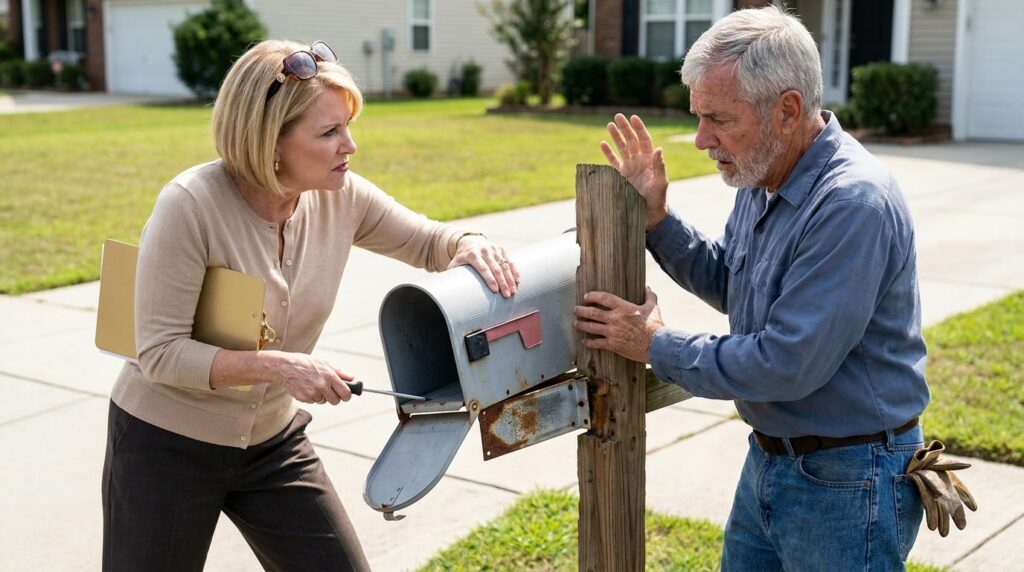
Joe drove his boot against the base of the timber, slamming his heel into the dirt to pin the cedar upright before the shifted soil could torque the lower carriage bolt. The iron plate groaned against the wood grain, rust powder shedding in a fine, reddish mist that coated the knuckles of his bare hand.
“Step back, Brenda,” Joe said.
Brenda didn’t move back. She couldn’t. Her garden shoes were planted on the asphalt edge, her heels locked against the rising heat of the blacktop. The yellowed tracing paper trembled in her grip, its crinkled edges fluttering like dried husk against the gray fabric of her poplin jacket.
“What ditch, Joe?” Her voice was stripped down to raw wire, shorn of every meeting rule, every typed ordinance, every thin veneer of control she had carried down the street. “Ed was the surveyor. He signed off on the compaction certs for every foundation poured on this ridge.”
“He signed them after the wash gave in eighty-nine,” Joe said. He didn’t look at her; his eyes were pinned to the gap behind the loosened mailbox, where the dark void between post and curb had widened by a quarter-inch. “The county hit an unmapped artesian line during the trenching. Two hundred feet of clay sloughed into the crawl space under what became your living room. The crew had twelve hours before the township inspector showed up to condemn the parcel.”
Joe hooked his fingers behind the black iron plate, leaning his full body weight against the torn bracket. The metal was ice cold despite the noon sun, leeching frost from the depths where the ground had never dried out.
“Ed knew a condemnation would bankrupt the developer and scrub his own engineering license,” Joe continued, his voice grinding low and rhythmic, pacing the deep, subterranean creak beneath their feet. “So he called my boy. Evan was nineteen. He was the only welder on the graveyard shift certified for high-pressure casing sleeves. They dropped four tons of slag and iron into the void to plug the seam, sealed the water pocket behind a retaining bulkhead, and built this manifold right here to bleed the pressure off.”
He twisted his wrist, levering the plate just far enough for the afternoon light to cut down into the recessed notch of the post.
Brazed directly to the underside of the heavy iron slab was a small, oblong tag of jeweler’s brass, untouched by corrosion, shielded from the elements by three decades of heavy tallow. Stamped into its center, surrounded by the rough bead of a rookie welder’s hand, was a single line of block lettering:
EVAN MILLER — RETENTION CELL 4 — HELD TIGHT.
Brenda looked at the tag. The gold clipboard in her arms slipped an inch, its clip biting into her ribs. Her face had gone the color of damp chalk.
“Evan didn’t die in an auto accident on Route 9,” she whispered. The realization didn’t hit her like a blow; it sank into her face like slow rot, pulling at the corners of her mouth and hollowing out her eyes. “The township report… Ed brought the casserole to your kitchen. He sat in your parlor and took the collection envelope.”
“The ditch wall collapsed during the tie-in,” Joe said, his thumb resting flat against his son’s rough weld. The pulse of the water line three feet below pulsed through the metal, a slow, hydraulic heartbeat that had kept her house from cracking in half for thirty years. “Ed pulled him out, but the void was open. If the township knew, the development died right there. So Ed poured the slurry, brought the slab up to grade, and told everyone the boy slid off the shoulder in the fog. And then he spent the next twenty years inventing mailbox rules, fence setbacks, and easement restrictions so no county engineer would ever bring a backhoe within ten feet of this curb.”
A second hollow thump traveled up through the post, vibrating into Joe’s shoulder.
Across the manicured lawn, at the corner of Brenda’s house where the brick veneer met the foundation parging, a hair-thin crack spidered up from the turf line, whispering through the mortar until it stopped two inches below the front picture window.
Brenda saw it. Her jaw worked, but no sound came out. The pristine white frame of her home, the uniform neighborhood she had patrolled with an iron clipboard, was balanced on a lie held together by forty pounds of scrap iron and a father’s silence.
“You take this box off,” Joe said, his voice flat as the gray stone, “and the bleeder cap unseats. The sub-base washes out into the storm drain in forty-eight hours. Your slab drops six inches by Sunday.”
Brenda looked from the cracked brick back to the rusted screwdriver lying in the mulch. The yellow plastic handle looked absurd now, a toy abandoned by a child in the dirt.
Slowly, her thin hands reached down. She didn’t pick up the driver. She set her gold clipboard on the dry grass, bent her knees despite the stiffness in her joints, and placed her palms against the wooden post beside Joe’s hand.
Together, their shoulders touching under the blazing sun, they leaned their weight into the cedar upright, forcing the timber back into the shifting dirt until the iron plate settled flush against the post, the hollow ping fading back into the deep, heavy silence of the earth.
Joe pulled a spare lag screw from his front pocket, set the battered threads against the original mounting hole, and used the blunt end of his pocketknife to tap it into place—not pretty, not compliant, but braced against the load.
Brenda stood up, wiping gray dust from her palms onto the thighs of her slacks. She didn’t look at the crack in her foundation. She looked at the scarred iron plate, then at Joe.
“Section four,” she said, her voice trembling slightly before she caught it, swallowing the break down into her throat. “Section four has an grandfather clause for historic markers. I’ll file the variance myself at the six o’clock meeting.”
“Do what you have to do, Brenda,” Joe said, turning his back on the curb and walking toward his porch steps. “Just keep your tools off the post.”








