
CHAPTER 3: THE STRATUM OF SLEEPING DIRT
The gray wax in the engraving yielded like aged cheese beneath the tip of Joe’s pocketknife. It peeled away in curled, blackened shavings that smelled faintly of paraffin and machine oil, dropping into the dry grass around his boots.
He knelt in the roadside dirt, ignoring the dull ache where gravel bit into the denim over his right knee. The sun had shifted west, casting the long, needle-sharp shadow of the cedar post across the curb. On the road surface, heat shimmers had begun to break up the clean rooflines of the neighboring ranch houses, softening the edges of their vinyl siding into uneasy ripples.
The lower numbers on the plate were not county coordinates.
Joe traced the line with his thumb. 4-12-89 / SUB-FL. 06. It wasn’t a survey datum; it was a fabrication log. His knuckles brushed the inner side of the post where the wood had been grooved with an auger bit, hollowed out just enough to house a quarter-inch copper line that ran straight down into the dirt beside the footing. The copper was green with verdigris, brittle as dried bone, its end closed by a flattened, soldered crimp. Stamped into the solder was a five-digit regional exchange that had been dismantled before the sub-development even broke ground: LOcust-4.
The click of a deadbolt sliding back echoed across the quiet cul-de-sac.
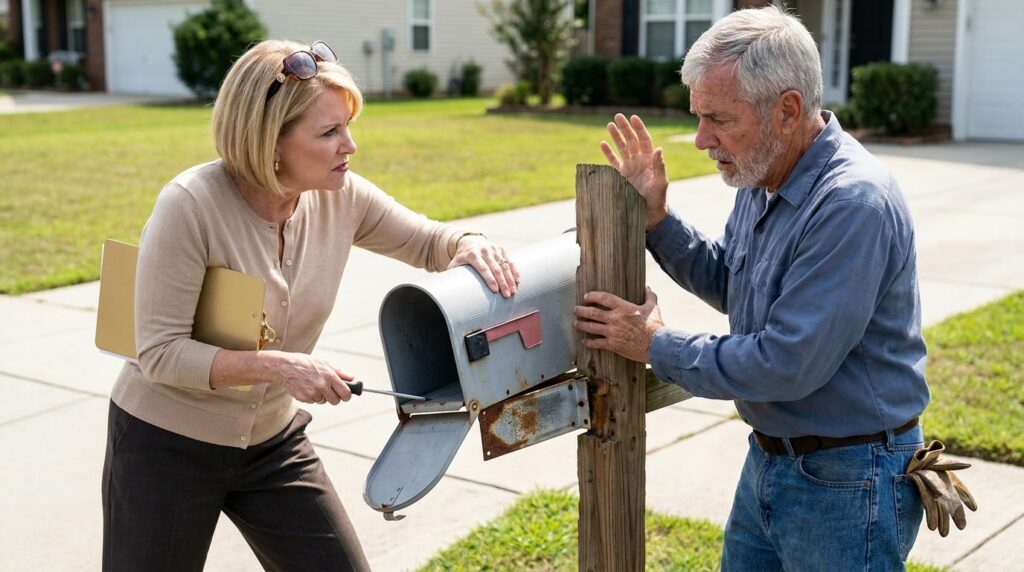
Joe didn’t stand up. He kept his shoulder pressed against the leaning mailbox, maintaining the appearance of a man fiddling with an ordinary stripped lag screw. In the narrow reflection of the tin flap, he saw Brenda emerge from the side entrance of her garage.
She had changed out of the beige cardigan into an oversized poplin utility jacket, the cuffs folded twice back over her thin wrists. The gold clipboard was gone. In its place, she carried an aged beige manila folder, curled at the edges and secured with a wide rubber band that had lost its elasticity, dry-rotted into a yellow crust against the cardstock.
Her gait across the asphalt wasn’t the rigid, clipped march from an hour ago. Her steps were deliberate, measured, her rubber-soled garden shoes scuffing the pavement as though she were checking the solidity of every square foot under her feet.
She stopped at the opposite edge of the gravel trench, four feet away, looking down not at Joe, but at the copper line exposed in the timber groove.
“Ed kept the blueprints in the footlocker under the stairs,” Brenda said. The wind took her words and flattened them out against the dry heat. “The county records office had a water damage claim in ninety-two. Entire filing room flooded after a storm main backed up on Fifth Street. That’s what he told everyone when the survey maps went missing.”
Joe turned his blade, scraping a flake of rust from the hexagonal head. “Ed was always good with water. Knew where it went. Knew where it wasn’t supposed to go.”
“He built this corner first,” she said, her voice dropping, thin and dry as paper. She tapped the manila folder against her thigh. “Before they graded the cul-de-sac. Before the developer laid the blacktop or poured the foundation pads. He told the framing crew that the post was a temporary triangulation point.”
“It wasn’t temporary,” Joe muttered. “And it wasn’t triangulation.”
“I pulled his field notes,” she continued, looking past Joe toward her own immaculate front lawn, her eyes settling on the concave dip where the sprinkler head sat slightly cocked in the turf. “He noted a subterranean fissure running from the old quarry wash straight under lot fourteen. My lot, Joe. Our living room floor isn’t on bedded aggregate. It’s bridged on six inches of reinforced concrete over an uncompacted silt pocket.”
She opened the folder with steady, deliberate fingers. Inside lay a single yellowed sheet of tracing paper, hand-drawn in indelible blue ink, cross-hatched with geological contour lines that abruptly halted at the boundary of Joe’s cedar post.
“He used the association covenants to keep anyone from digging here,” Brenda said, her eyes shifting to meet Joe’s. “The mailbox standard wasn’t mine. It was Ed’s. He wrote the original bylaws in ninety-six. He made the curb an untouchable architectural zone so the township backhoes would never dig a test pit on this line.”
She was looking for relief in the paper—a municipal excuse, an architectural technicality that would preserve her authority and keep the street looking like a glossy brochure. But Joe looked down at the copper sleeve running into the soil, and his chest tightened with a dark, heavy certainty.
“Brenda,” Joe said, his voice dropping into a low, gravelly rasp. “Ed didn’t write those bylaws to save your slab.”
She frowned, the stiff line of her jaw returning, hardened by confusion. “The field notes are right here. The silt pocket will swallow the foundation if the water table rises two feet.”
“Read the initials again,” Joe said, pointing the flat of his blade toward the cold-chiseled mark beneath the state benchmark.
She didn’t lean down. She didn’t have to. She stared at E.M., the corners of her mouth twitching. “Edward Miller. My husband.”
“My boy was Evan Miller,” Joe said, the words falling hard, cold and final as dropped lead. “He had your husband’s initials because they worked the same county road crew that summer. But Ed wasn’t on the site the night the drainage ditch collapsed.”
The wind died completely, leaving the suburban street in an unnatural, suffocating quiet. The hum of an air conditioning compressor three houses down kicked on, vibrating through the dry air like an approaching storm.
Brenda’s fingers froze against the edge of the yellowed paper. Her gaze darted from the copper tubing to the iron plate, then to Joe’s weathered face, where thirty years of sun and silence had etched lines as deep as chisel marks.
“The silt didn’t settle on its own, Brenda,” Joe said, rising slowly to his feet, the cedar post creaking in protest as he shifted his weight. “And that copper pipe isn’t an inspection port.”
From inside the hollow cavity of the post, a sudden, sharp metallic ping echoed—a tension fracture inside the subterranean sleeve, triggered by the slight shift of the loosened timber. Beneath their boots, the dry soil at the lip of the curb shuddered, and a trickle of loose gravel slid quietly into the dark opening behind the post.








