CHAPTER 2: THE SURVEY MARK
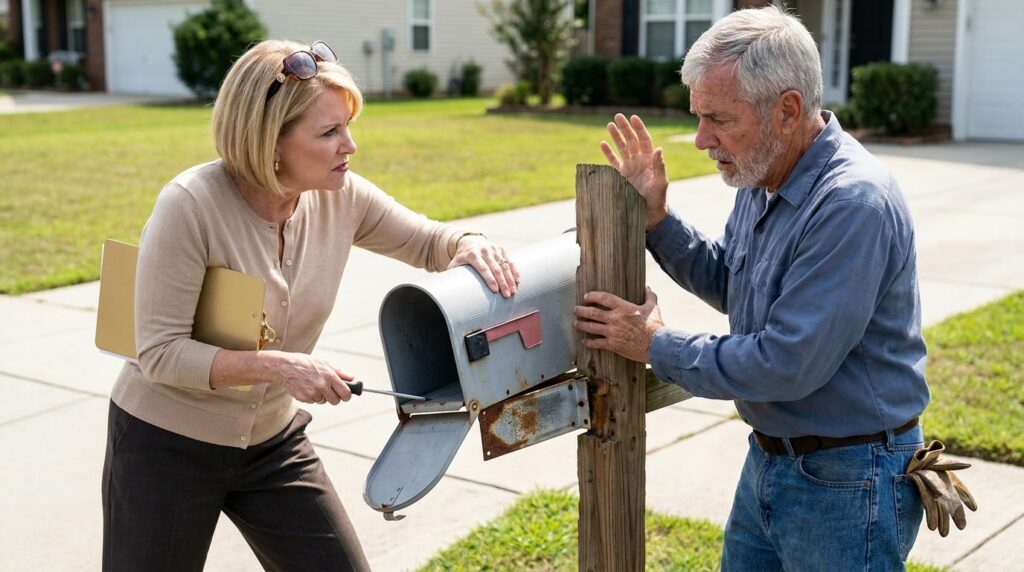
Brenda didn’t pull the driver back. She didn’t drop her arm, either. Her fingers remained hooked around the fluted plastic handle, her knuckles white where the sun had thinned the skin over the joints.
Between them, the split grain of the cedar post leaked a sharp, resinous smell into the noon heat. The heavy black iron plate, uncovered by the tilt of the mailbox, sat dead center in the post’s heartwood, anchored by two hexagonal lugs that were crusted over with decades of red scale.
“You had no permit for non-standard footings,” she said, but the snap was gone from her voice. The words came out flat, dragging like dry iron across stone.
“Take another turn on it,” Joe told her. He didn’t blink. The glare bouncing off her gold clipboard was harsh enough to burn, but he kept his eyes locked on the corner of her jaw. “The hex heads are three-quarter-inch cast iron, Brenda. You strip that lower shank, you’re looking at criminal mischief on a public utility marker.”
Her throat moved once—a small, rigid swallow that barely disturbed the stiff collar of her cardigan. She looked down, her tortoiseshell frames tipping forward on the crown of her head until a strand of dyed blonde hair fell across her forehead. Her gaze drifted from the rusted flange of the box to the lower edge of the plate, where a row of raised alphanumeric figures stood out under thirty years of grease: BM-77-E / DEPT. PUB. WKS.
Directly beneath the state seal, pressed into the metal while it was still cooling in a sand mold, two letters had been carved with a cold chisel: E.M.
“Ed didn’t survey this block,” she said, her voice dropping into a register that had nothing to do with the association handbook. It was low, raspy, stripped of its administrative veneer. “The developer laid the water grid in eighty-four. Ed was county road commission until ninety-one. He never worked this lateral.”
“He didn’t work the lateral,” Joe said, shifting his boots on the crumbly asphalt edge. “He poured the sleeve. Look at the curb seam, Brenda. Right where your sprinklers hit the gravel.”
She didn’t move her eyes, but her shoulders tightened, the cardigan drawing taut across her shoulder blades.
Ten feet back, where the manicured Kentucky bluegrass of her corner lot met Joe’s unwatered crabgrass, a faint, concave depression ran diagonally toward her two-car garage. It was subtle—the kind of settling that lawnmower wheels catch every Saturday without the owner ever asking why the deck scalped the turf. In the high midday sun, the shadow pooled in the rut like spilled engine oil.
“This is an unauthorized fixture,” she repeated, though her thumb had already slipped from the butt of the screwdriver. “The board voted on mailbox uniformity to preserve street value. You were notified in March. You were notified in May.”
“And your husband signed the easement variance in June of ninety-three,” Joe said softly. He stepped half an inch closer, his forearm pressing against the cedar post, pinning the crooked mailbox firmly against the wood so it wouldn’t tear free and drop. “The original municipal grid didn’t skirt this property line. It cuts straight through the sub-base beneath your slab. Ed knew the ground was unstable. He set this marker to keep the county backhoes from trenching through the bypass when the sub-development went in.”
“Ed died six years ago, Joe,” she snapped, her chin coming up in a reflexive jerk of defensive pride. Her eyes were hard, pale blue behind her wrinkles, but the corner of her mouth had developed a faint, uncontrollable tremor. “Don’t you drag his name into an architectural compliance dispute. You think a rusted bolt gives you an exemption from the covenants?”
“I think your husband was an engineer who knew what was buried three feet under your footings,” Joe replied, his voice level, heavy as a sack of dry mix. “And I think you know damn well why he told the road crew to never touch this corner post.”
Brenda let the screwdriver slip. It didn’t clatter; the rubberized grip hit the soft dirt of the mulch bed with a dull thud. Her hand stayed in the air for a second, curved around empty space, before she deliberately tucked it beneath the clipboard against her side.
“This post is three inches inside the road allowance,” she said, attempting to reclaim the cadence of the committee meetings, but the words felt hollowed out, rattled by the dry breeze that stirred the dust along the gutters. “It is association property by default of placement.”
“Then call the sheriff to pull it,” Joe said. He reached into his back pocket, pulled out the stiff leather work gloves, and slapped them against his thigh, raising a small puff of pale gray dust. “Go on, Brenda. Walk up the driveway, dial dispatch, and tell them Joe Miller has a municipal datum plate bolted to his cedar post, and you want county public works to come verify the right-of-way.”
She stared at the blackened iron. Her eyes narrowed, tracking the twin hex bolts, then moving down to the faint, hand-carved initials E.M.
She knew her late husband’s hand. Every surveyor in the county had recognized the heavy, left-leaning stroke of Ed Miller’s cold chisel. But Ed had been an uncle, a brother, a township surveyor—not a man who wasted steel on a neighbor’s curb without an entry in the county ledger. Unless the entry had been purged before the plat map was filed.
“You’re bluffing,” she whispered, though she made no move toward her phone. “The township surveyor’s office has the digitized plat from ninety-five. There is no recorded easement through my foundation.”
“Not on the digitized map,” Joe said. He tapped the iron plate with the blunt brass buckle of his glove strap. A sharp, dead ring echoed down the hollow cavity of the post. “Because Ed didn’t file the revision. He hid it right here, behind the four-penny nails and the cedar lap. If this box comes off, the township sees what’s under the timber. And then the structural inspectors come for the corner lots.”
Brenda took a single step back, her flat-soled leather shoes crunching into the dry leaves that had drifted against the curb. The hostility was still in her face, but it had morphed into something colder—the calculating panic of someone who realized the house they were defending had its sill plate resting on rotten ground.
“Leave the box as it is,” she said, her voice dropping so low the distant hiss of a lawn sprinkler down the block nearly drowned it out. “Don’t touch it. Don’t touch the bracket.”
“I’m not touching anything,” Joe said, keeping both work-roughened hands resting flat on the battered tin. “I’m standing on my dirt. You’re the one holding the tool.”
She didn’t pick up the screwdriver. Leaving the yellow handle half-buried in the cedar shavings, she turned on her heel and walked down the asphalt toward her driveway, her gold clipboard clamped against her chest like an iron plate of her own.
Joe watched her until the side door of her garage closed with a sharp, heavy click.
Then he looked down at the exposed plate. With a slow, deliberate movement, he ran the callused pad of his thumb across the initials E.M., wiping away the accumulated spider silk and rust. Beneath the cold-punched letters, almost entirely filled with gray wax, was a second set of markings Ed had never shown the county—the precise depth coordinates to a buried void that was never meant to stay dry.