
CHAPTER 1: THE TEETH OF THE SCREW
“It doesn’t belong there anymore,” Brenda said. Her voice had the dry, clipped snap of shears through dry hedge.
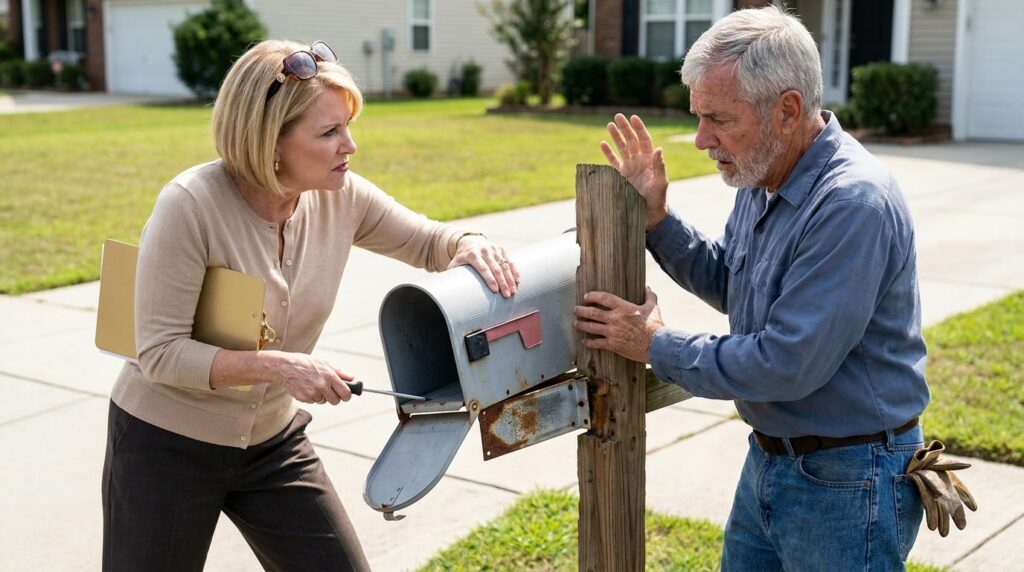
The flathead bit against the soft metal of the mounting bracket, screeching as the threading stripped. She had both thumbs braced against the yellow handle of the driver, her beige cardigan bunched tight at the elbows, her gold clipboard pinned like a shield between her ribcage and the cedar post. The sun hit the oxidized green tin of the box, throwing the sharp angles of her knuckles into high relief.
Joe took the curb in two long, heavy strides, the cracked soles of his boots grinding dried mulch into the asphalt. He didn’t yell. The heat of late morning had already baked the moisture out of the dirt, and his tongue felt like salt. He locked his left hand around the cedar upright just below the shelf and took the front corner of the metal box with his right, arresting the tilt before the wood could splinter.
“You don’t own my mailbox, Brenda.”
She didn’t yield an inch of ground. Her sunglasses, wide and tortoiseshell, sat pinned in the sprayed crown of her short blonde hair, staring down at him like a pair of dead glass eyes. Her jaw worked, grinding on some small, internal calculation of leverage. With a hard, downward twist, she dragged the shank of the tool down the grain, gouging a pale, fresh furrow into the gray cedar. The tin housing jumped sideways in Joe’s grip, jarring the bone in his wrist.
“Section four, paragraph B,” she said, leaning her entire weight onto the top seam. “Standardized brushed aluminum or a fine on the fifteenth. The committee gave you thirty days. The thirty days expired when the sun came up.”
“You touch the wood again, you pay for the post.”
“The curb belongs to the easement, Joe. Read your deed.”
She wrenched the screwdriver sideways, using the cedar as a fulcrum. Metal screamed against iron. The box gave with a hollow, booming thud, sagging forty-five degrees to the right, held now only by the lower carriage bolt. Joe tightened his fingers until the calluses on his palm pinched against the torn sheet tin, his shoulder hard against her shoulder. The smell of her citrus perfume cut sharp through the sour odor of dry dust and iron scale.
He didn’t pull back. He simply shifted his footing, dropping his center of gravity until the cedar stopped swaying under their combined weight.
“Look at the bracket,” Joe said quietly.
Brenda gave a derisive snort, her mouth tightening to lever the driver one more time into the joint. “I don’t care who made it—”
The tip of the flathead caught on something that wasn’t wood and wasn’t sheet zinc. It rang out clear and dull, like a railroad spike struck underground.
Brenda’s shoulder twitched. The movement stopped in her elbow, freezing the driver mid-turn.
Behind the twisted flange of the lower bracket, where thirty years of weather had sealed the tin to the timber, the displacement had cleared away an inch of dark, compressed cedar rot. Peeking out from the crevice was no ordinary washer. It was a heavy, blackened iron plate, cold-forged and thick, secured to the heart of the post by two counter-sunk hexagonal bolts stamped with an unweathered state seal and an etched initials mark that Brenda’s own husband had used on private engineering contracts thirty years ago.
Her hand went slack on the plastic grip, the screwdriver wobbling loose in the slit.
Joe felt the shift through the post, the sudden absence of resistance. He kept his grip ironclad on the torn metal, staring straight down at the pale ring where her fingers had loosened.
“Turn it again,” Joe said, his voice flat as the gray pavement between them. “See what comes up with the post.”








