
CHAPTER 5: THE COLLAPSE
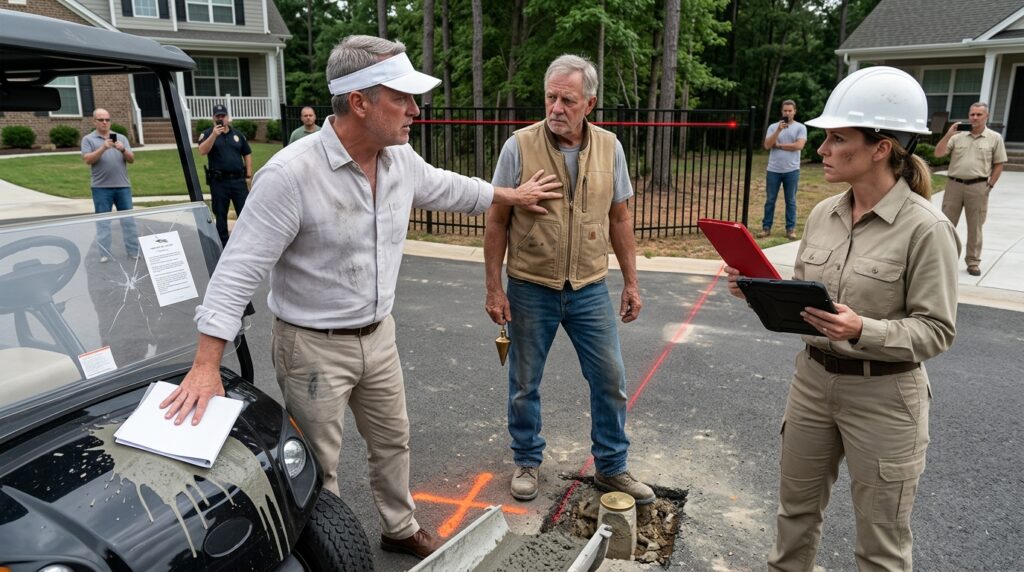
The heavy iron cylinder of the state surveyor’s core drill bit ground to a teeth-rattling halt against the granite face of the 1954 township monument. A thick, milky plume of limestone dust plumed upward into the sweltering July heat, coating the wet gray slurry of the cement truck’s aborted pour like ash. Harrison Drake didn’t move. He stood completely rigid on the edge of the blacktop, hisVisor slightly askew, watching a tiny drop of sweat track through the fine gray powder that had settled across the expensive crest embroidered on his linen shirt.
“Shut down the secondary compressor,” Senior Inspector Elena Rostova ordered, her voice cutting through the high-pitched hum of the diesel rigs with the clinical precision of a bone saw. She unclipped a heavy, red-inked enforcement pad from her leather belt and pressed it flat against the hood of Drake’s black golf cart. The plastic frame cracked slightly under the force of the downward stroke. “Mr. Drake, this property line is no longer a matter of residential mediation or neighborhood association interpretation. You have willfully obstructed a municipal geodetic anchor point. That is a state-level administrative violation.”
Drake’s hands twitched at his sides, his fingers grasping at the empty air where his leather folders had been. “Inspector, my legal team has a standing motion—”
“Your legal team can argue the structural liabilities from the curb,” Rostova interrupted without looking up from her pad. She ripped the top sheet off with a sharp, violent shredding sound that made the nearby construction foreman flinch. She slapped the bright orange placard directly onto the center of the golf cart’s windshield, right over the copy of the fake infrastructure waiver. “This is a formal, non-negotiable stop-work mandate and a structure remediation directive. Every piece of steel and unpermitted aggregate extending twelve feet west of this baseline is designated a public hazard. If your crews do not begin structural extrication within forty-eight hours, the county will execute the contract at your personal expense.”
Marcus stood perfectly still beside the yellow transit tripod, his palms raw and stained black from the tar sealer he had scraped away to expose the stone. He didn’t feel a sudden surge of triumphant warmth; his chest felt hollow, heavy with the cold, pragmatic weight of an assignment finally brought to its geometric conclusion. He reached into his canvas vest pocket and pulled out his cell phone, his thumb tapping the screen to release the holding pattern on the commercial nursery flatbed at the mouth of his drive.
“Alright, Miller,” Marcus said into the receiver, his eyes remaining locked on Drake’s face. “The easement is clear. Bring the rig down.”
The massive Peterbilt engine roared back to life with a deep, guttural belch of black exhaust that drifted over the freshly painted pickleball courts. Drake turned toward his two private security guards, his mouth opening as if to give a final command to hold the boundary line, but the two men had already unhooked their arms from behind their backs. They stepped off the asphalt, their heavy utility boots crunching into the dry ditch weeds as they walked back toward the main estate gates, completely ignoring the developer’s outstretched hand.
Across the road, the watching crowd of neighbors shifted. The silence that had held the cul-de-sac for an hour broke into a low, rolling murmur of overlapping conversations. Three separate cell phones remained hoisted along the front porch of the neighboring lot, their glass lenses tracking Drake as he slowly reached into his pocket to retrieve his ringing phone—his own investment partners already reading the digital code violations filing in real-time on the county portal.
Marcus walked back onto his own gravel, his boots leaving a faint trail of gray, dusty footprints across the stone line. The foreman of the concrete crew was already hoisting himself into the cab of the mixer, throwing the drum into reverse to pull the remaining load back into the valley before it hardened into a twelve-thousand-dollar block of solid waste.
“You think this patch of brush is worth the litigation, Vance?” Drake said, his voice dropping into a dry, hoarse whisper as the shadow of the nursery truck began to block out the sun between them. “You’re an old man living in a dead lot. Nobody is going to see these trees but you.”
Marcus stopped at the threshold where his gravel met his house. He looked down at the bright red laser line still burning a thin, perfect scar through the steel links of the fence Drake would have to tear down with his own hands.
“My wife would have seen them, Harrison,” Marcus said, his voice dropping into the quiet, unyielding rhythm of the timber lot. “And that’s all the math I need.”
He didn’t wait to watch the golf cart back away. He turned his back to the courts, his fingers tightening one last time around the cold brass bob in his vest pocket as the first ten-foot cedar sapling was swung clear of the trailer, its roots sinking deep into the shade of the land he had kept unbroken.








