
CHAPTER 4: THE SURVEY SHOWDOWN
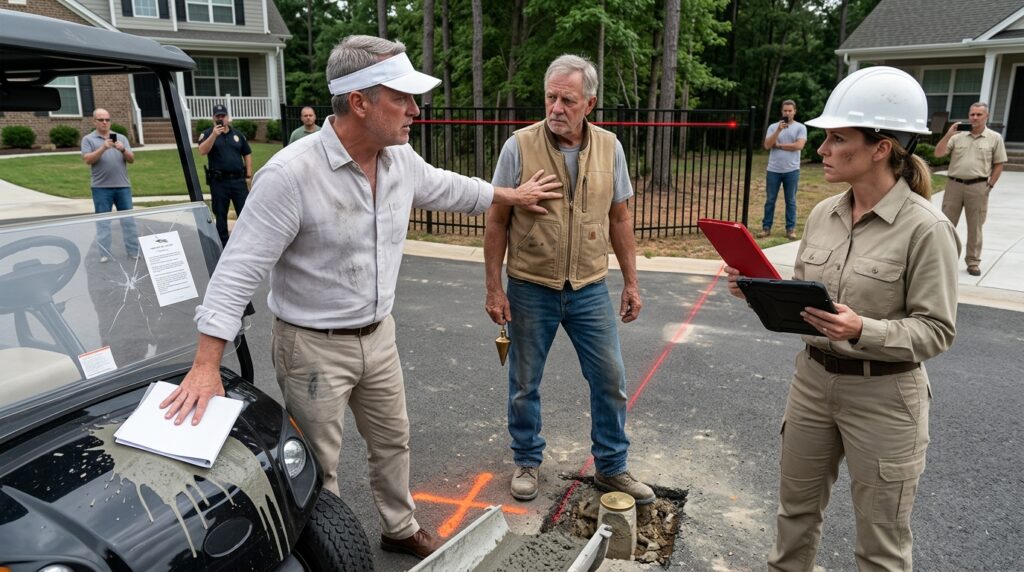
“Get that chute locked down right now!” Marcus shouted, his hand finally ripping free from his canvas pocket to point directly at the concrete mixer’s backing tires. The high-volume drum groaned, its heavy internal flights lifting the wet, slate-gray mortar to the lip of the metal delivery trough. A line of gray sludge spilled over the lip, splashing with a heavy splat onto the blistered asphalt sealer, a mere two inches from the neon crosshairs.
Harrison Drake took a sudden, aggressive step forward, his luxury golf cart forgotten behind him. His face was no longer composed into a neat marketing smile; the heat and the sudden intervention had pulled his mouth into a tight, white line. “Back that truck up!” he commanded the driver, his gold watch catching the fierce afternoon glare. “Vance, you don’t dictate commercial operations on an approved community drainage site. We’re pouring the load.”
“Not on this coordinate, you’re not,” a cold, sharp voice cut through the mechanical thunder.
An orange county-issued SUV swung into the cul-de-sac, its emergency flashers cutting bright yellow bars through the dust. Before the tires had even stopped crunching against the gravel, Senior Building Inspector Elena Rostova slid out of the driver’s seat. She wore a stained white hardhat over dark, swept-back hair, a heavy leather tool belt cinched over her uniform khakis, and carried a rugged, drop-tested field tablet. Behind her vehicle came a white panel van, its doors already swinging open to reveal a licensed state surveyor pulling a heavy, yellow laser-transit tripod from the back rack.
“Mr. Drake,” Rostova said, her boots hitting the blacktop with a solid, authoritative thud. She didn’t look at his linen shirt or his private guards; her eyes went straight to the cement mixer’s lowered chute. “This site is under an immediate investigative hold based on a priority utility discrepancy report filed at ten-forty-five this morning. Tell your driver to put that drum in neutral or I’m calling the county sheriff to pull his commercial registration before the pour sets.”
Drake’s arm swung out, thrusting the white leather folder toward her face. “Inspector, your office cleared this topographical remediation three months ago. The board signed the physical infrastructure waiver. We have twelve million dollars in private capital riding on the completion of this viewing deck before the regional tournament.”
Rostova didn’t take the folder. She tapped her field tablet, her thumb sweeping through a series of official digital plat layers. “The board signed a private agreement regarding neighborhood retention basins, Mr. Drake. The board does not possess the civic authority to grant an exclusion zone over a primary geodetic benchmark. Move your guards back.”
Marcus stepped over his gravel line, his boots sinking into the wet, gray overflow of concrete that had begun to pool on the edge of the asphalt. The heat radiating off the blacktop was suffocating, thick with the smell of wet lime and aggregate. He stood beside the state surveyor, who had already dropped the heavy brass plumb bob from the center of the tripod, aligning the crosshairs of the laser transit with the undisturbed concrete benchmark across the road.
“Vance is running a personal vendetta because he doesn’t want a fence near his trees,” Drake said, his voice lowering into a low, rumbling threat as he stepped directly into the surveyor’s line of sight. “We checked the GIS maps. The line is fluid along this ridge due to historic creek erosion.”
“The earth isn’t fluid, Harrison,” Marcus said, his voice flat, his fingers coated in a fine dust of gray lime as he knelt into the mud. He reached for his old three-pound steel engineering scale, using the blunt edge to scrape through the wet asphalt sealer where the neon orange crosshairs had blistered. “You didn’t check the maps to build. You checked the maps to find out when I’d be gone.”
The state surveyor adjusted his micrometer with a sharp, metallic click. “Transit is level, Inspector. Projecting the 1954 township baseline right now.”
A bright, thin beam of ruby-red laser light cut through the rising heat waves, striking the black fence line. It didn’t align with Drake’s steel posts. It ran exactly twelve feet to the west, cutting straight through the center of the newly poured spectator pavilion and the concrete foundations of the pickleball court.
“That’s impossible,” Drake said, his voice cracking slightly as the construction foreman slowly stepped back from the concrete truck, pulling off his hardhat to wipe a sheet of sweat from his forehead. The two private security guards had stopped moving altogether, their arms locked behind their backs, their eyes fixed on the bright red dot burning against the fence mesh.
“The laser doesn’t lie, Mr. Drake,” Inspector Rostova stated, her pencil scratching against her pad. “But that’s just the residential line. We’re here for the municipal anchor.”
Marcus didn’t wait for them to finish the calculation. He rammed the steel rule deep into the gray mortar soup beneath the mixer chute, his knuckles scraping against a hard, unyielding edge buried four inches beneath the fresh asphalt. It wasn’t the gravel base coat. It was smooth, chiseled granite. He wiped the sludge away with his bare palm, exposing a heavy, weathered brass cap embedded in the ancient stone, stamped with the deep, unmistakable seal of the 1954 municipal township survey.
Drake’s whole posture went rigid. The decoy secret of his HOA infrastructure waiver had collapsed into the wet dirt. He stood in the center of his expensive playground, his fake authority stripped away by a red light and a buried stone, while the neighbors on their front porches leaned over their railings, their smartphones raised to catch the exact second the developer lost the hill.








