
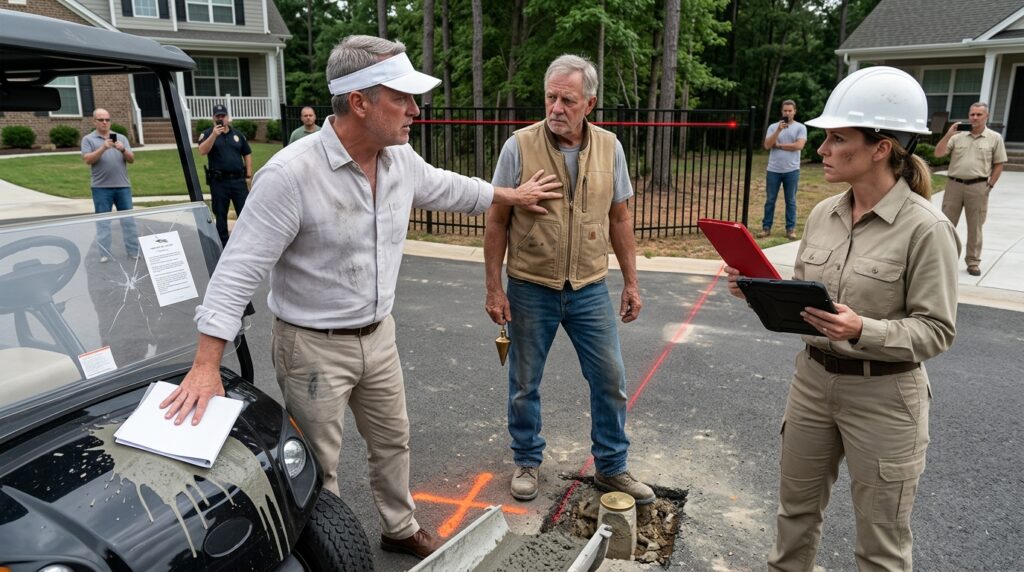
CHAPTER 2: THE PAPER TRAIL
The rusted padlock on Marcus Vance’s heavy green filing cabinet gave way with a sharp, metallic snap that echoed too loudly in the low-ceilinged basement. Outside, the steady, rhythmic thump-thump of Drake’s concrete vibrator shook the single-pane cellar window, loose dirt trickling down the foundation wall like sand through an hourglass. Marcus didn’t look up at the window. He wiped a streak of greasy orange rust from his thumb onto his denim trousers and pulled open the bottom drawer. The rollers ground against decades of grit, emitting a high-pitched protest that felt perfectly aligned with the pressure building on the surface of his lot.
He bypassed the folders labeled for the industrial pipelines, the state highway layouts from the late nineties, and the bridge abutment surveys from his years with the department. His fingers, calloused and thick-jointed from a lifetime of handling cold brass transits and steel tape measures, settled on a faded manila folder labeled Oak Ridge Subdivision – Historic Boundaries, 1989. The paper was soft, swollen with the dampness of the valley, smelling heavily of river mold and old ink.
Marcus carried the folder over to his work table, a thick slab of scarred oak lit by a single, bare sixty-watt bulb hanging from an exposed joist. He laid out his tools with geometric precision: his favorite three-pound steel engineering scale, a clean yellow legal pad, and the heavy, brass-bound plumb bob. The weight of the brass against the wood felt grounded, a silent anchor against the corporate arrogance hovering just twelve feet over his eastern line.
He opened the folder. The top document was his original warranty deed, stamped with the deep purple ink of the Douglas County Clerk. The description was unambiguous: From the stone monument marker at the convergence of Plat Creek, thence East two hundred feet… Marcus ran his finger along the crisp, typed lines. He knew the measurements by heart, but in his business, you never trusted memory when the earth was being moved against you.
Beneath the deed lay the community association’s historic drainage ledger—a document he had inherited from the subdivision’s original developer back before the valley had been subdivided into million-dollar lots with manicured lawns. As Marcus turned the yellowed pages, a single sheet of crisp, bright white bond paper tumbled out. It didn’t belong in the ledger. It was clean, unweathered, and bore the sharp, laser-printed letterhead of Westfield & Associates.
Marcus leaned closer, the shadow of his head cutting off the light as he scanned the text. It was a copy of a private infrastructure waiver, dated exactly three years ago, signed by the former president of the Oak Ridge HOA board and Harrison Drake. The language was dense, wrapped in the protective grease of corporate legalese, but the core calculation was unmistakable: the old board had granted Drake a sweeping “topographical remediation allowance” along the eastern ridge in exchange for Drake funding the community’s primary retention basin update.
Marcus let out a slow, dry breath through his nose. This was Drake’s shield. It wasn’t a county permit, and it wasn’t a legal easement change—it was a decoy secret, a internal neighborhood agreement designed to look like official authorization if anyone ever started asking questions about the cleared trees. The old board had traded away a boundary they didn’t own to save their clubhouse budget, and Drake had used it as a license to clear-cut the hillside while Marcus was hundreds of miles away tending to a dying woman’s estate.
But as Marcus studied the attached schematic, his eyes caught a tiny hand-drawn notation near the edge of the newly paved asphalt deck. The map showed a small, shaded circle labeled Marker 0-A (Status: Unverified).
Marcus stood up, his knees popping in the quiet basement. He knew exactly what Marker 0-A was. It wasn’t an HOA pin. It was the original 1954 municipal township stone monument—the absolute baseline for the entire valley grid system. If that stone was gone, or if it had been built over, Drake hadn’t just crossed a residential boundary; he had committed a major municipal violation by destroying a state-registered geodetic survey point.
Outside, the excavator engine died with a sudden, sputtering wheeze, leaving an unnatural silence hanging over the lot. Then came the slam of a car door, loud and close, right at the mouth of Marcus’s driveway. Marcus didn’t hurry. He carefully placed the infrastructure waiver inside his vest pocket, picked up his flashlight and his steel scaling rule, and began climbing the dark wooden stairs toward the kitchen. Every step groaned under his weight, a reminder of the friction that was about to land on his property threshold. Through the screen door, the glare of the July sun hit the gravel, and Marcus could see the shadow of a massive commercial flatbed truck loaded with thirty ten-foot-tall cedar saplings turning into the cul-de-sac.








