CHAPTER 3: THE BLOCKADE
The screen door slapped shut behind Marcus, the sound swallowed instantly by the roaring hiss of air brakes. Out on the cul-de-sac, the massive Peterbilt flatbed idled, its chrome exhaust stack vibrating against the July sky. Heat shimmered off the blacktop, carrying the heavy, industrial scent of hot diesel and scorched brake dust, mingling sharply with the raw, earthy smell of the thirty mature cedars strapped to the trailer. Their root balls were massive, wrapped in thick burlap and heavy gauge wire, representing tons of displaced earth meant to heal a broken line.
But the truck wasn’t moving.
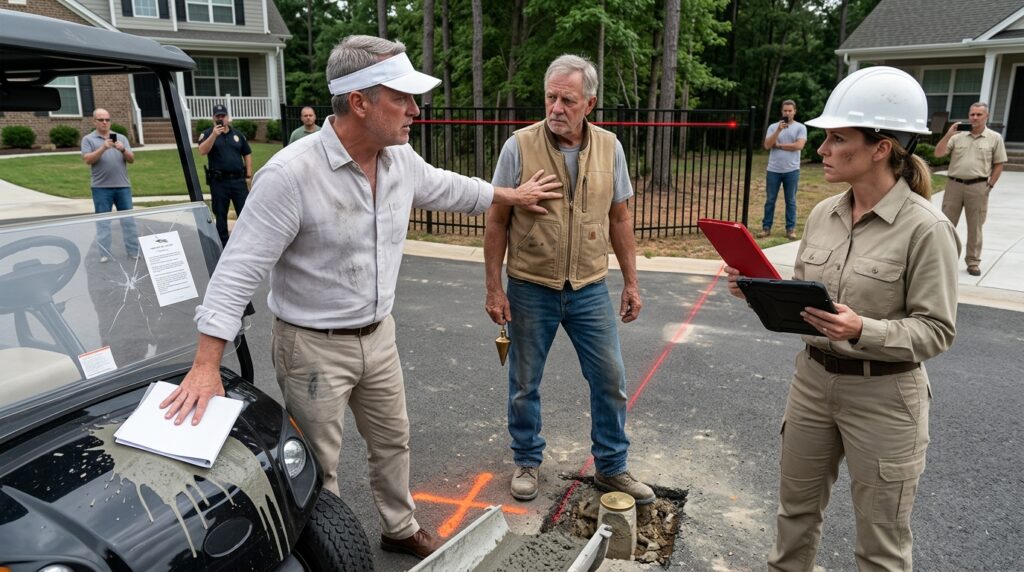
Harrison Drake’s customized black golf cart had shot out from the estate gates, cutting a sharp, reckless diagonal across the shared access lane. It skidded to a halt mere inches from the Peterbilt’s rear dual tires, effectively wedging the delivery vehicle between the narrow curb and the drop-off of the creek bed.
Drake stepped out. For the first time all day, he was on his feet, and the physical reality of the man matched the aggressive architecture of his property. He didn’t yell immediately. He simply stood in the blind spot of the massive trailer, adjusting the cuffs of his pristine linen shirt, radiating the absolute entitlement of a man who owned the airspace he occupied. Flanking him were two private security guards. They wore tactical navy polos stretched tight over broad shoulders, utility belts heavy with radios and pepper spray, their postures rigid with manufactured authority.
Marcus walked down the gravel drive, his boots crunching in a steady, unhurried rhythm. His right hand remained submerged in the canvas pocket of his jacket, his calloused thumb rubbing the cold, pitted brass of his antique plumb bob. He wasn’t looking at Drake. He was looking at the physics of the blockade. A twenty-ton machine immobilized by a fiberglass cart and the sheer weight of social intimidation.
“Kill the engine!” Drake barked, pointing a manicured finger up at the driver’s side window. He held a crisp, white document in his left hand—the exact infrastructure waiver Marcus had just discovered in the basement shadows. “This is a restricted community access lane. You are exceeding the structural weight limit of a remediated topographical zone. You back that rig up one more inch, and I’ll have the county impound it and fine your commercial license for reckless endangerment.”
The truck’s massive diesel engine sputtered and died. The silence that followed was heavy, broken only by the ticking of the cooling exhaust and the high-pitched hum of the cicadas in the remaining oaks.
The driver’s door swung open, and a man in a sweat-stained high-visibility vest climbed down the chrome steps. He looked at the golf cart, then at the two security guards, his shoulders slumping. “Look, buddy, I just got a delivery order. Thirty cedars for Vance. Address says this is the drop.”
“The address is irrelevant,” Drake snapped, waving the white paper. “The Oak Ridge HOA granted an infrastructure waiver for this ridge. It’s commercial-grade concrete and fresh asphalt down there. Your rig cracks my foundational work, your nursery is buying me a new tennis court. Turn it around.”
Marcus reached the edge of the asphalt. He didn’t cross the property line. He stopped exactly where his gravel met the street. “Morning, Miller,” Marcus said, his voice flat, gravelly, cutting under the shrill pitch of Drake’s demands.
The driver turned, wiping a streak of grease from his forehead. “Mr. Vance. Look, I don’t want no trouble. Dispatch didn’t say nothing about a restricted weight zone. If this guy has HOA papers, I can’t risk the rig.”
“He has a piece of paper,” Marcus said, his eyes finally shifting to Drake. “What he doesn’t have is jurisdiction. That easement is deeded to this lot, Miller. The liability is entirely mine.”
“It’s an active hazard zone, Vance!” Drake countered, stepping forward. He slapped the infrastructure waiver against the hood of his golf cart. “You think you can play cowboy with some potted plants? The board signed this ridge over to me three years ago for drainage remediation. You’re trespassing on a permitted community project.”
Marcus looked at the paper. It was a flawless bluff, designed to terrify a working man who couldn’t afford a legal battle. Drake knew the waiver wasn’t a county permit; it was a shield of private bureaucracy. But as Marcus looked down, his gaze caught something on the asphalt, just inches from the front tire of Drake’s cart.
The asphalt here was fresh, sealed with a thick coat of jet-black tar. But beneath the edge of the golf cart, the intense summer sun had begun to blister the topcoat. Bleeding through the black sealer was the unmistakable, faded neon orange of a surveyor’s marking paint. It wasn’t a standard utility line. It was a precise, perfectly intersected crosshair—an ‘X’ marking a specific coordinate. A coordinate Drake had gone to great lengths to paint over, seal, and obscure, right at the edge of the newly poured viewing deck.
Marcus felt the slow, heavy thud of his own pulse. Marker 0-A.
“I’m not eating a ten-thousand-dollar municipal fine for you, Mr. Vance,” Miller said, his voice tight with panic as one of the security guards stepped deliberately toward the truck’s cab, resting a hand on his radio. “I’m calling dispatch. I gotta take these trees back to the yard.”
“You leave this curb, Miller, and those roots dry out on the highway, I’m rejecting the shipment,” Marcus stated, entirely pragmatic. “Shut the cab door. Nobody is impounding your truck.”
“I am,” Drake smiled, a thin, razor-like expression. He nodded to the guard. “Call the local precinct. Tell them we have a commercial vehicle blocking a fire lane and a belligerent resident threatening property damage.”
The guard unclipped his radio, the static hissing loudly in the heat. It was a masterful chokehold. By the time the local police arrived, evaluated the fake HOA documents, and untangled the civil dispute, the day would be over. The trees would be gone. The momentum would be dead.
Marcus pulled his hand from his pocket, the brass plumb bob catching the sunlight. He reached for his phone with his other hand, knowing the paper trail in his basement wasn’t enough to stop men with badges and radios. He needed the absolute authority of the county, and he needed the state grid verified immediately.
But before Marcus could dial the number, the ground beneath their boots shuddered.
From behind the six-foot steel fence, the deep, guttural roar of a heavy diesel mixer drum grinding into gear shattered the standoff. Marcus’s eyes snapped past Drake’s shoulder. A massive cement truck, its chute already lowered, was backing directly toward the blistered orange ‘X’ on the asphalt. They weren’t just sealing the ground. They were preparing to pour a secondary slab, burying whatever lay beneath that marker under six feet of reinforced, unyielding concrete.