CHAPTER 7: THE PERMANENT MARKER
The first drop of rain didn’t fall from a storm cloud; it felt like a cold condensation leak from the wet slate sky, striking the center of the 1974 linen blueprint with a heavy, spreading grey circle. It dissolved a tiny section of the draftsman’s blue-line ink right where the primary polygon loop failed to close. The lead surveyor didn’t pull the roll away. He rolled it up with a slow, grinding friction, sliding the heavy tube back into the truck’s rear cab as if he were burying a ledger that had already finished its calculations.
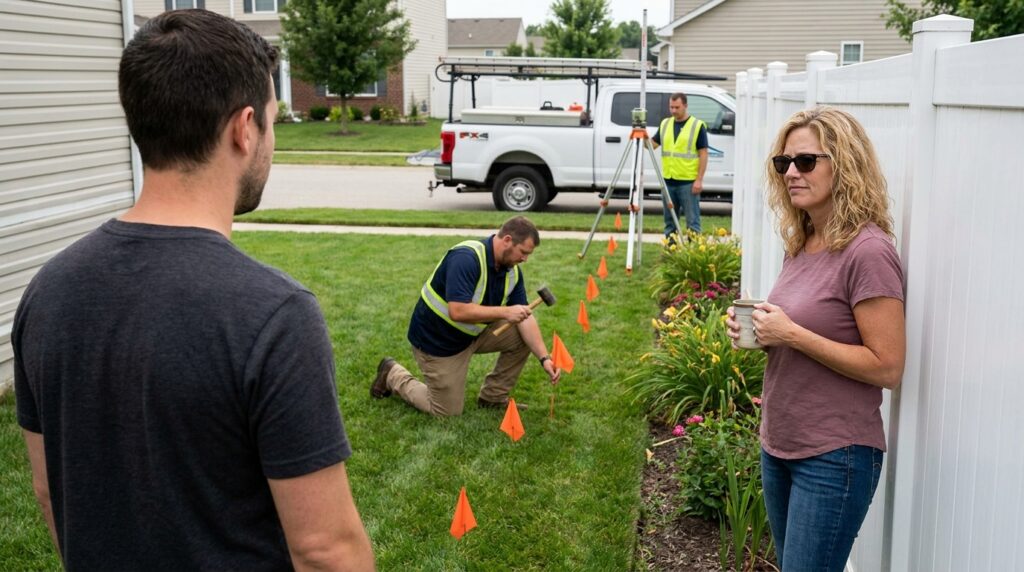
Time slowed down to the speed of the water pooling on the hot asphalt. I looked at Brenda. The hairline fracture running down the front of her ceramic mug finally yielded to the structural pressure of her hands. A thin, dark line of cold coffee bled through the gap, dripping onto the sleeve of her mauve top before hitting the dry gravel path with a rhythmic tap, tap, tap. She didn’t drop the porcelain. She just stood there, her dark sunglasses reflecting the three orange survey flags that cut across her lawn, their vinyl faces flapping like small, neon tongues in the rising wind.
“The line,” she whispered, her voice stripped of its practiced weight, sounding as thin and fragile as the old bond paper in my kitchen lockbox. “The line is… we’ve been paying the taxes on it.”
“The tax registry uses the plat maps, Brenda,” I said, my voice dropping into that quiet, flat register that left no room for legal arguments or neighborly compromise. “And the plat maps are broken. The line is exactly where it’s supposed to be, according to the error. We’re all sitting on borrowed dirt.”
Arthur Vance didn’t pick up his folder from the gravel. The starched linen of his shirt had completely collapsed under the humidity, sticking to his ribs like a wet shroud. He looked down the length of the cul-de-sac—at the three-street subdivision he had managed with the mechanical precision of a shipping port—and saw only a series of overlapping trespasses. His entire kingdom was built on an unclosed polygon.
“We have to file a corrective deed aggregation,” Arthur muttered, his hand trembling as he wiped a smear of clay dust from his chin. “If the state enforcement bureau logs the watershed encroachment, the fines accumulate daily. The whole block… the title values will drop to zero by Friday.”
The lead surveyor swung his legs into the driver’s side of the Ford F-250, the diesel engine giving a heavy, throbbing roar that shook the dry fescue along our borders. His assistant picked up the heavy brass transit tripod, swinging it onto the back rack with a final, metallic clack that sounded like a prison door locking from the outside. They didn’t offer a solution; they had delivered the math, and the math didn’t owe any of us a clean resolution.
The white utility truck pulled away from the curb, its yellow strobe lights casting one last amber flash across the front of Brenda’s house before disappearing down the throat of the access lane.
The silence that returned to the block was absolute, heavy with the realization that our local wars were entirely meaningless. Brenda turned slowly, her loafers dragging through the gray dust of her driveway as she walked back toward her porch. She didn’t look at me, and she didn’t look at Arthur. She left her front door wide open behind her, a dark, hollow rectangle that swallowed the remaining light of the afternoon.
I walked back to my own steps, my boots leaving dark, wet impressions on the concrete. The three orange flags remained standing in the backyard, driven deep into the hard clay—permanent public testaments to a truth that had shattered the neighborhood’s peace without offering a drop of healing. I looked down at the rusted survey pin resting near the edge of my porch, its flaking metal bleeding a red-brown stain onto the steps as the rain began to fall in earnest. The sanctuary I had fought for was mine now, but it was a cold, iron sanctuary built on a foundation that had never truly existed.