
CHAPTER 6: THE SHATTERED LEDGER
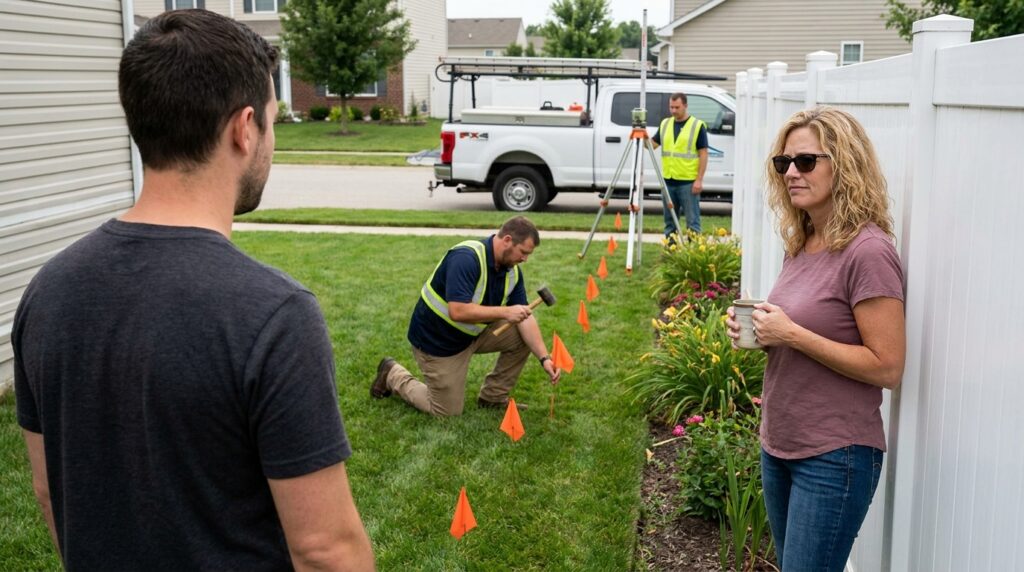
“The ledger records are filed in the north annex, Arthur! He’s using outdated county maps!” Brenda’s voice didn’t just crack; it splintered into a sharp, desperate rasp that cut straight through the low vibration of the utility truck’s idle. She pulled a faded blue ledger folder out from behind her back, her fingers shaking so violently that her knuckles caught the corner of her ceramic mug, sending a dark splash of cold coffee over her mauve sleeve. She slammed the paper onto the top rail of the vinyl fence. “Look at the ninety-four amendment stamp! Richard paid for the variance! The structure is grandfathered!”
Arthur Vance reached for his glasses, his linen shirt clinging to his ribs as he leaned over the fence. His fingers fumbled with the folder, his practiced, managerial confidence faltering as his eyes scanned the old lines. “The signature looks correct, surveyor. It’s logged under the residential improvement registry.”
I took two slow steps toward the line, pulled the crisp copy of the unrecorded 1994 agreement from my pocket, and dropped it onto the vinyl rail right next to her folder. The rust scales from the survey pin had left a faint orange ring across the signatures. “It was never recorded with the county recorder, Arthur. Richard paid twelve hundred dollars under the table to build that slab, but the title insurance company never saw the ink. Her garage is sitting clear on my legal dirt. It’s an unrecorded encroachment.”
Brenda froze, her chin tilting down as she stared at the brown-stained paperclip on my copy. The black chrome disks of her sunglasses caught the glare of the gray morning sky, reflecting the sharp orange boundary flags that bordered her concrete slab like tiny, mocking spikes. Her mouth opened, but only a small, breathy whistle came out.
The lead surveyor didn’t glance at either document. He remained leaned over the transit eyepiece, his thumb dialing a brass calibration wheel with a slow, grinding crunch. “None of those folders matter anyway,” he said, his voice entirely flat, carrying the weight of a machine that didn’t care about thirty years of neighborhood architecture.
Arthur’s hand stopped on the manila tab. “What do you mean they don’t matter? The variance defines the easement coordinates.”
The surveyor stood up, pulling a long, yellowed roll of heavy linen paper from the truck’s rear cab. He spread it across the flat hood of the F-250, his rough, clay-smeared palms pinning the corners down against the hot steel. It was the original 1974 blueprint roll for the entire subdivision, complete with the blue-ink signatures of the long-dead county engineers.
“Look at the western baseline axis on Block Four,” the surveyor said, his callused index finger tapping a tiny string of faded engineering annotations near the cul-de-sac’s throat. “The draftsman didn’t close the primary polygon loop. He missed a four-foot curve calculation where the access lane cuts into the county watershed line. It’s a cumulative baseline systemic error.”
I moved closer to the truck, the smell of diesel exhaust and ancient paper filing my lungs. My eyes followed his finger along the faded blue grid.
“The error didn’t just happen yesterday,” the surveyor continued, his rough rasp completely steady. “It’s been sitting in the plat ledger for fifty-two years. Because the primary benchmark at the road throat was set four feet off-center, every single lot on this western curve is technically shifted. Brenda’s garage isn’t just on Adam’s property. Adam’s kitchen is sitting on Arthur’s property line, and Arthur’s entire back patio is encroaching four feet into the protected state watershed preservation zone.”
The words hung in the humid air, heavier than the heat radiating from the asphalt. Arthur’s face went entirely slack, the manila folder slipping from his grip and dropping into the dry gravel path with a soft thud. He looked down at his shoes, then back toward his own house, his rigid, institutional posture dissolving into a sudden, trembling panic. “The watershed zone? The county issues immediate demolition mandates for conservation violations. My insurance won’t cover a systemic plat variance.”
Brenda didn’t move. She stood against her fence, her fingers locked around her ceramic mug so tightly that a tiny hairline crack split down the side of the porcelain, leaking a dark drop onto her fingers. The small victory I had calculated—the clean, satisfying vindication of catching her in an unrecorded encroachment—had completely evaporated. The decoy secret of her illegal garage had shattered, only to reveal an ancient, structural paradigm shift that threatened to pull down every single house on the cul-de-sac. We weren’t fighting over three inches of dirt anymore; we were all trespassing on land none of us had ever owned.








