CHAPTER 2: THE WEAR OF THE ASPHALT
“A fifteen-year ledger doesn’t overwrite a county stamp, Brenda,” I said, my voice dropping into the low, gravelly register I used when the server racks at work started throwing critical errors at three in the morning. I didn’t wait for her to formulate a counter-strike. I picked up the two grocery bags, the plastic handles groaning against the weight of the canned goods, and walked inside, letting the screen door slam shut behind me. The spring inside the mechanism gave a rusted, high-pitched whine before the latch caught.
Inside, the house smelled of old plaster and the faint, metallic tang of the copper pipes I’d spent the previous weekend scouring with steel wool. It was a standard 1970s split-level, built during the first suburban expansion when developers were turning old dairy pastures into grids of identical quarter-acre lots. The walls were thick, but the foundation settled unevenly, leaving a two-degree tilt in the utility closet that I could only track with a brass plumb bob.
I set the groceries on the laminate counter and walked directly to the hallway closet where the original closing documents were kept. The previous owner, an elderly veteran who had died in a VA hospice three months before I put down my deposit, had left everything in a green metal lockbox hidden behind the intake vent. The key was gone, but the cylinder was so worn from years of humidity that the tip of a pocketknife popped the internal tumblers with a dry clack.
The papers inside were crisp, yellowed at the margins by the slow seepage of time. I spread them out across the kitchen table, the rough grain of the veneer scraping against my forearms. My fingers traced the blue-ink signatures of the county clerk from 1974, the faded seals of the original land developer, and the plot maps that showed our cul-de-sac when it was nothing but an unlabeled turn off the state highway.
Everything looked uniform until I reached the back of the packet—a secondary envelope tucked beneath the title insurance policy, held together by a single, rusted paperclip that had left a brown stain across the top sheet. It was a copy of a private variance agreement from 1994.
The text was typed on an old IBM Selectric, the letters unevenly struck into the heavy bond paper. It was an easement release, signed by Brenda’s late husband, Richard, and the previous owner of my house. According to the typed lines, Richard had paid twelve hundred dollars in cash to extend their shared white vinyl fence four feet past the eastern boundary line. The reason wasn’t listed, but a hand-drawn schematic on the reverse side showed the outline of a concrete slab—the foundation for the detached double-car garage that currently sat at the back of Brenda’s property.
I leaned back, the wooden chair creaking under my weight. The air from the floor register blew cold against the back of my neck, carrying the scent of dry dust from the crawlspace.
If that 1994 agreement was never recorded with the county recorder’s office—and there was no registry stamp on the document, only the raw signatures—then the legal line remained exactly where it had been in 1974. Brenda hadn’t just encroached on my yard; her entire garage, the structural brick foundation she had spent fifteen years defending with HOA citations and parking threats, was sitting directly on my legal dirt. She wasn’t protecting the neighborhood’s standards. She was protecting an illegal structural addition that would invalidate her homeowner’s insurance the second a title clerk looked at it.
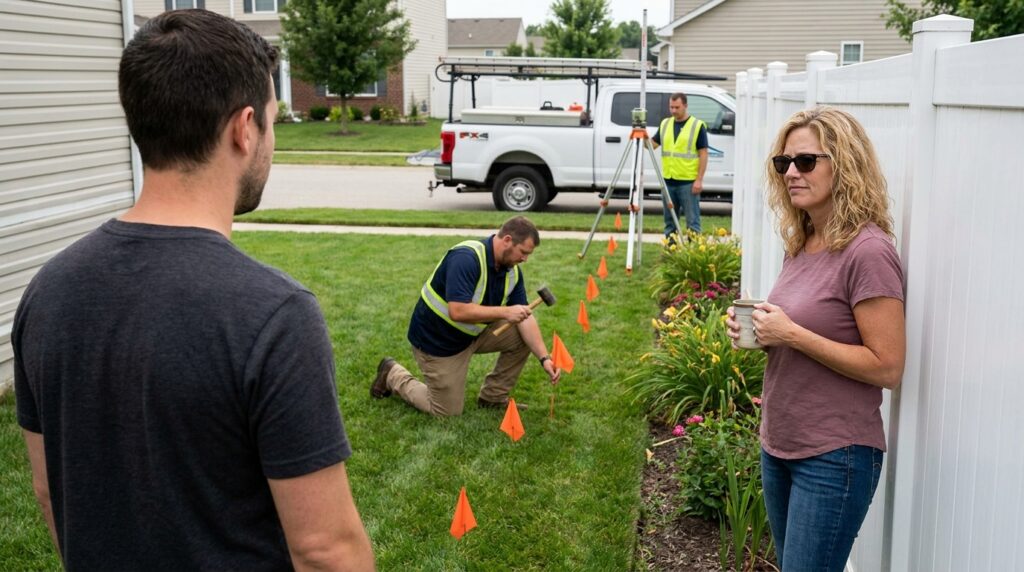
A shadow crossed the kitchen window. The glare from the afternoon sun caught the top edge of Brenda’s sunglasses as she walked down the gravel path between our houses, her phone pressed tight to her ear. She was gesturing sharply with her free hand, her fingers curled tightly around the handle of that same ceramic mug, her mouth moving in rapid, silent jerks. She wasn’t just calling the board; she was building the perimeter.
I reached down and touched the rusted survey pin I had pulled from the flower bed earlier, now resting on the edge of the kitchen table. The iron was flaking, leaving small, red-brown scales on the white laminate. It felt cold, heavy, and entirely indifferent to the fifteen years of history Brenda had manufactured to cover her tracks. I folded the 1994 agreement, slid it into the pocket of my charcoal T-shirt, and walked back toward the front door. The real work hadn’t even started yet, and the asphalt outside was already beginning to radiate the stored heat of the day.