CHAPTER 4: THE ARRIVAL OF THE IRON
The low, heavy rumble of a diesel engine vibrating through the floorboards woke me five minutes before my alarm went off. I didn’t lie in bed. I pulled on a pair of work boots, their leather stiff and unyielding from the dry air, and walked to the window. The sky was the color of a wet slate shingle, a cold gray that offered no real light, just a desaturated exposure of the cul-de-sac.
A white Ford F-250 utility truck sat idling at the curb, its yellow warning lights rotating silently, casting rhythmic amber strobes across the front of Brenda’s house. Mounted to the truck’s bed was a heavy steel gear rack holding iron pipes, wooden grade stakes, and long reels of steel measuring chains. The exhaust smelled of unburnt fuel and sulfur, a thick vapor that hung close to the parched grass.
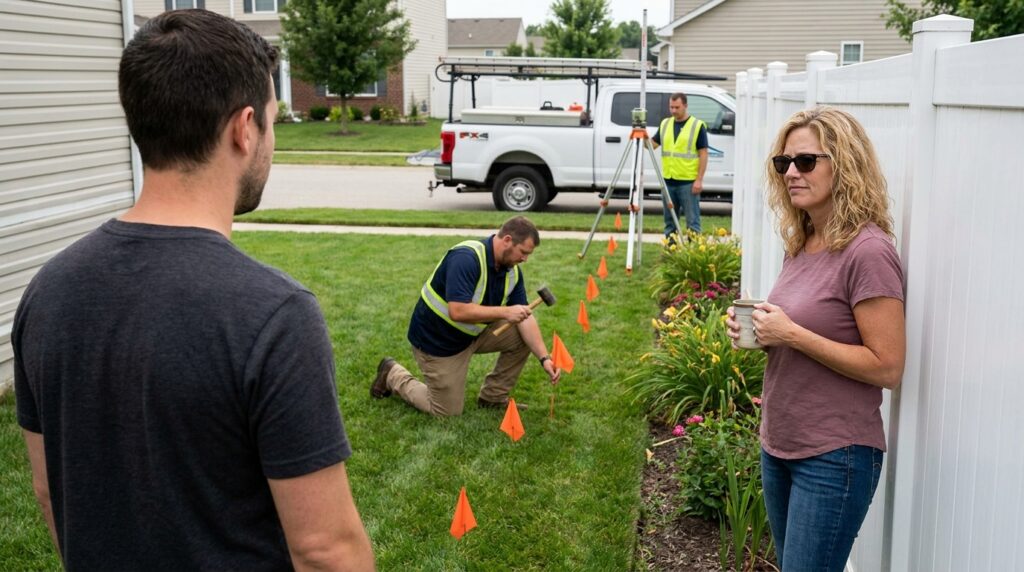
I stepped onto the porch just as the truck’s doors slammed shut. Two men in high-visibility neon vests stepped into the cool air. The lead surveyor, a man with short graying hair and a jawline that looked like it had been carved out of an oak block, didn’t check his phone or look at the houses. He unlatched the truck’s tailgate with a sharp, heavy clack, pulled out a heavy yellow plastic case containing a mechanical transit, and swung a wooden tripod over his shoulder.
“Adam?” he asked, his voice a low, rough rasp that sounded like gravel sliding down a chute. He didn’t wait for a nod; his eyes were already scanning the curb line, looking for the brass county benchmarks embedded in the concrete.
“Yeah. The line is on the east side, next to the vinyl fence,” I said, pointing toward the gap where the asphalt ended and the dry dirt began.
The assistant, a younger man with a thick dark beard and work pants stained with dried red mud, was already dragging a steel link chain down the gutter line. The metal links rattled against the concrete, a cold, rhythmic sound that brought a window shade up across the street. A second later, the front door of Brenda’s house clicked open.
She didn’t come out in a bathrobe. She was fully dressed in the same mauve long-sleeve top and dark jeans from the day before, her dark sunglasses already hiding her eyes despite the lack of direct sun. She carried her ceramic mug like an official piece of documentation, her steps deliberate as she marched down her driveway toward the truck.
“You’re blocking my driveway access,” she said, her voice sharp enough to cut through the idle of the diesel engine. She didn’t look at me; she went straight for the lead surveyor, who was currently leveling the tripod legs on the curb. “This is a private subdivision road. You don’t have a permit from the association to park commercial equipment here.”
The lead surveyor didn’t lift his head from the bubble level on the instrument frame. He adjusted a small brass screw with his thumb, his movements clinical, completely detached from her proximity. “County land court authorization order, ma’am. We’re tracking the primary benchmark for Block Four. If you have an obstruction complaint, you can call the sheriff’s dispatcher. They have our crew log on the dashboard.”
Brenda’s posture went rigid, her fingers clamping tightly around the porcelain handle. The amber strobe from the truck flashed across her glasses, revealing a quick flare of her nostrils. “I know the board president, Arthur Vance. He issued a structural freeze notice on this perimeter yesterday. You’re tampering with a disputed grading line.”
“We don’t look at grading lines, ma’am,” the surveyor said, his tone as flat and unyielding as an iron plat sheet. He reached into his vest pocket, pulled out a heavy steel plumb bob suspended by a braided nylon cord, and let it drop until the pointed tip hung exactly one millimeter above a chipped cross-mark in the concrete curb. “We look at the math. If the math says your fence is on the dirt, the fence is on the dirt. Move your vehicle if it’s within six feet of the transit path.”
Behind her, Arthur Vance’s front door opened, his starched shirt a white beacon against the desaturated gray of his porch. The neighborhood was waking up to the sound of iron chains clashing against the gutter, and the cold, mechanical indifference of the crew was already turning the cul-de-sac into a courtroom.
I stood on the bottom step of my porch, my hands deep in my pockets, watching the assistant drive the first steel locator pin into the edge of the access lane with a heavy three-pound mallet. The iron rang true—a sharp, high-pitched ping that echoed off the white vinyl panels of Brenda’s fence. The legal clock had started ticking, and the iron plats weren’t going to look at Brenda’s fifteen years of authority; they were going to look at the cold, hard geometry of the earth.