
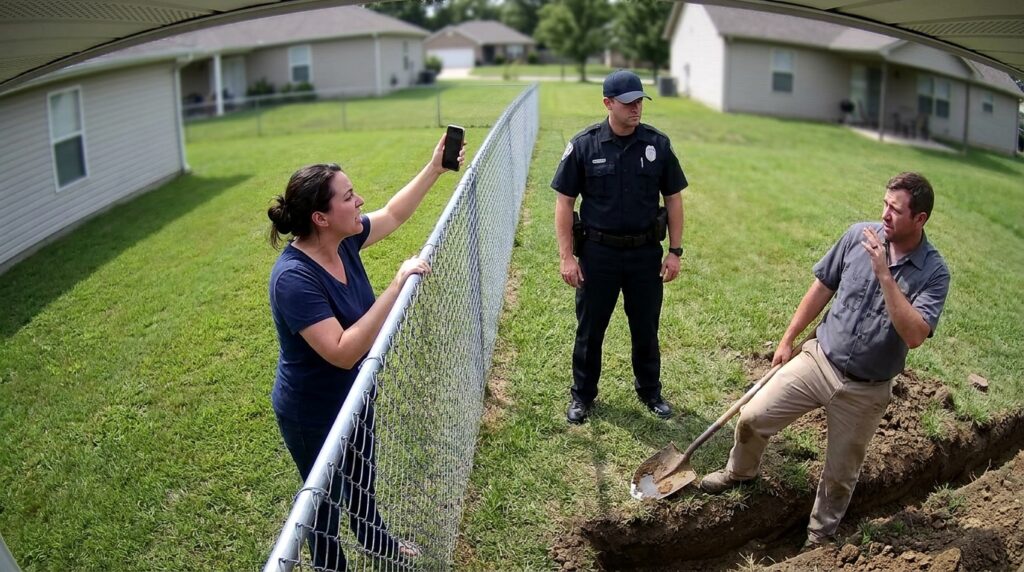
CHAPTER 6: THE STAMP IN THE SHADOWS
The back door crashed against the house siding, a sharp wooden crack that made a pair of sparrows burst out of the overgrown boxwood hedge. Brenda marched back down the porch steps, her sneakers cutting track marks through the wet lawn. In her left hand, she gripped a heavy, yellowed manila folder, clutching it to her chest as if protecting it from the fine mist that was turning into a steady, cold drizzle.
“Here it is,” she panted, her voice tight, triumphant, and strained as she skidded to a halt on her side of the fence. “I told you. My father didn’t lie. He kept every receipt, every survey, every scrap of paper.”
She pulled a single sheet of heavy bond paper from the folder. The edges were browned and brittle with thirty years of age, folded into crisp thirds that groaned as she snapped it open against the chain-link wire.
Officer Miller stepped up to the mesh, his dark uniform cap shedding rain droplets onto his shoulders. He reached his gloved hand through the diamonds of the wire, taking the paper by its edge. I stepped in beside him, my boots sinking half an inch into the softening clay at the trench wall.
“Read it, Jim,” Brenda demanded, her phone still raised in her other hand, recording Miller’s face. “Nineteen ninety-four. Signed by my father, Thomas Miller, and Arthur Henderson. They explicitly agreed to establish the fence boundary six inches north of the original plat line to preserve the silver maple root structure and prevent soil erosion between the lots.”
Miller held the paper flat against his clipboard to shield it from the rain. I leaned over his shoulder, my eyes scanning the faded typewriter font. The signatures were there—dark blue ink, heavy pressure on the strokes. Beside Arthur Henderson’s signature was a hand-drawn sketch, identical to the red grease pencil crosshatch on the schematic in my own folder.
It was real. It was a genuine, executed neighbor agreement from 1994. The decoy secret stood bare in the gray daylight: a private pact born of good intentions, preserved in a fireproof safe for three decades.
“It’s signed,” Officer Miller acknowledged, his voice quiet, steady, and analytical. He turned the paper over.
On the back of the sheet, tucked into the bottom left corner, was a faint, purple-ink rectangle.
“Look at the seal, Officer,” I said, pointing a muddy fingernail at the smudged lettering inside the purple box.
Miller squinted, his thumb wiping a drop of rainwater off the paper’s plastic sleeve. The stamp read: WAKE COUNTY REGISTER OF DEEDS – RECEIVED FOR FILING NOV 12 1995. But right across the center of the purple rectangle, two thick lines of red grease pencil had been drawn in a bold, crosswise X. Beneath it, in tiny, hurried cursive, was a clerk’s note: REJECTED – INCOMPLETE LEGAL DESCRIPTION. DEED AMENDMENT REQUIRED. NOT RECORDED.
The air went still between us, save for the patter of raindrops hitting the galvanized fence rail.
“What does that mean?” Brenda demanded, her voice losing its sharp edge, her eyes darting between Miller’s face and the back of the paper. “What are you looking at?”
Officer Miller raised his head slowly. The neutral, professional mask of a veteran patrolman remained firmly in place, but his tone carried a cold, unshakeable finality.
“Ms. Miller,” Miller said, handing the paper back through the chain-link mesh. “Your father brought this agreement to the county courthouse in November of ninety-five. The Registrar of Deeds rejected the filing because it wasn’t drafted as a formal deed amendment with a certified legal description. It was never recorded.”
“No,” she whispered, her fingers crumpling the edge of the yellowed paper. “No, he paid the fee. He told me it was settled!”
“He might have thought it was, or he might have intended to fix the filing and never got around to it,” I said softly, stepping closer to the fence. “But without that county seal, Brenda, this piece of paper is just a thirty-year-old promise between two men who don’t own the lot anymore. The legal boundary remains where the county set it—at the brass pin buried six inches on your side of the wire.”
Brenda’s phone lowered until the screen pointed straight down into the mud. Her chest heaved under her navy shirt, her face pale against the dark background of her wet lawn. The weight of thirty years of false certainty collapsed in a single second, crushed not by shouting or fists, but by two lines of red grease pencil on the back of an unrecorded page.
Officer Miller clicked his pen shut and slid his notebook into his breast pocket.
“Ms. Miller,” Miller said firmly, looking her straight in the eye. “Mr. Vance is operating under a valid municipal permit on a legally established setback. Not only is his work fully compliant, but according to the official county monuments, this entire run of chain-link fence sits six inches inside Mr. Henderson’s property line. It constitutes an unpermitted encroachment.”
Brenda stood frozen, the rain dripping from the ends of her dark hair, unable to utter a single word.








