
CHAPTER 3: THE CALL ON MAPLE STREET
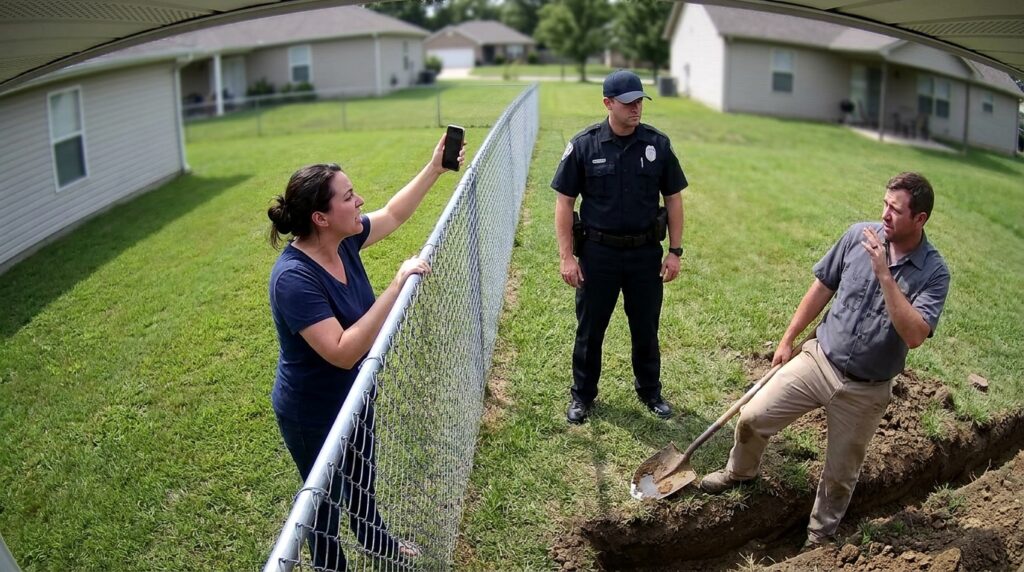
The siren cut out two streets over, leaving behind a sudden, heavy quiet. The air smelled of damp earth and ozone, the sky above the neighborhood shifting from hazy morning grey to the bruised purple of an advancing summer storm front. Across the fence, Brenda didn’t relax her grip on the smartphone. If anything, the silence made her lean further into the rail, her chest pressed against the wire until the galvanized diamonds left indented red lines across her navy T-shirt.
“He’s turning the corner now,” she said, her voice dropping into a tight, rhythmic cadence. “You still have time to take your shovels and go, mister. Once he steps into this yard, it’s off my hands.”
I didn’t answer. I reached down to the pocket of my canvas work vest and pulled out my digital level and a roll of high-visibility orange marking tape. If this was going to be an official record, I needed every measurement locked down before the first drop of rain turned the trench into mud. I snapped the level onto the steel spine of my spade, checking the angle of the cut.
“You’re real proud of that little tool belt, aren’t you?” Brenda mocked, her phone tracking my hands as I wrapped a strip of orange vinyl around a wooden locator stake and drove it twelve inches back from the trench line. “You think having a piece of tape makes you legitimate. My husband paid eight thousand dollars to have this yard graded ten years ago. We put in the retaining wall, we put in the drainage bed along the garage, and we maintained this fence line. You don’t just walk in with a spade and tell people where their property ends.”
“I’m not telling you where it ends, Brenda,” I said, my thumb scraping against the coarse edge of the surveyor’s tape. “The county surveyor told both of us forty years ago when they drove the pins.”
“County papers don’t account for real life!” she snapped, her knuckles turning grey against the plastic casing of her phone. “My father lived in this house until the day he died. He sat right there on that back porch with old man Henderson back in ninety-four. They drank iced tea, they walked this exact boundary, and they agreed on where the fence went. They signed a piece of paper, put it in the safe, and that was that. You don’t get to erase thirty years of history because you have a job ticket.”
I caught the detail as it landed. A piece of paper in a safe. The red grease pencil mark on Henderson’s old schematic—the strange, hand-drawn crosshatch near the rear boundary—suddenly aligned with her words. It wasn’t an official revision; it was an informal marker for a private deal made between two men over thirty years ago.
“Did your father file that paper with the Register of Deeds?” I asked, looking her dead in the eye.
Her mouth tightened into a hard, thin seam. Her shoulders twitched upward, a micro-reaction that told me everything her phone camera was trying to hide.
“It didn’t need to be filed,” she said, her voice hardening. “It was an agreement between neighbors. Respectable people don’t go running to the courthouse every time they set a fence post.”
“Respectable people do if they want the fence to stay legal when the property changes hands,” I said softly.
Before she could spit back an answer, the heavy crunch of gravel signaled the arrival of a vehicle in the front driveway. A white-and-blue municipal cruiser pulled onto the shoulder of Maple Street, its engine idling with a low, mechanical thrum that vibrated through the damp soil beneath my boots. Through the narrow gap between the houses, I saw the driver’s door swing open.
Brenda didn’t wait. She turned away from the fence line, stepping around her wilted hydrangeas, her posture straightening instantly as she called out over the gate.
“Over here, Officer Miller! In the back! He’s still digging!”
I didn’t chase her to the gate. I stayed right where I was, grounded in the clay beside my trench. I reached into the shallow hole I’d cleared at the base of the middle post, using the edge of my trowel to scrape away another half-inch of packed soil. Beneath the rust-flaked iron pin I’d found earlier, my steel blade scraped against something else—something solid, metallic, and flat.
It wasn’t a root, and it wasn’t a stone. It was a secondary surveyor’s marker: a heavy steel spike notched on four sides, capped with a tarnished brass tag buried three inches below the dirt level. Someone had buried it deep on purpose, hiding the true monument line right under the sod.
I wiped the grit off the top of the brass cap with my thumb, revealing the faint, stamped numbers of an official county survey registration.
The front gate unlatched with a sharp metallic clatter, and heavy boot heels began crunching down the concrete walkway toward the backyard.








