CHAPTER 2: THE COLD ARCHIVE OF THE DIRT
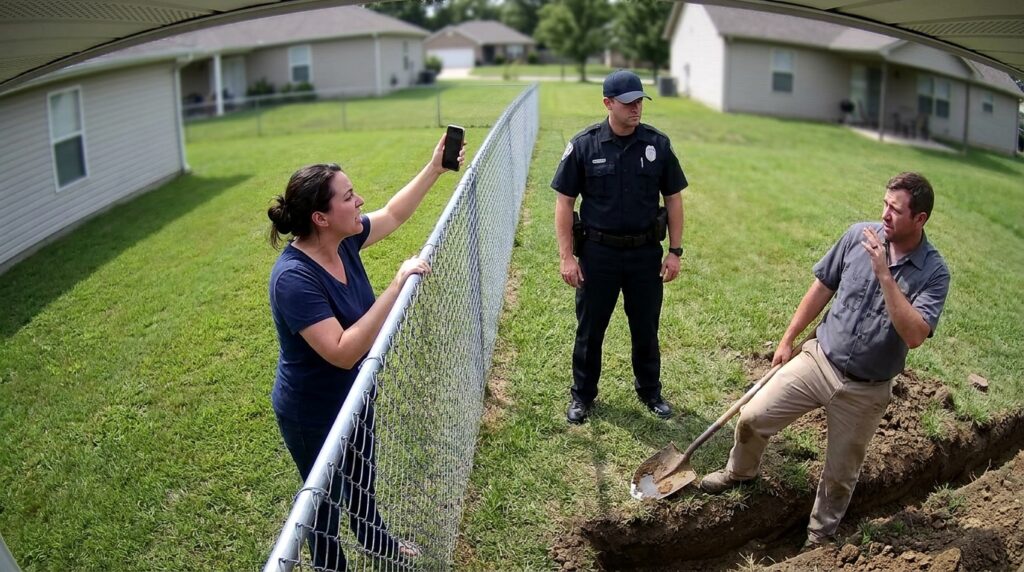
The click of Brenda’s smartphone screen hung in the humid air like a snapped dry branch. She didn’t drop her phone. She held it steady at chest height, her thumb hovering over the screen, her dark eyes tracking my hands as I knelt on the sun-baked clay.
Across the fence line, her breathing came short and shallow, rattling in her chest. She wanted a retreat. She wanted me to toss my spade into the back of the Ford, slam the tailgate, and leave her master of this six-foot strip of weeds. Instead, I pressed the pad of my left thumb into the dirt, feeling the sharp, jagged corner of iron buried beneath the dead sod.
“You’re making a mistake, mister,” she said, her voice dropping out of the shrieking register into something colder, laced with the bitter confidence of a woman who had the city’s authority on speed dial. “They’re five minutes away. When the squad car turns onto Maple, you’ll be on the pavement in handcuffs.”
I didn’t look up at her. Looking at her gave her leverage; it made it a duel of tempers, and temper was a luxury I couldn’t afford on a fifty-dollar-an-hour utility contract. Three years ago, over in Guilford County, an home-owner named Gable had claimed I cut his primary fiber line on purpose out of spite. He’d yelled just like Brenda, made his calls, and by the time the state board finished their audit, six months of my life and eight thousand dollars in legal retainers were gone. The board cleared me, but the stain on a license doesn’t wash out with a letter of exoneration. You learn to record everything. You learn that the earth is the only witness that doesn’t lie under oath.
“I’m not leaving the site, Brenda,” I said, my thumb tracing the rough, pitted top of the square iron stake. It was encrusted with rust, flakes of ancient orange paint clinging to the corners like dried lichen. “The permit is taped to the driver’s side window of my truck. The job order is logged with the county public works desk. If I pull off this job now, Mr. Henderson’s foundation takes four hundred gallons of runoff by six o’clock tonight.”
“Mr. Henderson is eighty-two years old and doesn’t know what day of the week it is!” she snapped, her knuckles turning white around the casing of her phone. “You took advantage of an old man who can’t read a plot plan!”
“He read it fine,” I said.
I pulled my yellow work clipboard out from the leather pouch on my hip. The plastic sleeve was smudged with grease and clay, but inside lay the blueprint copy I’d pulled from the register office at seven this morning. Tucked behind the blue line drawings was a faded document I’d found in Henderson’s kitchen folder—a photocopy of an old property survey from 1994. Across the top margin, someone had drawn a faint, jagged line in red grease pencil, making a small crosshatch pattern near the rear boundary. I hadn’t made sense of that mark when I checked in at dawn, but holding the clipboard against my knee now, the pattern mirrored the exact curve of Brenda’s sagging chain-link fence.
“Look at the fence, Brenda,” I said, keeping my tone flat, stripped of anger.
“I know what my fence looks like!”
“Look at the posts,” I insisted, standing up slowly. The joint in my right knee popped, a dull ache radiating down my calf. I pointed a dirt-stained finger down the line toward the rear property corner where an overgrown wild rose bush choked the wire mesh. “Your posts aren’t set in poured concrete footings. They’re driven straight into the soft topsoil on five-foot centers. Someone pushed this line out thirty years ago to save a row of silver maples that died before I was born.”
She stiffened, her chin jerking up. For a fraction of a second, something shifted behind her eyes—a flicker of calculation, the sharp, cold recognition of a name or a date she hadn’t expected me to know. She pulled her phone back half an inch, her arms drawing in close against her navy shirt.
“My father put that fence up in ninety-two,” she said, her voice tight, transactional. “He built it with the previous owner. They had a written understanding.”
A written understanding. The phrase hung between us, heavy and stale. In the world of suburban real estate, a “written understanding” tucked away in a shoe box meant nothing against a recorded deed, but the confidence in her voice wasn’t performance anymore. She believed it. She believed her father’s hand on a piece of paper carried the weight of law.
“An agreement doesn’t change the plat unless it’s filed with the clerk, Brenda,” I said softly.
“It’s filed where it needs to be,” she spat, her defensive posture snapping back like a compressed spring. “You think you’re smart because you carry a clipboard? You’re a hired hand digging a ditch. You don’t know this neighborhood, you don’t know this land, and you certainly don’t know who you’re dealing with.”
From two blocks over, the faint, wailing rise of a municipal siren broke through the humid stillness. It was high-pitched, warbling—the sound of a city unit navigating the morning school zone traffic on Oak Street.
Brenda smiled then. It wasn’t a pleasant sight; it was the sharp, narrow grimace of a trap springing shut.
“That’s Officer Miller,” she said, resting her forearm on the top rail of the chain-link wire, the rusted mesh biting into her skin. “He lives four doors down on the corner. He knows who lives here, and he knows who doesn’t.”
I didn’t move toward my truck. I didn’t reach for my keys. I stepped back to the edge of my trench, picked up my square spade by the ash handle, and wiped a smudge of damp clay off the steel face with my sleeve.
“Good,” I said, looking down at the red pencil mark on the old survey sheet tucked under my thumb. “Let’s see what Officer Miller thinks about the iron in the dirt.”