
CHAPTER 4: THE MONUMENT IN THE CLAY
The latch clicked open with a harsh, ungreased snap that echoed down the alley between the houses. Heavy leather boots crunched over the gravel pathway, slow and deliberate, the measured tread of a patrol officer who had walked this exact block a thousand times.
I didn’t rise immediately. I stayed on one knee in the soft, dark soil, my fingers cupped around the tarnished brass cap I’d unburied beneath the rust. The stamped numbers—NC-SR-8842—were cut clean into the metal, still sharp under thirty years of packed mud. I pulled a small, stiff-bristled wire brush from my vest pocket and made two firm passes across the brass face, clearing away the fine silt until the county seal caught the gray storm light filtering through the trees.
“Mark Vance?”
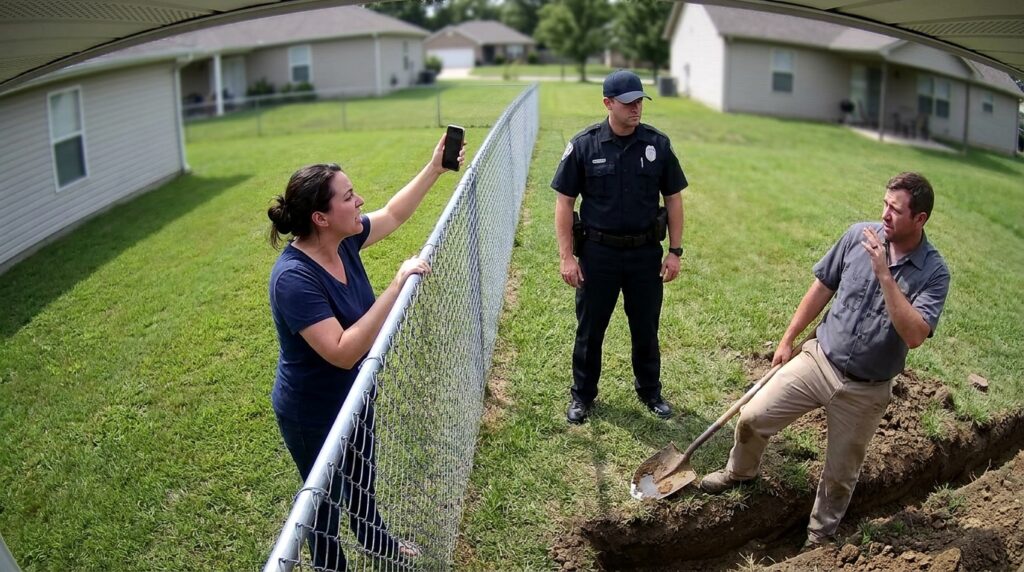
The voice was even, mid-thirties, flat with the neutral weight of someone used to settling arguments over loud music and property lines. Officer Miller stopped five feet back, his dark uniform immaculate, his duty belt squeaking faintly as he shifted his weight. His cap shadowed his eyes, but his gaze swept the scene with practiced efficiency: the straight cut of the six-inch trench, the spade resting upright in the soil, my yellow clipboard lying open on the dry canvas sheet, and Brenda standing four feet behind him on her side of the chain-link, her smartphone still held at chest level like a raised shield.
“Officer,” I said, rising smoothly to my feet. I wiped my clay-stained palms against the sides of my work pants, keeping my hands low, open, and still. “Appreciate you coming out.”
“He’s destroying my foundation, Jim!” Brenda interjected, stepping up until the chain-link wire groaned against her navy shirt. She pointed her phone screen toward Miller’s face, her voice tight with urgent escalation. “I called dispatch fifteen minutes ago. He refused to stop digging, he’s piling contaminated runoff dirt against my property line, and he’s completely ignoring the boundary agreement my family has had on this lot since nineteen ninety-four!”
Officer Miller didn’t look at her phone. He didn’t raise his voice. He kept his eyes on me, his boots planted firmly in the grass on Mr. Henderson’s side of the property line.
“Mr. Vance,” Miller said, nodding once toward the trench. “Let’s start with the basics. Are you performing work under a municipal permit?”
“Yes, sir,” I said, stepping back two paces to give him a clear view of the work zone. I pointed toward my truck parked at the curb. “Public Works Permit number 409-B, pulled yesterday morning at seven-fifteen. It’s taped to the driver’s side wing window. I’m installing a standard three-inch perforated PVC drain line to pull standing water off Mr. Henderson’s rear foundation wall and route it down to the municipal storm sewer at the street.”
“And the digging?” Miller asked, his eyes dropping to the straight, spade-width channel. “Is any part of this trench or your equipment crossing the fence line?”
“Not an inch,” I replied. “The trench is set six inches off the wire mesh. Every shovelful of dirt has been placed on Mr. Henderson’s side of the line.”
“That fence is the line!” Brenda shouted, her voice rising an octave as she jabbed a finger toward the galvanized top rail. “Jim, you know this neighborhood! My father built that fence thirty years ago with old man Henderson! They sat at the kitchen table, they mapped out the boundary, and they put the fence right where it belonged. He has no right to come in here with a shovel and re-interpret where my yard begins!”
Officer Miller turned his head slowly toward Brenda. He didn’t argue, but the posture of his shoulders remained strict, neutral, and unmovable.
“Ms. Miller,” he said, his tone measured. “If there’s an easement or a private boundary dispute, that’s ultimately a civil matter for the county magistrate. My job right now is to ensure there’s no active trespass, no damage to public infrastructure, and no breach of the peace.”
“It’s not a civil matter when a stranger digs up my property!” she insisted, her knuckles turning bone-white around her phone. “I have the agreement in my house! My father kept it in the fireproof safe in the study! A signed, written agreement shifting the line six inches north to protect the old maple roots! I can go get it right now!”
There it was. Layer one unlocked, spoken aloud in front of law enforcement. A thirty-year-old handwritten document, tucked away in an iron box, born from a neighborly compromise that had long outlived the trees it was meant to save.
I didn’t interrupt her. I stepped back toward the middle fence post, reached down with my trowel, and pointed at the gleaming brass cap I had just brushed clean.
“Officer,” I said quietly, “before Ms. Miller goes inside to look for her paper, I think you should look at the ground.”
Miller stepped forward, his heavy boots coming to a stop right at the edge of the trench. He leaned down, his dark cap tipping forward as his eyes locked onto the exposed brass tag embedded in the hard clay.
“That’s a county surveyor’s monument pin,” I said, my voice steady against the rising wind. “Stamped NC-SR-8842. It marks the official, registered property corner between Lot 12 and Lot 13. And as you can see, officer, that brass pin sits six inches inside Brenda’s fence line.”
Miller squinted, his fingers resting casually on his duty belt as he evaluated the line between the brass tag and the galvanized post above it.
Brenda went dead silent behind the fence, her phone slowly dropping two inches from her chest.








