
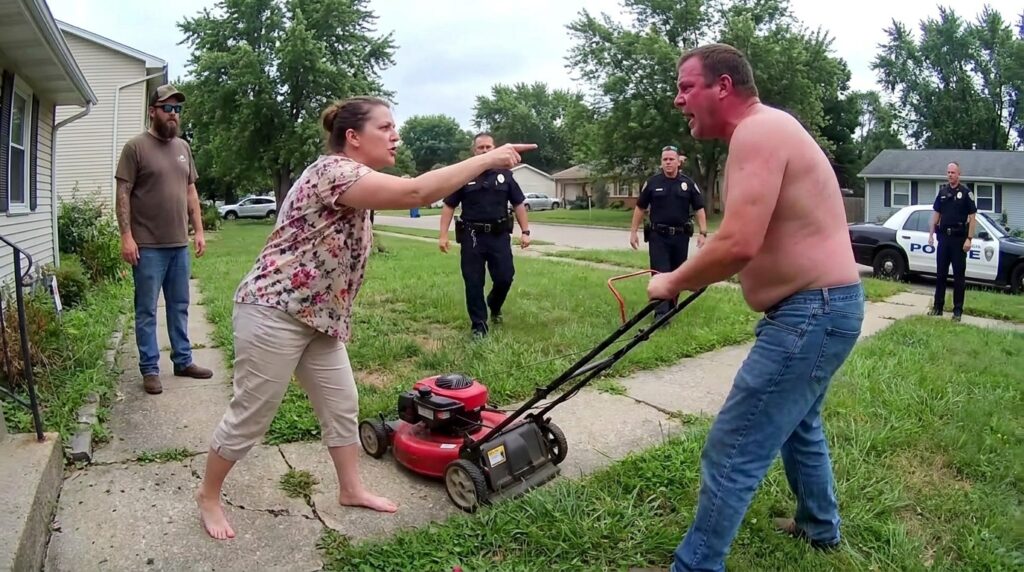
CHAPTER 3: THE DEFIANT BOUNDARY
Officer Davis moved with the slow, deliberate economy of someone who had spent a decade breaking up domestic border wars. Her heavy utility belt creaked, a rhythmic, mechanical protest against the afternoon heat as she stepped between Sarah and the front wheel of the red mower. Her hand didn’t leave the top of her security holster, but her fingers relaxed slightly, tapping a steady, flat cadence against the textured polymer.
“Sir, take your hands off the equipment and step back toward the driveway,” Davis said. Her voice didn’t rise above the level of the dry turf, yet it carried an institutional frost that made Gary’s chest stop heaving for a fraction of a second.
Gary didn’t drop his grip. Instead, his forearms locked harder, the thick tendons shifting beneath the dust and dried clover cuttings clinging to his skin. “This is a civil matter, Officer. I’m abating a public nuisance. This property line runs five inches deep on my side according to the original 1960 plat. I’ve got the iron pins to prove it.”
“I don’t care about the pins right now,” Officer Miller interrupted from the right margin. He didn’t approach Gary from the front. He moved laterally, his heavy boots crushing a patch of Sarah’s unclipped dandelions with a dull, wet snap. He positioned his bulk between Gary and the concrete path where Mark was watching. “Right now, you’re operating an engine over a resident’s bare feet. Step back.”
Sarah didn’t move her heels. She remained anchored to the buried concrete block, her toes curling into the dirt to keep from shaking. The heat from the mower’s muffler was a physical pressure against her skin, thick with the oily stench of unburned fuel. “He’s been doing this for three weeks,” she said, her voice tight, dry, and direct. “Notes on the mailbox. Chemical spray on the hydrangeas. Now he’s crossing the line when I’m not home.”
“I’m maintaining the neighborhood,” Gary barked, his eyes tracking Miller’s lateral movement. A sharp line of sweat ran through the grime on his temple, dropping onto the faded red metal deck of the machine. “Her father knew the real numbers. He’s the one who shifted the pins back in ninety-six when the county put the sidewalk in. He stole five inches from my family’s old acreage to clear her garage footprint, and I’m taking it back.”
Sarah’s gaze flicked from Gary’s flushed face down to the ground beneath the mower deck. Right where the uncut grass met the clipped, yellowed blades on Gary’s side, a small patch of earth had been freshly disturbed—scuffed away by a heavy boot. Beneath the loose dirt, something dull and metallic glinted in the harsh sun. It wasn’t the brass tag on the engine. It was the top of a square iron stake, ancient, pitted with rust, and buried far deeper than the modern survey markers the city used.
“Gary,” Officer Miller said, his tone dropping an octave into a low, transactional growl. He stepped directly into Gary’s peripheral vision, his right hand rising to hover near the buckle of his tactical vest. “I’m not going to ask you a third time. Leave the mower where it sits. Step back onto the concrete.”
The tension in the yard became a physical weight, thick as the humidity rising from the cracked drainage ditch at the curb. Mark shifted his weight on the porch path, his sunglasses catching the white glare of the sun as he tilted his head toward the buried iron stake. He knew what was under there. Everyone on the block knew that the old surveys were a mess of ink smudges and hand-drawn lines from before the township had even been incorporated.
Gary’s jaw worked, the muscle along his throat twisting into a hard knot. He looked at Sarah, then down at the phone she still held against her hip. His left hand slowly uncurled from the rubber handle, the skin raw, white, and creased from the pressure of the grip. But his right hand remained fixed on the metal crossbar near the oil cap, his thumb resting right next to the small brass tag with the county serial number.
“You think you won something because you called the city?” Gary whispered, his voice thin and dry as paper. He didn’t look at the officers. He looked straight through Sarah, his eyes reflecting a strange, cold certainty that made her bare feet feel even colder against the earth. “Your father left a map in those crates, Sarah. The real one. The one before the county re-platted the whole south side to cover the water main error. Ask yourself why he never registered the deed update before he died.”
Officer Davis didn’t wait for Sarah to answer. She stepped into the gap, her shoulder checking the line of sight between them, her leather gear brushing against the tall grass as she forced Sarah back toward the porch steps.
“Ma’am, let us handle the separation,” Davis said, her eyes already tracking the way Gary’s boots were shifting against the old iron pin. “Go sit on the porch. We’re going to run the names and check the call history.”
Sarah didn’t retreat. She stayed exactly where she was, her heart knocking against her ribs like a trapped bird, her eyes fixed on the small, rusted square of iron sticking out of her dirt. The world had shrunk down to the space between two yards, and the earth underneath them was starting to feel hollow.








