CHAPTER 2: THE ANCHOR AT THE CURB
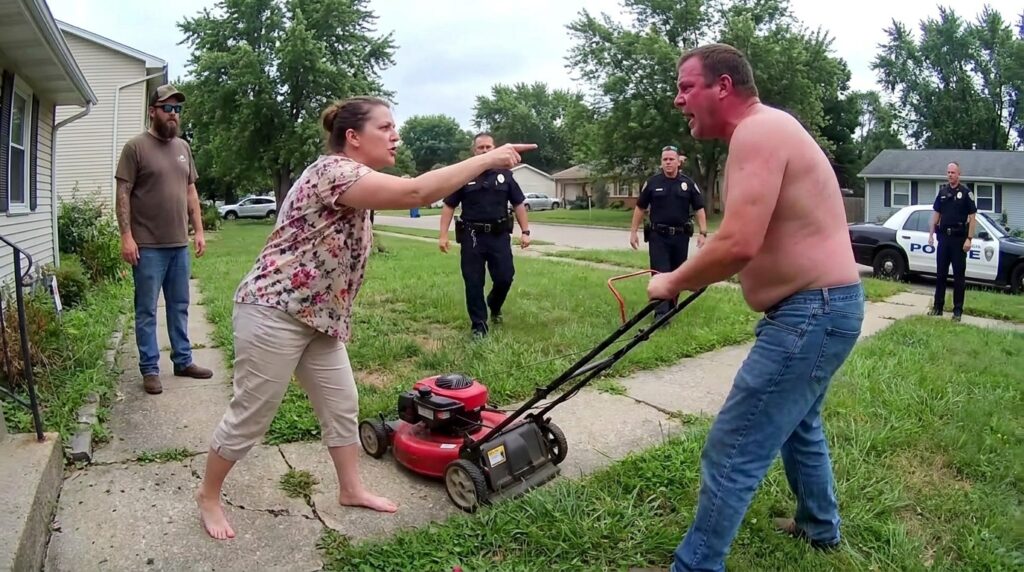
“Suspect is active on the property line, refusing to vacate, operating machinery near my feet,” Sarah said into the receiver. Her words came out flat, stripped of the panic she actually felt, replaced by the hard, transactional clarity of someone documenting a breach. She didn’t look at her phone. Her eyes remained anchored to the jagged silver scar on the mower’s side panel, where the red paint had bubbled away to expose the deep iron pitting beneath. The small brass tag, dull with age and green grease, seemed to grow larger in the humid glare.
“Ma’am, is he threatening you with the equipment?” the dispatcher’s voice crackled through the speaker, thin and tinny against the heavy, mechanical silence of the yard.
“He’s not moving,” Sarah replied, her voice dropping into a register that felt like gravel shifting under a boot. “And neither am I.”
Gary didn’t take his hands off the rubber grip. He let the dead weight of the mower rest between them, the metal deck vibrating slightly as his weight shifted on the uneven turf. A slow, greasy film of sweat tore through the green clippings on his chest, tracing the thick line of his collarbone. He looked down at the phone in her hand, then back up at her face, his jaw working a small, dry piece of tobacco against his back teeth.
“You’re making a mistake, Sarah,” Gary said. The casual arrogance in his tone had vanished, replaced by a cold, structural calculation that made his chest tighten. “You think you’re calling the city to protect your grass? You don’t even know where the iron pins are buried. You don’t know what happens when they actually bring the transit out here.”
“I know whose name is on the deed,” she said, her fingers tightening around the plastic casing of her phone until the glass creaked. She could smell the sulfurous tang of chemical weed killer drifting from the fence line—a sharp, artificial burn that sat on the back of her throat. It was the same smell she’d found near her hydrangeas two mornings ago, a gray, withered patch of rot that Gary had claimed was just fungus.
Mark hadn’t shifted an inch on the concrete path. His sunglasses reflected the desaturated green of the lawn, twin black mirrors that refused to offer an opinion. But his presence was an anchor of a different kind—the block was recording this, calculating the social cost of every inch Gary claimed.
The sound of the first siren didn’t rise from the distance; it cut in suddenly from two blocks over, the sharp, rhythmic yelp of a city cruiser hitting the intersection at Croyden Lane. The sound bounced off the aluminum siding of Sarah’s garage, loud and metallic.
Gary’s shoulders hardened. His eyes flicked toward the cracked asphalt of the curb, where the shadow of the telephone pole stretched long and thin across the gravel. For a second, just one micro-second, his fingers slackened on the mower handle. Sarah saw the skin underneath—white, unweathered, and marked by three distinct, circular scars across the knuckles, the kind left by old hydraulic line snaps. He wasn’t just a neighbor holding a grudge; he was a man holding onto a specific piece of machinery with the desperate, white-knuckled intensity of a thief who had just recognized the owner.
“The old man told me about your father,” Gary said, his voice dropping below the rising whine of the approaching engine. He didn’t look back at the street. He kept his face aligned with hers, his breath smelling faintly of stale coffee and hot zinc. “He told me how the county handled the 1996 re-platting. He said some people kept what wasn’t theirs because the clerks were too lazy to dig through the iron vaults.”
Sarah felt a cold drop of sweat trace the ridge of her spine. Her father hadn’t been a surveyor; he’d been a draftsman for the county extension office, a man who spent forty years rolling up linen maps and filing them in the basement boxes under the courthouse. When he died, the only things he left behind in the garage were three heavy wooden crates labeled Zoning Miscellany that she’d never had the heart to pry open.
The black-and-white cruiser nose-dived as it hit the driveway incline, the front bumper scraping against the concrete lip with a harsh, unyielding screech. The doors didn’t slam; they clicked open with the heavy, pressurized thud of modern fleet steel.
Sarah didn’t step back. Her bare heels were pressed against a buried chunk of concrete—the remnants of an old fence post Gary had insisted was five inches over his line three summers ago. The grit of the dry earth between her toes felt real, heavy, and completely unyielding.
“Step away from the equipment,” a voice called from the curb. It was a woman’s voice, crisp and formal, but carried the weight of leather gear and iron plating. Officer Davis was already moving down the margin of the yard, her boots making a dry, rhythmic crunch-crunch in the dead clover, her hand resting naturally against the top of her holster. Behind her, the larger frame of Officer Miller emerged from the driver’s side, his eyes scanning the hands, the handle, and the rusted tag near the oil cap.
Gary didn’t drop his hands. He just leaned back, his heels digging into his own side of the line, his chest rising as he prepared to lay out his version of the truth to the city.