
CHAPTER 6: ACCOUNTABILITY AND RESTITUTION
The heat radiating off the asphalt felt thick enough to touch, but on the lawn of Number Fourteen, no one moved.
Officer Miller took two steps across the grass, his boots stopping right beside the exposed brass cap embedded in the concrete. He reached down to his duty belt, unclipped a stiff leather clipboard, and flipped open a carbon-copy pad of bright yellow municipal citations. The sharp, mechanical click of his ballpoint pen extending sounded like a latch dropping shut.
“Brenda Vance,” Officer Miller said, his voice carrying flat and unhurried across the cul-de-sac. “I am issuing you a formal criminal summons for Intentional Damage to Private Property, Criminal Mischief, and Trespassing.”
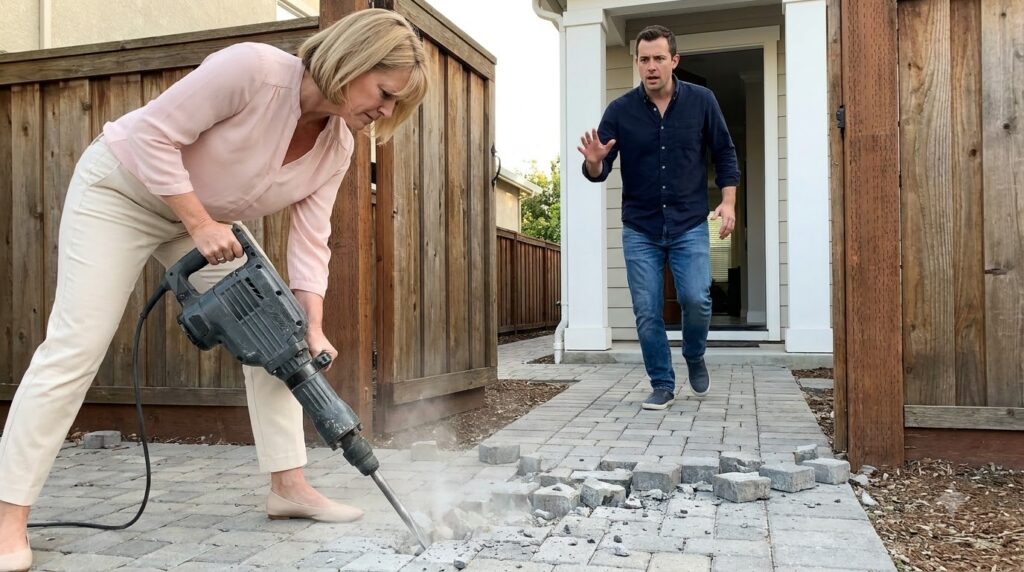
Brenda stood perfectly still in her pale pink blouse, her hands trembling slightly as she clutched the yellowed 1984 committee binder against her chest. Her mature, angular face had turned a pale, chalky gray. For three years, her authority had rested on the silence of her neighbors and the weight of official-sounding words. Now, standing on the grass she had spray-painted under the cover of darkness, surrounded by the people she had coerced, that authority vanished into the hot afternoon air.
“I… I was protecting community drainage,” Brenda whispered, her voice cracking, stripped of its practiced polish. “This is a administrative error…”
“There is no error, Mrs. Vance,” Inspector Vance interrupted, his voice rasping like coarse sandpaper as he rolled up the Mylar plat and slid it back into his leather case. “I am issuing a stop-work order and a three-thousand-dollar township citation for operating unlicensed heavy equipment on a private residential lot. In addition, county record office archives will be notified of your unauthorized removal of certified boundary pins.”
Officer Miller tore the top yellow carbon copy from his clipboard with a loud, crisp rip. He held the paper out toward her.
Brenda looked at the paper, then at Mark, then at the circle of neighbors watching from across the street. Greg Henderson stood with his arms crossed, his face set in a hard, quiet line of quiet vindication. Beside him, Sarah and Mrs. Jenkins watched as Brenda’s hand slowly reached out, her fingers taking the yellow ticket.
“Mr. Miller,” Officer Miller said, turning his head toward Mark. “You’ll receive a copy of this incident report by tomorrow morning. You have full legal standing to submit a complete contractor invoice for the full restoration of your walkway to the municipal court. Mrs. Vance will be ordered by a judge to cover every cent of the repairs.”
Mark stepped forward, stopping at the edge of the fractured stone where the demolition hammer had bitten into his hard work. He looked at Brenda, his eyes calm, unblinking, and entirely devoid of malice or excitement.
“The hired crew isn’t touching these pavers, Brenda,” Mark said, his voice quiet and steady against the vast silence of Maple Court. “A certified, licensed masonry contractor starts work on Monday morning. And the bill goes straight to your mailbox.”
Brenda didn’t answer. She clutched the yellow carbon copy in her right hand, her chin dipping low as she turned toward her driveway. The hired laborer who had accompanied her quickly pushed his flatbed wheelbarrow down the street toward his truck, the iron wheels rattling against the asphalt as he hurried to leave the lot.
Without looking back, Brenda walked up her front porch steps, her leather shoes clicking softly on the concrete before her front door shut behind her with a dull, final thud.
Inspector Vance strapped the heavy brass locator rod into its leather holster and extended his hand toward Mark. “Good work holding your ground, Mr. Miller. Most folks just give in when people start throwing old paperwork around.”
“I work with surveys for a living, Inspector,” Mark said, shaking the older man’s hand firmly. “The brass pins don’t lie.”
“No, they don’t,” Vance agreed with a brief nod. “They stay right where they’re buried.”
The county truck and the police cruiser pulled away from the curb, their tires crunching softly over the loose gravel at the edge of the asphalt. As the vehicles turned the corner and disappeared from the cul-de-sac, the heavy tension that had hung over Maple Court for three years seemed to lift with the warm breeze.
Greg Henderson walked across the street, stopping at the edge of Mark’s lawn. He looked down at the broken stone, then at the bright brass pin gleaming in the open soil by the hedge.
“Looks like the walkway’s going to turn out real nice, Mark,” Greg said, his voice carrying a warmth that hadn’t been there that morning.
Mark looked down at the site of the confrontation—the gray pavers that would soon be replaced, the clean line of his lot, and the solid ground beneath his boots.
“It will, Greg,” Mark replied, stepping back onto his porch threshold as the quiet afternoon settled over Number Fourteen. “It’s built on solid ground.”








