
CHAPTER 1: THE DUST ON THE THRESHOLD
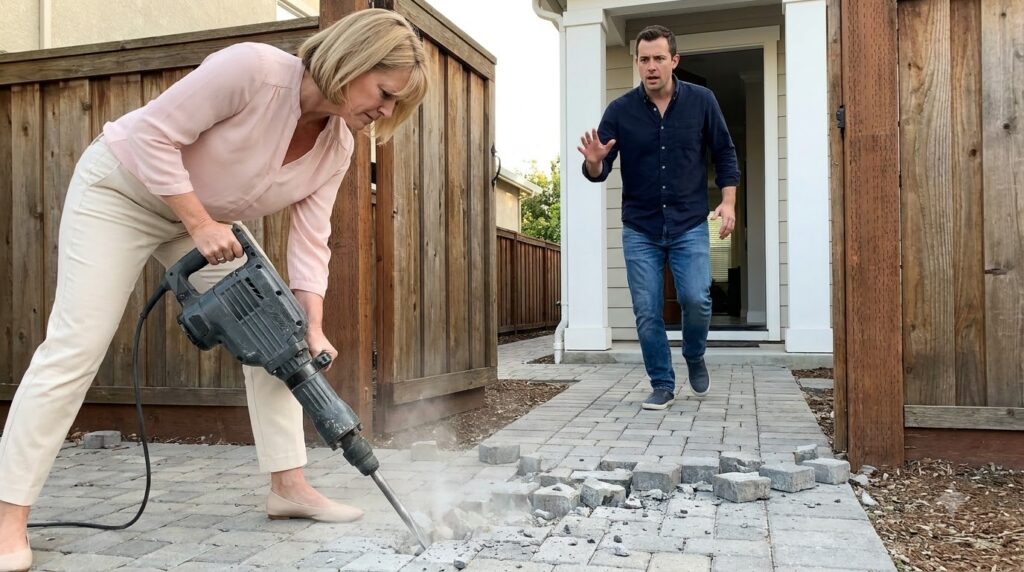
The steel bit hit the gray interlocking stone with a flat, deafening crack that rattled the leaded glass inside the door frame.
Mark Miller didn’t drop his mug, but the dark surface of the coffee shivered, sending a tiny ripple against the ceramic rim. It wasn’t the distant throttle of a contractor’s wood chipper or the smooth, steady hum of a riding mower. It was the heavy, rhythmic thud of a powered demolition hammer driving straight down into solid masonry, four feet from his front door.
He set the mug on the oak counter and pulled the oak door inward.
The morning air smelled of crushed limestone, dry topsoil, and hot machine grease. In the left foreground of his entry courtyard, framed by the open dark-stained wooden side gate she had pushed past, stood Brenda Vance. Her pale pink blouse was already dusted with white powder around the cuffs. Her cream trousers were stiff, her posture locked as she leaned her full body weight over the handles of a heavy, gray-black electric breaker tool. The vertical chisel bit deep into the seam between two gray pavers Mark had hand-fitted three weekends ago, jumping violently as chips of masonry flew across the green turf.
Mark stepped over the threshold, his work boots catching on the top riser. He kept his hands open, raised chest-high, taking four fast strides down the porch steps toward the edge of the walk.
“Stop! What are you doing to my front walk?”
The words cut through the mechanical racket, sharp and clipped.
Brenda didn’t flinch. She let her thumb slip off the rubber trigger throttle. The high-pitched whine of the electric motor died down into a low, metallic idle before cutting out entirely. The silence that followed was heavy, filled only with the faint drift of masonry dust settling over the light leather of her loafers.
She didn’t drop the tool. She didn’t step back from the cracked stone. Slowly, her shoulder-length blonde hair settling over her collar, she straightened her spine, her mature, angular face tightening into an expression of cold, unbothered ownership. She looked at his navy work shirt, his jeans, and the white dust coating his boot toes, then held his gaze with flat eyes.
“I know exactly what I’m doing,” she said.
The tone was smooth, deliberate, and entirely stripped of urgency—the voice of a person who believed the ground beneath her feet belonged to whoever spoke loudest.
“You’re destroying private property, Brenda,” Mark said, his voice dropping an octave, steadying as his internal instincts as a civil drafter kicked in. He didn’t reach for the tool. He didn’t push forward into her physical space. “Turn that machine off, get off my lot, and step back onto the street.”
Brenda let out a short, dry breath that was almost a laugh. She adjusted her grip on the rubber handles, her hands steady, her manicured nails clean despite the flying gravel. “This walk sits inside the township’s secondary drainage easement, Mark. You laid these pavers without an approved Aesthetic Impact Clearance from the block committee. As chair, I am abating an illegal runoff obstruction before the next rain cycle.”
Mark looked down at the four feet of fractured stone between them. The pavers were cracked down the center line, gray gravel spilling into the grass where the edge restraint had been ripped away. Beneath the dust, tucked under the lip of the turf three feet to her left, sat the cold, unyielding edge of a brass surveyor’s pin he had inspected himself before laying the first base of crushed stone.
“There is no easement on this side of the house,” Mark said quietly, his eyes fixing on hers. “The township drainage right-of-way ends ten feet behind my rear fence line. I hold the certified 2021 county survey, and my building permit was stamped three weeks ago.”
Brenda’s jaw tightened, a thin, tight smile touching her lips that failed to reach her eyes. She pointed one finger toward the open wooden gate behind her. “Permits are municipal paperwork, Mark. They don’t override community standards or block authority. You have four hours to haul these broken pavers off the lane, or I’ll bring a commercial crew in to clear the site and attach the labor cost directly to your property tax assessment.”
She released her grip on the heavy tool, leaving the gray-black demolition hammer standing upright, its chisel wedged tight into the cracked paver seam. Without another word, she turned, brushed a speck of white dust from her pink blouse, and walked out through the side gate, the dark wood latch dropping shut behind her with a dull, final click.
Mark stood alone on the threshold. The silence of Maple Court felt unnaturally thin. He didn’t run after her down the driveway. Instead, he reached into his pocket, pulled out his phone, and raised the lens toward the silent machine wedged into his ruined walkway, his thumb tapping the screen as he began calculating the exact physical cost of her overreach.
As he shifted his camera angle to capture the chisel jammed into the stone, his eye caught a thin, unnaturally clean strip of dark earth near the hedge where his pink survey flags used to stand—and the fresh smear of orange contractor paint running parallel to his foundation.








