
CHAPTER 3: THE PATTERN OF NEIGHBORHOOD BULLYING
The ignition turned, the diesel engine of Mark’s pickup coming to life with a low, heavy thrum that vibrated through the steering wheel. He shifted into reverse, backing out of his driveway slowly, his eyes sweeping the quiet cul-de-sac.
Across the street, Greg Henderson stood motionless beside his running hose, his shoulders slouched in a posture that had belonged to the entire neighborhood for three years. Mark pulled forward toward the mouth of Maple Court, passing Number Twelve—the Jenkins house.
He slowed down as he passed their front yard. The grass there was lush, green, and completely uniform, but near the property line, the retaining wall had a strange, slightly mismatched section of stone. Two years ago, when the Jenkinses were visiting their daughter in Florida, Brenda had brought a skid-steer and three laborers into their yard, tearing down twenty feet of dry-stack wall under the claim of “emergency drainage clearance.” The invoice she had mailed them—drawn up on counterfeit Maple Court Architectural Review Committee letterhead—had forced an elderly couple to dip into their savings to pay her nephew’s landscaping LLC two thousand dollars just to stop a lien from being filed against their title.
Mark shifted into second gear and pulled onto the county road heading toward the municipal complex.
The heat of the morning sun was rising off the asphalt, creating a shimmering distortion over the hood of his truck. He knew how Brenda operated. She didn’t rely on state statutes or recorded county deeds. She relied on a thick, yellowed leatherette binder she carried to every bi-annual neighborhood meeting—a binder filled with mimeographed 1984 developer layout maps, hand-annotated in faded blue ink by long-retired board members. She used those forty-year-old drafts as if they were holy scripture, dropping words like non-conforming setback, unapproved easement, and administrative assessment until homeowners gave up out of sheer exhaustion.
Twenty minutes later, Mark turned into the shaded gravel parking lot behind the Municipal Land Records Office.
The building was a low-slung red brick structure built in the 1970s, smelling faintly of old paper, floor wax, and dry air conditioning. Mark carried his blue document tube under his arm as he pushed through the glass double doors into the public records hall.
Behind the high oak counter sat Sarah Henderson—Greg’s younger sister, who had worked as a county record clerk for fifteen years. She looked up as the door chime sounded, her expression shifting from routine boredom to sudden alertness when she saw Mark’s face and the blue tube in his grip.
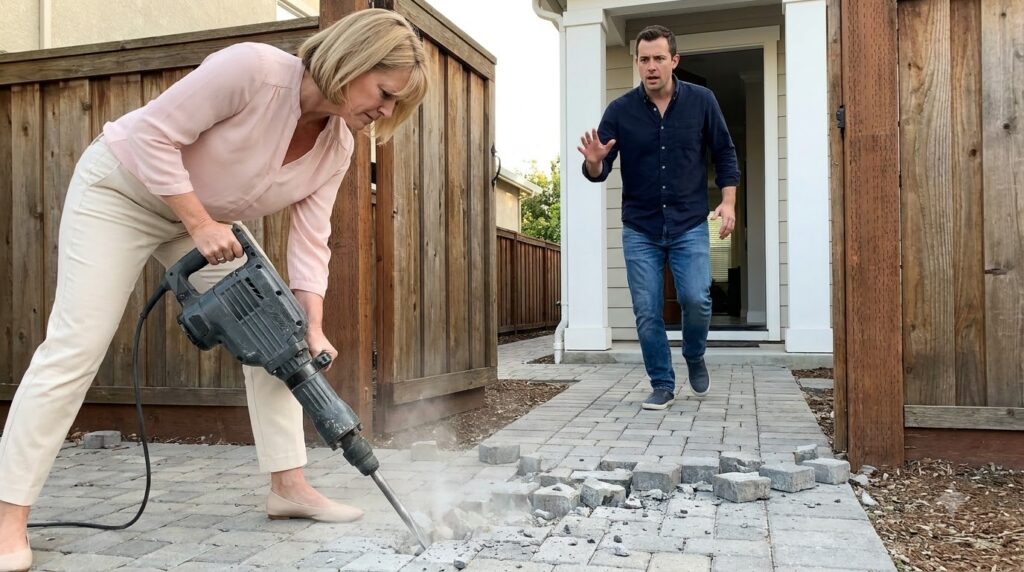
“Mark,” she said, leaning over the counter, her voice dropping into a hush that echoed softly in the tall room. “Greg called my cell two minutes ago. He told me she brought a jackhammer to your front yard.”
“She brought an electric breaker tool,” Mark corrected, setting the document tube on the polished oak counter. “She broke four feet of interlocking pavers and threatened to bring a commercial crew to clear the lot within four hours.”
Sarah closed the heavy ledger sitting in front of her with a dull thud. “She’s been using that 1984 developer binder on the whole street for five years, Mark. When her brother was on the zoning board, nobody dared check the master archives because he’d just stall their permits or send building inspectors out for minor roof shingles. She thinks those old paper drafts give her legal easement rights over every yard between Number Eight and Number Twenty.”
“She showed up at midnight last night,” Mark said quietly, unzipping the top of his document tube. “She pulled my survey stakes out of the ground and sprayed a fake line with contractor paint. I have it on infrared video.”
Sarah stared at him, her lips parting slightly. “She pulled certified survey stakes? On private ground?”
“I need the complete archive file for Lot 14, Sarah,” Mark said, his voice flat and precise. “Including the 1984 initial developer draft she keeps referencing, and the official 2021 county resurvey plat.”
Sarah didn’t hesitate. She stepped away from the counter and walked into the high-density rolling record stacks behind her desk. The heavy metal shelves groaned as she spun the hand-wheel, opening a narrow aisle into the historical land files.
Mark stood at the counter, his fingers resting on the smooth wood.
Five minutes later, Sarah returned carrying a thick, gray archival box labeled Tract 402 – Maple Court Sub-Division. She set it on the oak counter and lifted the lid, pulling out two distinct documents.
The first was a yellowed, fragile piece of drafting paper from 1984—the exact document Brenda kept in her leatherette binder. In the margin, written in faded blue ballpoint pen, was a hand-drawn hatch pattern labeled Proposed Secondary Storm Utility Corridor.
“There it is,” Sarah whispered, pointing to the blue ink. “That’s what she’s been using. When the original developer laid out the tract in ’84, they drafted a temporary drainage easement right across what is now your front walkway.”
Mark leaned in close, his trained eye scanning the fine lines of the draftsman’s grid. “Look at the seal, Sarah,” he said, pointing his finger at the bottom right corner.
The 1984 map bore only an unratified preliminary stamp—a draft layout that had never been submitted to the county registrar for final recording.
“Now pull the 2021 master plat,” Mark said.
Sarah slid the second document across the table—a crisp, polyester-film Mylar sheet stamped with the vibrant blue ink of the State Professional Engineer’s Seal, dated November 12, 2021.
Mark unrolled the sheet flat. The 2021 resurvey, executed when the township installed the new high-pressure water mains, showed every boundary with absolute clarity. The old 1984 proposed corridor was explicitly marked with a solid black line and three bold words: EASEMENT EXTINGUISHED BY COUNTY ORDINANCE 402-B.
The decoy authority Brenda had used to intimidate the cul-de-sac for three years was nothing more than an unratified paper draft that had been legally dead for over thirty months.
“She doesn’t just lack authority,” Mark said softly, his jaw locking as he looked at the stamped seal. “She’s committing criminal destruction of property on unencumbered private land.”
Behind Sarah, a heavy wooden door marked CHIEF CODE INSPECTOR swung open, and a tall man with short gray hair, wearing a khaki county uniform with an ironed crease down the sleeves, stepped out into the hallway.
Inspector Arthur Vance paused, his eyes falling on the Mylar plat unrolled on the counter and the blue document tube sitting beside it.
“What’s going on out here, Sarah?” Inspector Vance asked, his voice low and gravelly.
Sarah looked up from the Mylar sheet. “Inspector… you need to see what Brenda Vance just did at Lot 14.”








