
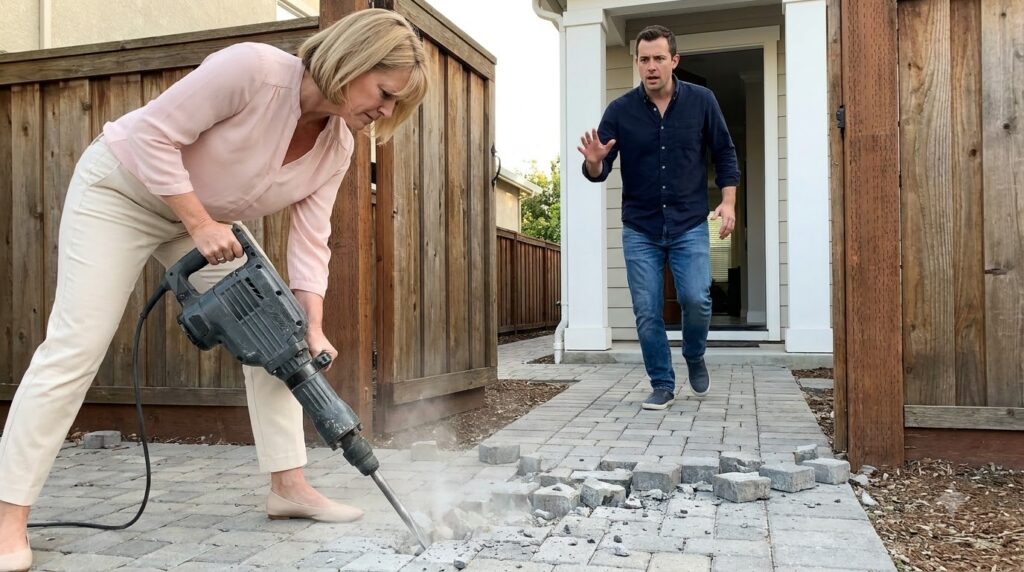
CHAPTER 5: THE ONSITE REVERSAL AT THE WALKWAY
At 1:28 PM, the sun sat high over Maple Court, beating down on the asphalt until the air vibrated with a dry, suffocating heat.
Mark stood on his porch steps, the blue cardboard document tube resting against his thigh. He watched a rusted, sun-faded pickup truck with wooden stake-sides turn into the cul-de-sac. It pulled up to his curb, blocking his driveway.
Out of the passenger side stepped Brenda Vance. She had swapped her loafers for stiff leather work shoes, though she still wore her pale pink blouse and cream trousers. Behind her, a young laborer in a dust-covered shirt clambered out of the bed, dragging a heavy flatbed wheelbarrow with rusty iron handles. The steel wheel hit the asphalt with a dull, echoing clank.
“Get the shovel,” Brenda instructed the laborer, her voice carrying sharply across the quiet street. She pointed her manicured finger toward the fractured pavers in Mark’s entryway courtyard. “Clear everything right down to the compacted dirt. Stack the broken pieces in the truck bed.”
Mark didn’t wait. He descended his porch steps, his work boots making no sound on the dry turf, and stepped directly into the walkway lane. He stood squarely between the hired laborer and the broken stone, his tall, broad-shouldered frame blocking the path to the gate.
“You don’t take a single stone off this lot,” Mark said, his voice quiet, flat, and absolute.
Brenda stopped short at the edge of the grass, adjusting her dark sunglasses with one hand while holding her yellowed committee binder tucked under her arm. “Move aside, Mark. I am exercising the committee’s right of site abatement before the afternoon storm front moves in. If you physically obstruct authorized maintenance, I will add a fifty-dollar-per-hour administrative delay fee to your bill.”
The young laborer paused three feet behind her, his hand resting uncertainly on the wooden handle of a flat-head shovel, his eyes darting between Brenda’s rigid posture and Mark’s immovable stance.
“He isn’t moving, Brenda,” a voice called out from across the street.
Greg Henderson was standing at the edge of his lawn, accompanied by his wife Sarah. Down the cul-de-sac, two more neighbors—Mrs. Jenkins and her son—stepped out onto their front porch, watching the standoff. The quiet pressure of the neighborhood was coalescing around the damaged walkway of Number Fourteen.
Brenda turned her head slightly, her jaw tightening as she saw the gathering witnesses. “This is private committee business!” she snapped toward Greg. “Return to your lot!”
“It isn’t committee business, Brenda,” Mark said, stepping forward one pace so that his boots rested on the exact edge of the fractured stone. “Because there is no committee. And there is no easement.”
“I have the 1984 developer layout right here!” Brenda shouted, slamming her hand against the vinyl cover of her binder. The sound cracked through the heat like a gunshot. “This drainage corridor was established forty years ago! You cannot erase community infrastructure with a town permit!”
Before Mark could reply, the low, twin-engine hum of a county vehicle sounded from the entrance of the cul-de-sac.
A white County Code Enforcement truck turned the corner, its yellow rooftop beacon flashing in silent, rhythmic pulses. Following directly behind its rear bumper was a marked local police cruiser, its white-and-blue paint reflecting the harsh sunlight.
The two vehicles pulled up to the curb, pinning Brenda’s stake-side truck between them.
The driver’s side door of the county truck swung open, and Inspector Arthur Vance stepped out into the road. He wore his khaki uniform hat, and in his right hand he carried the heavy, brass-tipped electronic surveying locator rod, its metal casing glinting in the sun. From the police cruiser stepped Officer Miller, his hand resting casually near his utility belt, his eyes sweeping the scene with practiced, objective focus.
Brenda’s posture stiffened instantly. A thin, artificial smile forced its way across her face as she took three brisk steps toward the curb, waving her yellowed binder.
“Inspector! Officer!” Brenda announced, elevating her voice for the benefit of the watching neighbors. “I am so glad you arrived. I called in an emergency easement obstruction earlier today. This resident constructed an unpermitted stone structure that threatens secondary stormwater drainage.”
Inspector Vance walked past her without slowing down. He didn’t look at her binder. He didn’t acknowledge her smile. He walked straight to the edge of Mark’s lawn, stopping right where the boxwood hedge met the turf.
“Mrs. Vance,” Vance said, his voice raspy and loud enough to reach every porch on Maple Court. “We didn’t come out here on your call. We came on Mr. Miller’s criminal complaint.”
Brenda’s smile froze. Her hand dropped slowly to her side. “His complaint? I am the block chair—”
“You are a private citizen,” Officer Miller interrupted, stepping up beside Vance, his notebook already open. “And according to the dispatch report, you operated heavy equipment on private property without a permit, a utility mark-out, or land title authority.”
“I operated on the township drainage easement!” Brenda insisted, her voice rising an octave, a sudden edge of panic straining her control. “It’s right here in the master layout!” She thrust the yellowed 1984 binder toward Vance’s chest.
Vance didn’t take the binder. He reached down, unzipped his own leather document case, and pulled out the crisp, polyester-film Mylar sheet—the official 2021 county resurvey plat bearing the bright blue state engineer’s seal.
Unrolling it flat across the hood of the police cruiser, Vance set two magnetic weights on the corners to keep the warm breeze from catching it.
“This is the official 2021 county resurvey plat, Mrs. Vance,” Vance announced clearly, pointing a thick index finger at the map. “This document was recorded with the county registrar thirty months ago. It explicitly extinguished the temporary 1984 developer draft you’re holding. There is no easement on Lot 14. There hasn’t been one for over two years.”
Brenda stared at the blue seal on the Mylar sheet, her throat working silently as her eyes scanned the bold black text. “No… no, that’s impossible. The developer map—”
“The developer map was an unratified preliminary sketch,” Vance stated flatly. “It carried zero legal authority. You have been using a dead piece of paper to intimidate this neighborhood.”
Vance turned away from the cruiser, raising the heavy brass locator rod in his right hand. He walked to the edge of the turf, three feet past Brenda’s spray-painted orange line, and set the brass tip against the dark soil near the hedge.
He flipped the toggle switch on the handle. A sharp, continuous electronic tone—BEEP-BEEP-BEEP-BEEP—shattered the silence of the cul-de-sac.
Vance reached into his belt pocket, pulled out a small steel trowel, and drove it into the sod. He scraped away two inches of loose topsoil and dry grass roots until the steel blade struck something hard with a heavy, metallic CLINK.
He brushed the dirt aside with his thumb. Embedded deep in a block of solid concrete was a gleaming, unmarred brass benchmark cap stamped with the official county seal and the serial number T-402-14.
“This is the official county benchmark pin,” Vance said, standing up and pointing down at the exposed brass. “It sits three feet outside Mr. Miller’s walkway. Which proves, beyond any shadow of a legal doubt, that every single paver he laid sits entirely on his private, unencumbered land.”
A sudden, audible sigh went through the neighbors watching from the curb. Greg Henderson crossed his arms over his chest, a long-suppressed smile breaking across his face.
Brenda stood motionless on the grass, her face drained of color, her eyes locked on the gleaming brass pin exposed in the dirt at her feet.








