
The Cold Brass Pin at the Boundary of Number Fourteen

CHAPTER 1: THE DUST ON THE THRESHOLD

The steel bit hit the gray interlocking stone with a flat, deafening crack that rattled the leaded glass inside the door frame.

Mark Miller didn’t drop his mug, but the dark surface of the coffee shivered, sending a tiny ripple against the ceramic rim. It wasn’t the distant throttle of a contractor’s wood chipper or the smooth, steady hum of a riding mower. It was the heavy, rhythmic thud of a powered demolition hammer driving straight down into solid masonry, four feet from his front door.

He set the mug on the oak counter and pulled the oak door inward.

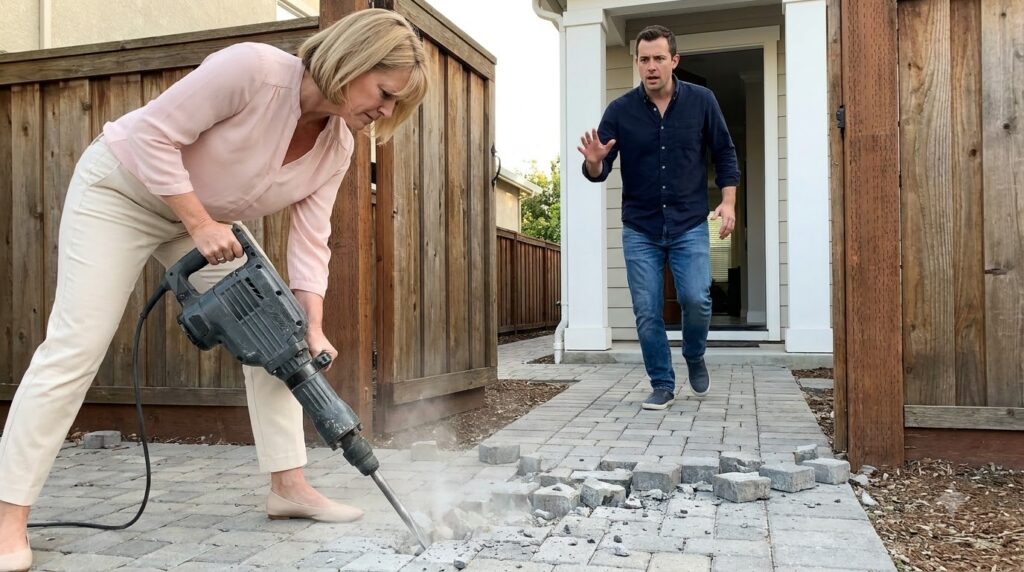
The morning air smelled of crushed limestone, dry topsoil, and hot machine grease. In the left foreground of his entry courtyard, framed by the open dark-stained wooden side gate she had pushed past, stood Brenda Vance. Her pale pink blouse was already dusted with white powder around the cuffs. Her cream trousers were stiff, her posture locked as she leaned her full body weight over the handles of a heavy, gray-black electric breaker tool. The vertical chisel bit deep into the seam between two gray pavers Mark had hand-fitted three weekends ago, jumping violently as chips of masonry flew across the green turf.

Mark stepped over the threshold, his work boots catching on the top riser. He kept his hands open, raised chest-high, taking four fast strides down the porch steps toward the edge of the walk.

“Stop! What are you doing to my front walk?”

The words cut through the mechanical racket, sharp and clipped.

Brenda didn’t flinch. She let her thumb slip off the rubber trigger throttle. The high-pitched whine of the electric motor died down into a low, metallic idle before cutting out entirely. The silence that followed was heavy, filled only with the faint drift of masonry dust settling over the light leather of her loafers.

She didn’t drop the tool. She didn’t step back from the cracked stone. Slowly, her shoulder-length blonde hair settling over her collar, she straightened her spine, her mature, angular face tightening into an expression of cold, unbothered ownership. She looked at his navy work shirt, his jeans, and the white dust coating his boot toes, then held his gaze with flat eyes.

“I know exactly what I’m doing,” she said.

The tone was smooth, deliberate, and entirely stripped of urgency—the voice of a person who believed the ground beneath her feet belonged to whoever spoke loudest.

“You’re destroying private property, Brenda,” Mark said, his voice dropping an octave, steadying as his internal instincts as a civil drafter kicked in. He didn’t reach for the tool. He didn’t push forward into her physical space. “Turn that machine off, get off my lot, and step back onto the street.”

Brenda let out a short, dry breath that was almost a laugh. She adjusted her grip on the rubber handles, her hands steady, her manicured nails clean despite the flying gravel. “This walk sits inside the township’s secondary drainage easement, Mark. You laid these pavers without an approved Aesthetic Impact Clearance from the block committee. As chair, I am abating an illegal runoff obstruction before the next rain cycle.”

Mark looked down at the four feet of fractured stone between them. The pavers were cracked down the center line, gray gravel spilling into the grass where the edge restraint had been ripped away. Beneath the dust, tucked under the lip of the turf three feet to her left, sat the cold, unyielding edge of a brass surveyor’s pin he had inspected himself before laying the first base of crushed stone.

“There is no easement on this side of the house,” Mark said quietly, his eyes fixing on hers. “The township drainage right-of-way ends ten feet behind my rear fence line. I hold the certified 2021 county survey, and my building permit was stamped three weeks ago.”

Brenda’s jaw tightened, a thin, tight smile touching her lips that failed to reach her eyes. She pointed one finger toward the open wooden gate behind her. “Permits are municipal paperwork, Mark. They don’t override community standards or block authority. You have four hours to haul these broken pavers off the lane, or I’ll bring a commercial crew in to clear the site and attach the labor cost directly to your property tax assessment.”

She released her grip on the heavy tool, leaving the gray-black demolition hammer standing upright, its chisel wedged tight into the cracked paver seam. Without another word, she turned, brushed a speck of white dust from her pink blouse, and walked out through the side gate, the dark wood latch dropping shut behind her with a dull, final click.

Mark stood alone on the threshold. The silence of Maple Court felt unnaturally thin. He didn’t run after her down the driveway. Instead, he reached into his pocket, pulled out his phone, and raised the lens toward the silent machine wedged into his ruined walkway, his thumb tapping the screen as he began calculating the exact physical cost of her overreach.

As he shifted his camera angle to capture the chisel jammed into the stone, his eye caught a thin, unnaturally clean strip of dark earth near the hedge where his pink survey flags used to stand—and the fresh smear of orange contractor paint running parallel to his foundation.

CHAPTER 2: THE MIDNIGHT TRAIL

The glass lens of the phone camera clicked in rapid succession, capturing the fractured edges of the interlocking stone. Concrete dust drifted into the grass, coating the roots of the turf in a fine gray chalk.

Mark knelt on one knee, his boot resting against the unbroken pavers at the edge of the courtyard. Up close, the damage was brutal. The demolition hammer’s chisel hadn’t just cracked the surface; it had driven four inches deep into the compacted crushed-stone base beneath, disturbing the drainage substrate he had leveled with a hand tamper over two scorching weekends in July.

He swung the camera lower, aiming at the side gate. The dark stained pine swung gently in the light breeze, its brass latch scratched where Brenda had forced it open.

Then he saw the line.

It ran two feet inward from his boxwood hedge, cutting directly across the manicured clover. A bright, glaring stripe of neon-orange contractor paint, freshly applied, the solvent smell still sharp enough to sting the nostrils. The grass blades where the paint clung were still wet to the touch.

Mark stood up slowly, the phone resting in his palm. Brenda had claimed she was abating a non-conforming structure during daylight hours, but neon marking paint didn’t dry in twenty minutes under a midday sun. The edges of the overspray were already stiff, dust from the morning demolition stuck to the dried enamel.

He turned toward his front step, walked inside, and let the heavy oak door latch shut behind him. The cool interior air of the hallway smelled faintly of stale coffee and cedar. He bypassed the kitchen, walked straight into his small home office off the living room, and woke the desktop computer.

The monitor flickered to life, illuminating rows of CAD drawings, municipal plat maps, and civil engineering schematics pinned to the corkboard above the desk. Mark opened the security portal for his high-definition doorbell camera, setting the playback filter to the previous twelve hours.

He scrubbed the timeline backward past sunrise, past the paperboy at 5:15 AM, into the dead-still hours of the night.

At 11:42 PM, the infrared sensor on the porch camera had triggered.

Mark zoomed in on the black-and-white feed. The frame showed the front walkway bathed in the soft glow of the streetlamp at the corner of Maple Court. A shadow moved into the frame from the right, stepping around the boxwood hedge with deliberate, careful footsteps.

It was Brenda.

She wasn’t wearing her pink blouse or tailored cream slacks. She wore a dark Windbreaker, the hood pulled low over her shoulder-length hair, and a pair of heavy gardening gloves. In her left hand, she carried a long, thin steel pry bar. In her right, an inverted aerosol can of surveyor’s marking paint.

Mark watched the screen in cold silence.

On the video, Brenda knelt at the property edge where Mark had driven two wooden survey stakes topped with bright pink surveyor’s ribbon a week before laying the first paver. She jammed the flat end of the pry bar under the base of the first wooden stake, leaned her weight into it, and popped the wood out of the soil with a sharp jerk. She didn’t throw it down. She picked up the stake, slipped it into the deep pocket of her jacket, and walked four paces toward the porch to yank the second stake.

Then, pulling the paint aerosol from her jacket, she shook the can—the faint clack-clack of the internal agitator ball picked up clearly by the microphone—and sprayed the straight neon line across Mark’s grass, shifting the visual boundary two feet closer to his porch foundation.

Mark paused the frame at 11:44 PM. Her face was turned directly toward the lens for a fraction of a second, her eyes narrowed in concentration, her lips pressed into a hard, triumphant line.

He didn’t yell. He didn’t slam his hand on the oak desk. The quiet, methodical rhythm of a man who worked with calipers and land surveys took over. He inserted a flash drive into the front port, exported the raw footage with its cryptographic timestamp intact, and saved the high-resolution still images into a dedicated folder titled Maple_Court_Lot14_Incident.

He printed three copies of the timestamped screenshots on the heavy laser printer beside his desk. The warm paper slid into the tray, showing Brenda in stark black-and-white, caught in the act of pulling legal markers on private land.

Mark picked up the papers, slipped them into a blue cardboard document tube alongside his stamped building permit, and walked out to his porch.

Across the asphalt of the cul-de-sac, his neighbor Greg Henderson was standing near his driveway, holding a garden hose with a green nozzle. Greg wasn’t washing his sedan; the stream of water was aimlessly hitting the same patch of gravel near his mailbox while his eyes stayed fixed on Mark’s front courtyard.

Mark locked his front door, tucked the blue document tube under his arm, and stepped down toward the street, crossing the warm pavement directly toward Greg’s driveway.

Greg saw him coming and immediately let go of the hose handle, the water dying down to a trickle in the gravel. He looked up and down the street toward Brenda’s shuttered two-story colonial before stepping closer to the property line, his face drawn tightly with hesitation.

“She used the jackhammer on it, didn’t she, Mark?” Greg asked, his voice dropping low, his knuckles resting against the top of his mailbox. “We heard the impact from our breakfast table. Sarah thought a tree branch fell on your roof.”

“She brought a breaker tool into my courtyard,” Mark said, stopping at the edge of the asphalt. “She shattered four feet of stone and gave me a four-hour ultimatum to haul the debris away.”

Greg let out a weary breath, shaking his head as he stared at the blue tube under Mark’s arm. “Mark… you gotta be careful with her. She did the exact same thing to the Jenkins family two years ago over their back patio. Claimed their retaining wall was blocking a secondary runoff channel. Brought a hired crew in while they were visiting their daughter in Florida, tore down twelve feet of stone, and billed them two grand for ’emergency site abatement.’ Nobody stopped her because her brother was sitting on the town zoning board back then.”

Mark adjusted the tube under his arm, his thumb tracing the smooth rim of the plastic cap. “Her brother stepped down last May, Greg.”

“Doesn’t matter to Brenda,” Greg insisted, his eyes darting back toward Brenda’s quiet house. “She still holds those old architectural committee binders from 1984. She thinks she owns the easement rights on every lot on this block.”

“The 1984 layout was a temporary developer draft,” Mark said, his tone flat, unyielding. “The county resurveyed this entire tract in 2021 when the township upgraded the water mains. There is no easement on my lot.”

Mark pulled one of the printed screenshots from the tube and held it out. Greg leaned in, his eyes widening as he recognized Brenda’s dark Windbreaker, the steel pry bar in her gloved hand, and the pink surveyor flag being pulled from the dirt under the midnight gloom.

“She pulled your pins?” Greg whispered, his voice cracking slightly.

“Last night at midnight,” Mark replied. “And she left her demolition tool on my grass. I’m heading downtown to the Land Records Office now.”

Greg looked at the paper, then back at Mark’s calm, unblinking face. The hesitation in the older man’s posture shifted into something harder. “Vance is the Chief Code Inspector downtown,” Greg offered, his voice dropping even lower. “Arthur Vance. He doesn’t like people faking township authority, Mark. Not one bit.”

“Good,” Mark said. “Because I’m not settling this over a porch railing.”

He folded the screenshot, slipped it back into the blue tube, and turned toward his truck parked along the curb, leaving Greg standing beside the running hose as the morning sun caught the glint of broken stone in the yard of Number Fourteen.

CHAPTER 3: THE PATTERN OF NEIGHBORHOOD BULLYING

The ignition turned, the diesel engine of Mark’s pickup coming to life with a low, heavy thrum that vibrated through the steering wheel. He shifted into reverse, backing out of his driveway slowly, his eyes sweeping the quiet cul-de-sac.

Across the street, Greg Henderson stood motionless beside his running hose, his shoulders slouched in a posture that had belonged to the entire neighborhood for three years. Mark pulled forward toward the mouth of Maple Court, passing Number Twelve—the Jenkins house.

He slowed down as he passed their front yard. The grass there was lush, green, and completely uniform, but near the property line, the retaining wall had a strange, slightly mismatched section of stone. Two years ago, when the Jenkinses were visiting their daughter in Florida, Brenda had brought a skid-steer and three laborers into their yard, tearing down twenty feet of dry-stack wall under the claim of “emergency drainage clearance.” The invoice she had mailed them—drawn up on counterfeit Maple Court Architectural Review Committee letterhead—had forced an elderly couple to dip into their savings to pay her nephew’s landscaping LLC two thousand dollars just to stop a lien from being filed against their title.

Mark shifted into second gear and pulled onto the county road heading toward the municipal complex.

The heat of the morning sun was rising off the asphalt, creating a shimmering distortion over the hood of his truck. He knew how Brenda operated. She didn’t rely on state statutes or recorded county deeds. She relied on a thick, yellowed leatherette binder she carried to every bi-annual neighborhood meeting—a binder filled with mimeographed 1984 developer layout maps, hand-annotated in faded blue ink by long-retired board members. She used those forty-year-old drafts as if they were holy scripture, dropping words like non-conforming setback, unapproved easement, and administrative assessment until homeowners gave up out of sheer exhaustion.

Twenty minutes later, Mark turned into the shaded gravel parking lot behind the Municipal Land Records Office.

The building was a low-slung red brick structure built in the 1970s, smelling faintly of old paper, floor wax, and dry air conditioning. Mark carried his blue document tube under his arm as he pushed through the glass double doors into the public records hall.

Behind the high oak counter sat Sarah Henderson—Greg’s younger sister, who had worked as a county record clerk for fifteen years. She looked up as the door chime sounded, her expression shifting from routine boredom to sudden alertness when she saw Mark’s face and the blue tube in his grip.

“Mark,” she said, leaning over the counter, her voice dropping into a hush that echoed softly in the tall room. “Greg called my cell two minutes ago. He told me she brought a jackhammer to your front yard.”

“She brought an electric breaker tool,” Mark corrected, setting the document tube on the polished oak counter. “She broke four feet of interlocking pavers and threatened to bring a commercial crew to clear the lot within four hours.”

Sarah closed the heavy ledger sitting in front of her with a dull thud. “She’s been using that 1984 developer binder on the whole street for five years, Mark. When her brother was on the zoning board, nobody dared check the master archives because he’d just stall their permits or send building inspectors out for minor roof shingles. She thinks those old paper drafts give her legal easement rights over every yard between Number Eight and Number Twenty.”

“She showed up at midnight last night,” Mark said quietly, unzipping the top of his document tube. “She pulled my survey stakes out of the ground and sprayed a fake line with contractor paint. I have it on infrared video.”

Sarah stared at him, her lips parting slightly. “She pulled certified survey stakes? On private ground?”

“I need the complete archive file for Lot 14, Sarah,” Mark said, his voice flat and precise. “Including the 1984 initial developer draft she keeps referencing, and the official 2021 county resurvey plat.”

Sarah didn’t hesitate. She stepped away from the counter and walked into the high-density rolling record stacks behind her desk. The heavy metal shelves groaned as she spun the hand-wheel, opening a narrow aisle into the historical land files.

Mark stood at the counter, his fingers resting on the smooth wood.

Five minutes later, Sarah returned carrying a thick, gray archival box labeled Tract 402 – Maple Court Sub-Division. She set it on the oak counter and lifted the lid, pulling out two distinct documents.

The first was a yellowed, fragile piece of drafting paper from 1984—the exact document Brenda kept in her leatherette binder. In the margin, written in faded blue ballpoint pen, was a hand-drawn hatch pattern labeled Proposed Secondary Storm Utility Corridor.

“There it is,” Sarah whispered, pointing to the blue ink. “That’s what she’s been using. When the original developer laid out the tract in ’84, they drafted a temporary drainage easement right across what is now your front walkway.”

Mark leaned in close, his trained eye scanning the fine lines of the draftsman’s grid. “Look at the seal, Sarah,” he said, pointing his finger at the bottom right corner.

The 1984 map bore only an unratified preliminary stamp—a draft layout that had never been submitted to the county registrar for final recording.

“Now pull the 2021 master plat,” Mark said.

Sarah slid the second document across the table—a crisp, polyester-film Mylar sheet stamped with the vibrant blue ink of the State Professional Engineer’s Seal, dated November 12, 2021.

Mark unrolled the sheet flat. The 2021 resurvey, executed when the township installed the new high-pressure water mains, showed every boundary with absolute clarity. The old 1984 proposed corridor was explicitly marked with a solid black line and three bold words: EASEMENT EXTINGUISHED BY COUNTY ORDINANCE 402-B.

The decoy authority Brenda had used to intimidate the cul-de-sac for three years was nothing more than an unratified paper draft that had been legally dead for over thirty months.

“She doesn’t just lack authority,” Mark said softly, his jaw locking as he looked at the stamped seal. “She’s committing criminal destruction of property on unencumbered private land.”

Behind Sarah, a heavy wooden door marked CHIEF CODE INSPECTOR swung open, and a tall man with short gray hair, wearing a khaki county uniform with an ironed crease down the sleeves, stepped out into the hallway.

Inspector Arthur Vance paused, his eyes falling on the Mylar plat unrolled on the counter and the blue document tube sitting beside it.

“What’s going on out here, Sarah?” Inspector Vance asked, his voice low and gravelly.

Sarah looked up from the Mylar sheet. “Inspector… you need to see what Brenda Vance just did at Lot 14.”

CHAPTER 4: SECURING COUNTY SANCTION

Inspector Arthur Vance didn’t move fast, but there was an unyielding weight to the way his boots struck the terrazzo floor. He stopped two feet from the oak counter, his gray eyes fixing first on the unrolled Mylar sheet, then on the blue document tube lying open beside it.

“I asked a question, Sarah,” Vance repeated, his voice a dry, rasping rumble. “What’s Brenda Vance up to now?”

Mark didn’t wait for Sarah to answer. He turned the Mylar sheet so the bottom right corner faced the Chief Inspector, placing his thumb right beside the blue state seal.

“She brought a powered demolition hammer onto my property at eight o’clock this morning,” Mark said, his voice level, stripped of any emotional tremor. “She broke four feet of interlocking stone walkway inside my front courtyard, claimed it violated a secondary drainage easement, and gave me four hours to haul the debris away.”

Vance’s gaze shifted from the map to Mark’s face. He didn’t blink. “Lot 14 on Maple Court?”

“Lot 14,” Mark confirmed. “I filed my municipal building permit three weeks ago. I hold the 2021 county resurvey. There is no easement on my parcel.”

Inspector Vance reached into his shirt pocket, pulled out a pair of silver-rimmed reading glasses, and slipped them over his ears. He bent over the counter, his broad hand flattening the edge of the Mylar plat. His index finger traced the black boundary line surrounding Mark’s lot, stopping directly over the bold text: EASEMENT EXTINGUISHED BY COUNTY ORDINANCE 402-B.

“She tried to cite the old ’84 draft,” Sarah added, sliding the yellowed 1984 paper toward Vance. “The one with the handwritten margin notes.”

Vance let out a short, harsh sound through his nose—a grunt of pure, professional contempt. He pushed the 1984 draft away with the tip of his finger as if it were a piece of contaminated trash.

“That unratified sketch has been dead for thirty months,” Vance growled, his eyes narrowing. “Her brother tried to use that same unrecorded draft to block a culvert installation back in ’19 before he was ousted. Brenda knows damn well that paper carries zero legal weight.”

“She didn’t just cite the paper, Inspector,” Mark said quietly.

He pulled his phone from his pocket, opened the video clip from 11:42 PM, and laid the screen flat on the oak counter between them.

Vance leaned down. The black-and-white infrared light illuminated his weathered face as he watched Brenda in her dark Windbreaker, pulling the wooden surveyor stakes from Mark’s turf, popping them out of the soil with a steel bar, and laying down a fresh coat of orange marking paint across private grass.

When the video finished, Vance stood up straight. The casual, administrative air about him vanished completely. His jaw set into a hard, dangerous angle, the muscles along his neck tightening.

“She’s removing certified boundary pins on private land,” Vance said, his voice dropping into a register that made the glass in the counter display hum faintly. “And then she used power equipment to destroy a permitted structure based on a fraudulent line she painted herself.”

“She told me she’s coming back at one-thirty with a commercial crew to clear the stone,” Mark said, checking his watch. The hands read 11:15 AM. “She promised to attach the removal invoice directly to my county tax assessment.”

Vance turned toward the inner office doorway, shouting over his shoulder without looking back. “Simmons! Get Officer Miller from dispatch on the radio right now. Tell him I need an escort to Tract 402 on Maple Court by thirteen-hundred hours.”

A distant voice answered from the back offices. Vance turned back to Mark, reaching for a heavy leather holster sitting on the corner of his desk that held a brass-tipped electronic surveying locator rod.

“Mr. Miller,” Vance said, unbuckling the leather strap of the locator. “Brenda Vance has spent three years treating this township like her personal feudal estate because people were too tired to fight her paperwork. She thinks she’s going to clear your lot with a hired crew today.”

“I intend to stop her,” Mark said.

“You’re not going to have to,” Vance replied, his hand gripping the brass handle of the locator rod. “I’m going to conduct a formal boundary audit right on your lawn at one-thirty. When I unearth the official brass benchmark pin in front of her crew, she’s going to realize that her little ’84 draft isn’t just useless—it’s a roadmap to a criminal indictment.”

Vance looked down at the video still sitting paused on Mark’s phone screen, his thumb brushing against his belt. “She thinks she knows where the boundary ends, Mr. Miller. But she forgot one detail about the 2021 resurvey.”

Mark looked at the Chief Inspector, noticing a sharp, calculated stillness in the older man’s posture. “What detail?”

Vance snapped the leather holster shut with a metallic clack. “She thinks the easement was just moved. She doesn’t realize it was extinguished because the township transferred the master drainage line straight through the county right-of-way under the street. Which means she isn’t just trespassing on your land—she’s attempting to alter a public boundary.”

Vance grabbed his hat from the peg behind the door. “Get back to your house, Mr. Miller. Be on your porch at one-twenty. And don’t touch a single piece of that broken stone until I get there.”

Mark picked up his blue document tube, locked eyes with Sarah behind the counter, and turned toward the glass double doors, his boots echoing sharply against the terrazzo as the countdown to one-thirty began.

CHAPTER 5: THE ONSITE REVERSAL AT THE WALKWAY

At 1:28 PM, the sun sat high over Maple Court, beating down on the asphalt until the air vibrated with a dry, suffocating heat.

Mark stood on his porch steps, the blue cardboard document tube resting against his thigh. He watched a rusted, sun-faded pickup truck with wooden stake-sides turn into the cul-de-sac. It pulled up to his curb, blocking his driveway.

Out of the passenger side stepped Brenda Vance. She had swapped her loafers for stiff leather work shoes, though she still wore her pale pink blouse and cream trousers. Behind her, a young laborer in a dust-covered shirt clambered out of the bed, dragging a heavy flatbed wheelbarrow with rusty iron handles. The steel wheel hit the asphalt with a dull, echoing clank.

“Get the shovel,” Brenda instructed the laborer, her voice carrying sharply across the quiet street. She pointed her manicured finger toward the fractured pavers in Mark’s entryway courtyard. “Clear everything right down to the compacted dirt. Stack the broken pieces in the truck bed.”

Mark didn’t wait. He descended his porch steps, his work boots making no sound on the dry turf, and stepped directly into the walkway lane. He stood squarely between the hired laborer and the broken stone, his tall, broad-shouldered frame blocking the path to the gate.

“You don’t take a single stone off this lot,” Mark said, his voice quiet, flat, and absolute.

Brenda stopped short at the edge of the grass, adjusting her dark sunglasses with one hand while holding her yellowed committee binder tucked under her arm. “Move aside, Mark. I am exercising the committee’s right of site abatement before the afternoon storm front moves in. If you physically obstruct authorized maintenance, I will add a fifty-dollar-per-hour administrative delay fee to your bill.”

The young laborer paused three feet behind her, his hand resting uncertainly on the wooden handle of a flat-head shovel, his eyes darting between Brenda’s rigid posture and Mark’s immovable stance.

“He isn’t moving, Brenda,” a voice called out from across the street.

Greg Henderson was standing at the edge of his lawn, accompanied by his wife Sarah. Down the cul-de-sac, two more neighbors—Mrs. Jenkins and her son—stepped out onto their front porch, watching the standoff. The quiet pressure of the neighborhood was coalescing around the damaged walkway of Number Fourteen.

Brenda turned her head slightly, her jaw tightening as she saw the gathering witnesses. “This is private committee business!” she snapped toward Greg. “Return to your lot!”

“It isn’t committee business, Brenda,” Mark said, stepping forward one pace so that his boots rested on the exact edge of the fractured stone. “Because there is no committee. And there is no easement.”

“I have the 1984 developer layout right here!” Brenda shouted, slamming her hand against the vinyl cover of her binder. The sound cracked through the heat like a gunshot. “This drainage corridor was established forty years ago! You cannot erase community infrastructure with a town permit!”

Before Mark could reply, the low, twin-engine hum of a county vehicle sounded from the entrance of the cul-de-sac.

A white County Code Enforcement truck turned the corner, its yellow rooftop beacon flashing in silent, rhythmic pulses. Following directly behind its rear bumper was a marked local police cruiser, its white-and-blue paint reflecting the harsh sunlight.

The two vehicles pulled up to the curb, pinning Brenda’s stake-side truck between them.

The driver’s side door of the county truck swung open, and Inspector Arthur Vance stepped out into the road. He wore his khaki uniform hat, and in his right hand he carried the heavy, brass-tipped electronic surveying locator rod, its metal casing glinting in the sun. From the police cruiser stepped Officer Miller, his hand resting casually near his utility belt, his eyes sweeping the scene with practiced, objective focus.

Brenda’s posture stiffened instantly. A thin, artificial smile forced its way across her face as she took three brisk steps toward the curb, waving her yellowed binder.

“Inspector! Officer!” Brenda announced, elevating her voice for the benefit of the watching neighbors. “I am so glad you arrived. I called in an emergency easement obstruction earlier today. This resident constructed an unpermitted stone structure that threatens secondary stormwater drainage.”

Inspector Vance walked past her without slowing down. He didn’t look at her binder. He didn’t acknowledge her smile. He walked straight to the edge of Mark’s lawn, stopping right where the boxwood hedge met the turf.

“Mrs. Vance,” Vance said, his voice raspy and loud enough to reach every porch on Maple Court. “We didn’t come out here on your call. We came on Mr. Miller’s criminal complaint.”

Brenda’s smile froze. Her hand dropped slowly to her side. “His complaint? I am the block chair—”

“You are a private citizen,” Officer Miller interrupted, stepping up beside Vance, his notebook already open. “And according to the dispatch report, you operated heavy equipment on private property without a permit, a utility mark-out, or land title authority.”

“I operated on the township drainage easement!” Brenda insisted, her voice rising an octave, a sudden edge of panic straining her control. “It’s right here in the master layout!” She thrust the yellowed 1984 binder toward Vance’s chest.

Vance didn’t take the binder. He reached down, unzipped his own leather document case, and pulled out the crisp, polyester-film Mylar sheet—the official 2021 county resurvey plat bearing the bright blue state engineer’s seal.

Unrolling it flat across the hood of the police cruiser, Vance set two magnetic weights on the corners to keep the warm breeze from catching it.

“This is the official 2021 county resurvey plat, Mrs. Vance,” Vance announced clearly, pointing a thick index finger at the map. “This document was recorded with the county registrar thirty months ago. It explicitly extinguished the temporary 1984 developer draft you’re holding. There is no easement on Lot 14. There hasn’t been one for over two years.”

Brenda stared at the blue seal on the Mylar sheet, her throat working silently as her eyes scanned the bold black text. “No… no, that’s impossible. The developer map—”

“The developer map was an unratified preliminary sketch,” Vance stated flatly. “It carried zero legal authority. You have been using a dead piece of paper to intimidate this neighborhood.”

Vance turned away from the cruiser, raising the heavy brass locator rod in his right hand. He walked to the edge of the turf, three feet past Brenda’s spray-painted orange line, and set the brass tip against the dark soil near the hedge.

He flipped the toggle switch on the handle. A sharp, continuous electronic tone—BEEP-BEEP-BEEP-BEEP—shattered the silence of the cul-de-sac.

Vance reached into his belt pocket, pulled out a small steel trowel, and drove it into the sod. He scraped away two inches of loose topsoil and dry grass roots until the steel blade struck something hard with a heavy, metallic CLINK.

He brushed the dirt aside with his thumb. Embedded deep in a block of solid concrete was a gleaming, unmarred brass benchmark cap stamped with the official county seal and the serial number T-402-14.

“This is the official county benchmark pin,” Vance said, standing up and pointing down at the exposed brass. “It sits three feet outside Mr. Miller’s walkway. Which proves, beyond any shadow of a legal doubt, that every single paver he laid sits entirely on his private, unencumbered land.”

A sudden, audible sigh went through the neighbors watching from the curb. Greg Henderson crossed his arms over his chest, a long-suppressed smile breaking across his face.

Brenda stood motionless on the grass, her face drained of color, her eyes locked on the gleaming brass pin exposed in the dirt at her feet.

CHAPTER 6: ACCOUNTABILITY AND RESTITUTION

The heat radiating off the asphalt felt thick enough to touch, but on the lawn of Number Fourteen, no one moved.

Officer Miller took two steps across the grass, his boots stopping right beside the exposed brass cap embedded in the concrete. He reached down to his duty belt, unclipped a stiff leather clipboard, and flipped open a carbon-copy pad of bright yellow municipal citations. The sharp, mechanical click of his ballpoint pen extending sounded like a latch dropping shut.

“Brenda Vance,” Officer Miller said, his voice carrying flat and unhurried across the cul-de-sac. “I am issuing you a formal criminal summons for Intentional Damage to Private Property, Criminal Mischief, and Trespassing.”

Brenda stood perfectly still in her pale pink blouse, her hands trembling slightly as she clutched the yellowed 1984 committee binder against her chest. Her mature, angular face had turned a pale, chalky gray. For three years, her authority had rested on the silence of her neighbors and the weight of official-sounding words. Now, standing on the grass she had spray-painted under the cover of darkness, surrounded by the people she had coerced, that authority vanished into the hot afternoon air.

“I… I was protecting community drainage,” Brenda whispered, her voice cracking, stripped of its practiced polish. “This is a administrative error…”

“There is no error, Mrs. Vance,” Inspector Vance interrupted, his voice rasping like coarse sandpaper as he rolled up the Mylar plat and slid it back into his leather case. “I am issuing a stop-work order and a three-thousand-dollar township citation for operating unlicensed heavy equipment on a private residential lot. In addition, county record office archives will be notified of your unauthorized removal of certified boundary pins.”

Officer Miller tore the top yellow carbon copy from his clipboard with a loud, crisp rip. He held the paper out toward her.

Brenda looked at the paper, then at Mark, then at the circle of neighbors watching from across the street. Greg Henderson stood with his arms crossed, his face set in a hard, quiet line of quiet vindication. Beside him, Sarah and Mrs. Jenkins watched as Brenda’s hand slowly reached out, her fingers taking the yellow ticket.

“Mr. Miller,” Officer Miller said, turning his head toward Mark. “You’ll receive a copy of this incident report by tomorrow morning. You have full legal standing to submit a complete contractor invoice for the full restoration of your walkway to the municipal court. Mrs. Vance will be ordered by a judge to cover every cent of the repairs.”

Mark stepped forward, stopping at the edge of the fractured stone where the demolition hammer had bitten into his hard work. He looked at Brenda, his eyes calm, unblinking, and entirely devoid of malice or excitement.

“The hired crew isn’t touching these pavers, Brenda,” Mark said, his voice quiet and steady against the vast silence of Maple Court. “A certified, licensed masonry contractor starts work on Monday morning. And the bill goes straight to your mailbox.”

Brenda didn’t answer. She clutched the yellow carbon copy in her right hand, her chin dipping low as she turned toward her driveway. The hired laborer who had accompanied her quickly pushed his flatbed wheelbarrow down the street toward his truck, the iron wheels rattling against the asphalt as he hurried to leave the lot.

Without looking back, Brenda walked up her front porch steps, her leather shoes clicking softly on the concrete before her front door shut behind her with a dull, final thud.

Inspector Vance strapped the heavy brass locator rod into its leather holster and extended his hand toward Mark. “Good work holding your ground, Mr. Miller. Most folks just give in when people start throwing old paperwork around.”

“I work with surveys for a living, Inspector,” Mark said, shaking the older man’s hand firmly. “The brass pins don’t lie.”

“No, they don’t,” Vance agreed with a brief nod. “They stay right where they’re buried.”

The county truck and the police cruiser pulled away from the curb, their tires crunching softly over the loose gravel at the edge of the asphalt. As the vehicles turned the corner and disappeared from the cul-de-sac, the heavy tension that had hung over Maple Court for three years seemed to lift with the warm breeze.

Greg Henderson walked across the street, stopping at the edge of Mark’s lawn. He looked down at the broken stone, then at the bright brass pin gleaming in the open soil by the hedge.

“Looks like the walkway’s going to turn out real nice, Mark,” Greg said, his voice carrying a warmth that hadn’t been there that morning.

Mark looked down at the site of the confrontation—the gray pavers that would soon be replaced, the clean line of his lot, and the solid ground beneath his boots.

“It will, Greg,” Mark replied, stepping back onto his porch threshold as the quiet afternoon settled over Number Fourteen. “It’s built on solid ground.”

Similar Posts

Leave a Reply

Your email address will not be published. Required fields are marked *






