
CHAPTER 4: THE DECOY AMBUSH
“Look at the timestamp, everyone. July fourteenth, two weeks before the storm.”
Brenda Vance’s voice rang across the wet pavement of Oak Ridge Lane like an iron bell.
She stood at the head of Mark’s driveway beside a portable aluminum easel that Arthur Pendelton had just unfolded on the damp concrete. Mounted on the easel was a stark, high-gloss eight-by-ten photograph encased in clear plastic. Around it, fifteen neighbors stood in a tight semicircle, their rain jackets rustling as they leaned forward to examine the image.
Mark stepped around the side of the crane, his wet shoes silent on the asphalt. He didn’t rush. He calculated the geometry of the gathering. Brenda had positioned the easel precisely where the streetlamp cast an harsh overhead light down through the fog, making the image pop with surgical clarity.
“What are we looking at, Brenda?” asked Henderson, leaning heavily on his wooden cane, his brow furrowed beneath his dripping rain cap.
“A deliberate breach of drainage compliance,” Brenda declared, her gloved index finger tapping the plastic sleeve with a sharp clack-clack. “This photograph was taken by an independent property auditor during our annual neighborhood perimeter check. Notice the soil line right here at the base of the oak.”
Mark reached the edge of the circle. The neighbors parted slightly, making room for him, their eyes darting between his calm, rain-streaked face and the glossy print on the easel.
He looked at the image. It showed the base of the massive oak tree—his oak tree—set against the brick facade of his house. A red digital line had been overlaid across the turf, tracing a distinct downward trench dug along the root flare. Beside the trench sat a yellow plastic shovel and a pile of freshly excavated clay. Printed in crisp white numbers across the bottom right corner was the timestamp: 07/14/2026 – 14:22:01.
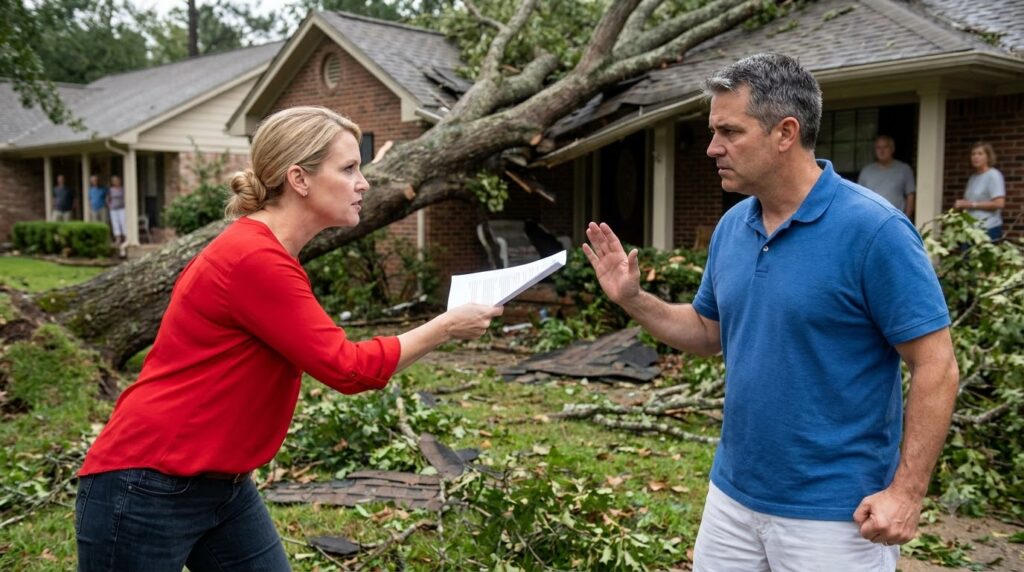
“Mark altered the slope of his lawn,” Brenda announced, turning to face the crowd, her bright red blouse catching the glare of the overhead light. “He dug out the natural retaining ridge to extend his garden bed. By stripping away four inches of packed clay around the primary anchor roots, he exposed the root ball to subsurface water pooling. When the storm hit, the soil turned to liquid mud. The tree didn’t blow over—it slid out of the ground because he destroyed its structural support.”
A collective murmur rippled through the neighbors. Henderson squinted at the photo, his jaw tightening. “Damn it, Mark… you dug out the retaining line?”
“Look closely at the photo, Henderson,” Mark said quietly. He didn’t raise his voice, but the cold precision in his tone cut through the whispering crowd instantly.
He walked past Brenda, ignoring her sharp intake of breath, and stopped two inches from the easel. He didn’t touch the plastic, but his eyes locked onto the details of the glossy print with laser focus.
“The shovel in that picture is a heavy-duty fiberglass trenching spade with a blue handle,” Mark noted, his voice flat and analytical. “I don’t own a fiberglass spade. I own two flat steel shovels with weathered ash handles. They’re sitting in my garage right now behind the water heater.”
“You could have bought a new spade for the project and thrown it away,” Brenda countered immediately, her response rehearsed and lightning-fast. “The shovel isn’t the evidence, Mark. The altered soil grade is. The photo proves you modified the turf fourteen days ago.”
“Does it?” Mark asked. He leaned closer to the bottom corner of the print, where the red digital line intersected the shadow of the brick wall.
Something in the image didn’t align. The brickwork in the background showed clean, dry mortar lines—yet July fourteenth had been the day of the county flash flood, when three inches of rain had turned every driveway on Oak Ridge Lane into a river. More importantly, the shadow cast by the oak tree fell toward the north-northwest, an angle physically impossible at two o’clock in the afternoon during a midsummer sun arc.
It was a composite. A high-resolution overlay fabricated using an old baseline photo of his foundation from three years ago, stitched together with fresh trenching footage to manufacture a clear, defensible cause of failure.
Brenda had brought a pre-packaged crime scene to his front lawn.
“This photo is a complete fabrication,” Mark said, turning his head slowly toward the crowd. “The shadow angle puts the sun at seven in the morning, not two in the afternoon. And the mortar on those bricks is bone-dry on a day it rained three inches.”
“He’s deflecting!” Brenda raised her voice, stepping between Mark and the neighbors, thrusting her hands out to hold their attention. “He knows that if the town inspector sees this evidence, the liability falls entirely on his shoulders! He’s trying to drag the whole community into his financial disaster!”
“Show them the original digital file, Brenda,” Mark pressed, taking a step toward her, his tall frame blocking the streetlamp light so her shadow stretched long and dark across her own easel. “Not a printed sheet inside a plastic sleeve. Show us the EXIF metadata on a phone right now.”
Brenda’s pale eyes flashed with a sudden, vicious spark. She didn’t reach for her phone. Instead, she reached into her jacket pocket and pulled out a fresh, folded sheet of paper—this one bearing a bright yellow municipal seal.
“I don’t need to debate photoshop theories with you, Mark,” she hissed softly, her voice dropping so only he and the nearest neighbors could hear. “The town code inspector just pulled into the lane. And I’ve already submitted this photograph directly into his official pre-inspection record.”
At the mouth of the cul-de-sac, a white municipal pickup truck with amber lights flashing on the roof slowly rolled to a stop behind the crane.
Mark looked at the flashing amber lights reflecting in the wet mud at his feet. The trap had sprung. Brenda hadn’t just created a decoy secret to fool the neighbors—she had entered a falsified evidence file into a public government record before he could even lay a tape measure across his lawn.
He reached into his pocket and touched the waterproof sleeve holding his three certified mail receipts. The fake photo was a powerful shield, but it relied entirely on one fundamental assumption: that the tree belonged to Mark Miller in the first place.
“Let him inspect it,” Mark said, his jaw locked, his eyes cold as flint. “Let him inspect every single inch.”








