CHAPTER 3: THE PAPER STRIKE
“A hundred and fifty dollars a day, Mark. Retrospective to six o’clock this morning.”
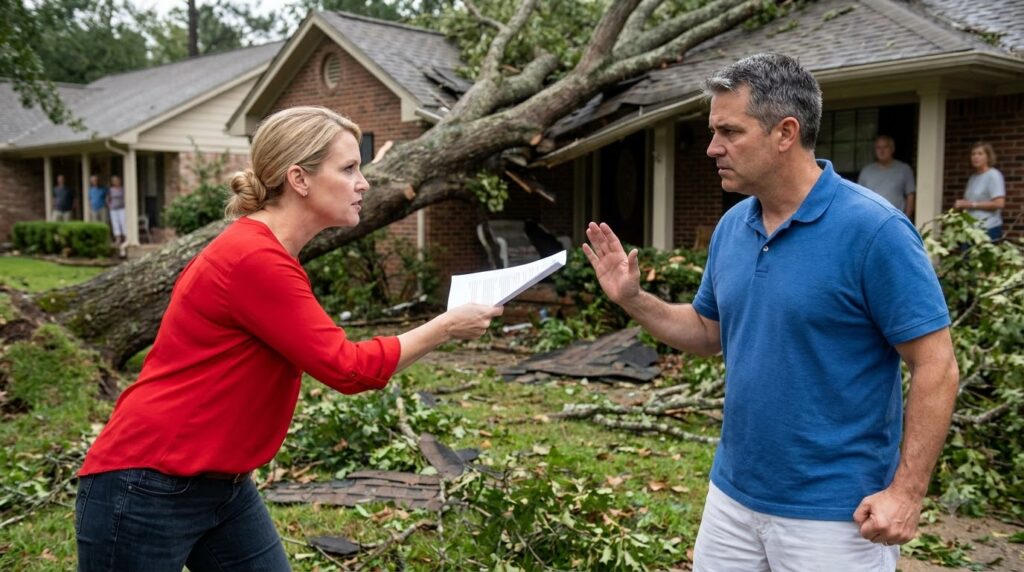
The paper didn’t just hover in the space between them—Brenda driven it forward, snapping the single crisp white sheet through the humid post-storm air until the edge grazed the damp cotton of Mark’s blue polo shirt.
The rain had tapered to a thin, frigid needle-mist that coated the front lawn in a silver sheen. Around the perimeter of the cul-de-sac, porch lights flickered on. Figures in rain jackets moved toward the property lines: the Webbers from number forty-two, old man Henderson leaning heavily on his wooden cane at the curb, three younger mothers from down the block holding umbrellas over their children. They watched in silent, uneasy fascination as Brenda Vance staked her claim in the mud.
Mark didn’t flinch. He stood planted in his white shorts and dark slip-on shoes, his tall frame blocking the crushed facade of his house like a storm wall. He didn’t reach for the paper.
“Read the line item, Mark,” Brenda demanded, her voice cutting cleanly across the hum of the crane idling twenty feet behind them. Her bright red blouse was pristine, immune to the moisture, while her blonde hair remained pinned in its ruthlessly tight bun. “Unapproved structural modification and intentional accumulation of hazardous visual debris. You are in open breach of Section Nine.”
“Section Nine governs unpermitted construction, Brenda,” Mark said softly. His hands remained at his sides, fingers relaxed, though his shoulder muscles were knotted like cold iron. “Acts of God are governed by Municipal Emergency Code 104. You know the hierarchy.”
“Act of God?” Brenda let out a short, sharp laugh that carried no warmth, designed specifically for the neighbors standing along the curb. “This oak didn’t fall because of a gust of wind, Mark. It fell because you neglected the root system. You let water pool near the foundation line for three years. That makes this a structural maintenance failure. That makes it your personal liability.”
She thrust the document closer, forcing it toward his chest height again, her sharp fingernails digging into the edge of the sheet. The paper was unusually heavy—32-pound high-grade linen stock. The HOA’s standard administrative budget only covered cheap 20-pound copy paper. Someone had paid out-of-pocket to make this notice feel heavy, official, and crushing.
Mark looked down at the sheet. The text was printed in dense, black serif type, complete with a forged digital signature from the architectural review committee.
“Take it,” she spat, her angular face inches from his. Her pale eyes were wide, unblinking, fixed on his facial expressions to catch the first flicker of panic. “Sign the acknowledgment of receipt, or I post it directly to your front door and initiate the legal lien proceedings before the banks open tomorrow.”
Mark raised his right hand. He didn’t take the paper. Instead, he lifted a single, open palm, holding it in mid-air four inches from the document—a wall of absolute refusal.
“Put that notice away, Brenda,” he said. The tone wasn’t raised, but it carried a dense, resonant weight that made the nearest watching neighbors shift their weight on the wet grass. “We’re dealing with this first.”
He extended his index finger past her ear, pointing directly behind her at the massive, shattered trunk lying across his rafters like a fallen monument.
“There are seventy thousand dollars in structural damage sitting on my roof,” Mark continued, his eyes locking onto hers with a cold, calculating stillness. “My family is inside clearing water out of the drywall. The crane is lifting three thousand pounds of oak every twenty minutes. And you’re standing in my mud with a piece of heavy linen paper trying to manufacture a code violation.”
Brenda’s jaw worked silently for a fraction of a second. She felt the crowd behind her—felt the silence of twenty neighbors watching her authority being openly turned aside without a single raised voice.
“The paper is legal notice, Mark!” she snapped, her posture rigid as an iron bar. “You don’t get to choose when the rules apply!”
“The rules apply to everyone, Brenda,” Mark replied. He stepped forward—just half a pace—forcing her to take an involuntary half-step back to preserve her line of sight. “Including the board. That paper claims I altered the drainage around the root ball. Where’s your engineering report?”
“The report is being processed,” she lied smoothly, her hand tightening around the document so hard the heavy paper creaked.
“Which means you don’t have one,” Mark said. “Which means this notice is an administrative fiction designed to force a settlement before the insurance adjuster arrives at one o’clock.”
He looked past her shoulder to where Arthur Pendelton was standing by his crossover, nervously tapping a manila folder against his thigh.
“You’re in a hurry, Brenda,” Mark added softly, dropping his voice so only she could hear the subtext. “Why are you in such a hurry?”
A flare of raw, genuine malice flickered behind Brenda’s pale eyes. She pulled the document back, folding it once with a deliberate, sharp snap that sounded like a dry twig breaking.
“You want an engineering report, Mark?” she whispered, her voice laced with venom. “You want to play by the absolute letter of municipal law? Fine. I’ve already called the town code enforcement officer. He’s on his way right now.”
She leaned in, her red blouse almost brushing his blue polo. “When he sees what’s under that root ball, he won’t just fine you. He’s going to issue an immediate Order of Condemnation for this entire structure. You and your family will be off this lot by nightfall.”
She turned on her heel and walked away toward the curb, her white shoes cutting clean tracks through the damp grass. Mark stood motionless, watching her go.
He didn’t look at the neighbors. He looked down at his own hand, where a fine smudge of black printer toner from the edge of her linen paper clung to his index finger. He rubbed his thumb against it, feeling the distinct, waxy texture of an industrial thermal press—the kind used exclusively by commercial legal firms specializing in immediate asset seizure.
Brenda wasn’t just trying to collect a fine. She was setting up a paper trail to declare the entire parcel uninhabitable before anyone could dig three feet into the mud behind the fallen roots.
Mark turned back toward the house, his eyes scanning the gaping hole in his roof where the crane’s steel cables were tensioning against the timber. Time was no longer a negotiation. He had less than an hour before the town inspector arrived.