
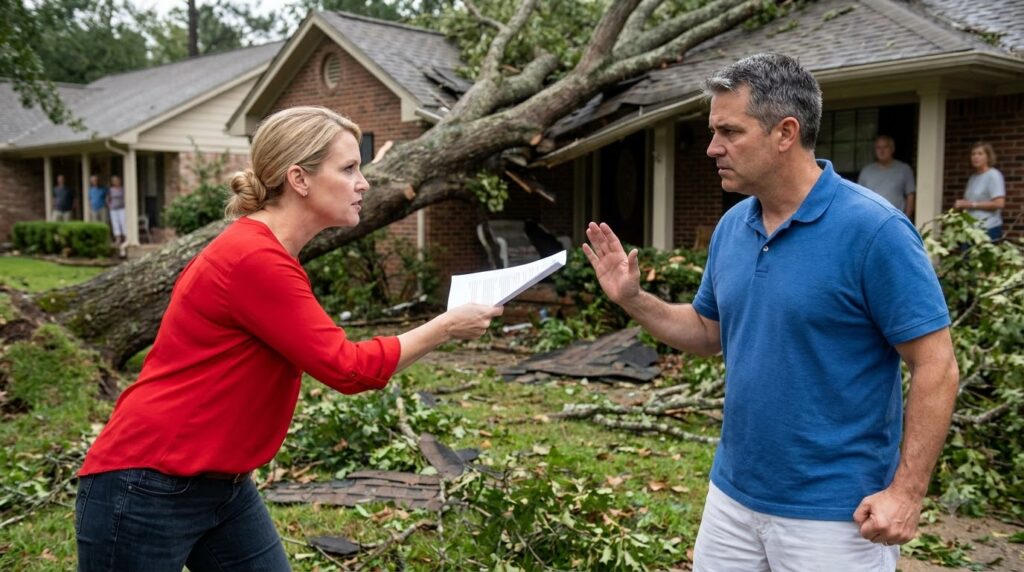
CHAPTER 2: THE PERIMETER BLOCKADE
“You’re backing that rig off my street, son, or I’m calling the county marshal for commercial trespassing.”
The words cut through the roar of a diesel V8 idling at the mouth of the cul-de-sac.
Mark stepped out into the steady downpour, his dark slip-on shoes splashing through two inches of murky runoff. At the end of his driveway, a seventy-foot yellow crane truck—its hydraulic boom strapped down like a sleeping steel monster— sat deadlocked. Blocking its path was a white luxury crossover parked horizontally across the narrow asphalt throat of Oak Ridge Lane.
Beside the crossover stood Arthur Pendelton, the board’s treasurer, wearing an oversized yellow oilskin slicker that made his frail frame look like a collapsible umbrella. He had his phone pinned against his ear, but his glare was fixed squarely on the young contractor in the cab of the crane truck. Brenda stood three paces behind him on the curb, her arms crossed beneath her clear plastic umbrella, a silent orchestrator watching the trap snap shut.
Mark didn’t slow his stride. He moved with the quiet, deliberate momentum of a man who had calculated every step long before his boots hit the pavement.
“Move the vehicle, Arthur,” Mark said, his voice dropping below the rumble of the diesel exhaust.
“Can’t do it, Mark,” Arthur replied, though his eyes flicked nervously toward Brenda before settling back on Mark. “Unapproved heavy equipment over ten tons damages the shared asphalt. Section eight, clause C. Until the board reviews the axle-weight permit, no commercial rigs enter the lane.”
The crane driver leaned out of his cab, wiping rainwater from his brow with a greasy forearm. “Look, mister, I’m billing fifty bucks an hour just sitting here idling. You want this tree off your roof or not?”
“He wants it off,” Brenda interjected smoothly, stepping forward onto the asphalt. The rain hissed against her umbrella. “But he will follow community protocol to do it. The road is common HOA property, Mark. You don’t own the asphalt.”
Mark stopped two feet from the driver-side door of the crossover. Through the tinted glass of Arthur’s back seat, Mark caught the glint of a heavy metal binder resting on the leather interior—a thick, ledger-style folder bursting with red tabs. It was the same shade of crimson as the stamp he’d spotted in Brenda’s pocket twenty minutes ago.
He didn’t waste breath arguing about axle weights. Instead, Mark leaned close to Arthur, his tall frame blocking the man from Brenda’s direct line of vision.
“Your crossover is parked over a municipal fire hydrant, Arthur,” Mark said, his tone razor-sharp and completely void of anger. “You’re within three feet of the yellow curb line. That’s a Class 2 obstruction under county code. The crane driver doesn’t need your permission to clear a disaster zone, but if I call the fire marshal right now, they won’t just tow this car—they’ll cite the driver, the owner, and the party authorizing the obstruction.”
Arthur’s throat bobbed. He shifted his grip on his phone, the oilskin rustling loudly. “We’re… we’re just enforcing board policy…”
“Check the street sign behind you,” Mark pressed, taking a half-step closer, crowding Arthur’s personal space with cold, athletic precision. “Oak Ridge Lane is a dedicated township road. The HOA maintains the grass island, but the asphalt was deeded to the county in 1994. You don’t own the road, Arthur. Brenda does.”
Arthur blinked, his eyes darting toward Brenda in sudden doubt. “Brenda, is that—”
“Don’t let him lawyer you, Arthur,” Brenda snapped, her voice tightening as she recognized the shift in control. She took a sharp step into the street, her heels clicking against the wet pavement. “The HOA has an emergency easement over all access routes during a self-declared compliance review.”
“A self-declared review doesn’t override township traffic laws,” Mark said, turning his head slowly toward her. His dark hair was plastered to his forehead by the rain, but his eyes were cold and tracking every twitch in her face. “You’re holding up an emergency structural crew while three tons of timber are threatening to collapse a residential ceiling. If that roof gives way while you’re standing on this asphalt holding a paper permit rule, the claim won’t just hit the HOA insurance. It’ll hit you personally for tortious interference.”
Brenda’s jaw tightened until the bone showed white against her angular cheeks. For two seconds, the only sound was the deep, rhythmic thrum of the crane’s engine and the patter of rain on fiberglass.
“Arthur,” Brenda said through clenched teeth, her eyes locked on Mark’s. “Move the car.”
Arthur didn’t hesitate. He practically scrambled into the driver’s seat, started the engine, and pulled the crossover into a nearby driveway, his tires spinning briefly on the wet pavement.
The crane driver gave a short honk of his horn and shifted the heavy rig into gear, the huge tires crushing storm debris as the truck rolled past into Mark’s driveway.
Mark didn’t celebrate. He stood in the middle of the street, watching the crane maneuver into position. Beside him, Brenda remained motionless, her clear umbrella dripping onto the dark asphalt.
“You think you’re very clever, Mark,” she said, her voice dropping into a dangerous, quiet register that subtext alone carried. “You think a surveyor’s pin and a few legal threats give you leverage. But you don’t know what’s coming at noon.”
Mark turned his head slightly, keeping his body angled toward his house. “Noon is two hours away, Brenda.”
“And by five minutes past noon,” she whispered, her thin lips curving into a cold, transactional smile, “you’ll realize this tree is the least of your problems.”
She turned and walked away down the center of the street, her bright red blouse retreating like a drop of blood spreading across wet gray silk. Mark watched her go, his mind instantly recalculating. She wasn’t bluffing about noon. She was setting up a public spectacle.
He reached into his pocket, his fingers brushing the wet, heavy paper of his own file—the certified mail receipts from eight months ago, tucked safely inside a waterproof sleeve. But as he pulled his hand out, his thumb caught on a small piece of debris clinging to his palm from the driveway margin: a tiny, rusted copper staple, freshly sheared off an old surveyor’s boundary ribbon.
He looked down at the mud on his boots, then back toward the crushed roof. The crane’s hydraulic outriggers were extending, biting into his lawn. He had two hours to figure out what Brenda had hidden in that ledger—and why she needed him ruined before the bank called her bluff.








