CHAPTER 1: THE DRIVEWAY AMBUSH
“You have forty-eight hours to clear this eyesore, Mark. After that, the board seizes control of the property.”
The voice sliced through the heavy drumming of the rain, sharp and devoid of basic human warmth.
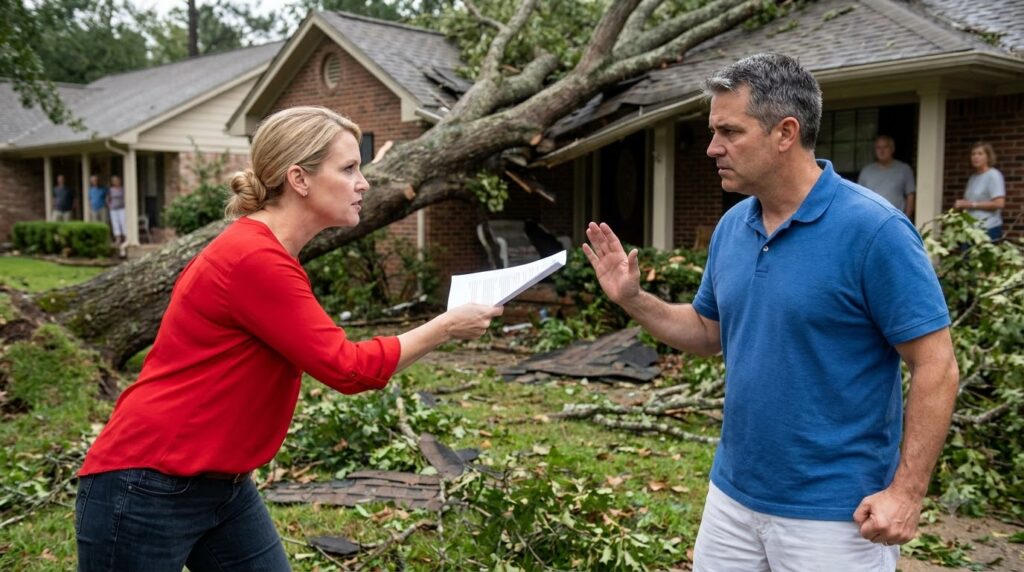
Mark Miller didn’t turn immediately. He kept his eyes locked on the catastrophic geometry of his ruined home. The century-old oak had cleaved the roofline with the precision of a butcher’s blade. Splintered trusses jutted into the gray, overcast sky like broken ribs. Cold rainwater poured through the shattered shingles, pooling onto the hardwood floors of his daughter’s bedroom somewhere in the dark interior. The air tasted of wet plaster, crushed pine needles, and the metallic tang of severed electrical wire.
He calculated the weight of the trunk. Three, maybe four tons of dead wood resting directly on the load-bearing walls. One wrong shift, and the second floor would completely pancake.
Only then did he turn.
Brenda Vance stood at the edge of his cracked concrete driveway. She held a clear plastic umbrella perfectly parallel to the ground. Beneath it, her bright red blouse was a startling, aggressive slash of color against the desaturated suburban devastation. Her blonde hair was pulled back so tightly into a bun that it pulled the skin taut at her temples, framing an angular face set in rigid, uncompromising lines.
She wasn’t looking at the destroyed roof. Her pale eyes were fixed entirely on the scattered branches muddying the pristine line of the sidewalk.
“Did you hear me, Mark?” Brenda asked, her voice carrying the transactional flatline of a predator evaluating an injured asset. “Section four, paragraph two of the bylaws. Catastrophic or not, visual blight is subject to immediate daily compounding fines.”
Mark tightened his jaw, feeling the abrasive grit of brick dust coating his stubble. He stepped down from the porch, his dark slip-on shoes sinking slightly into the saturated turf. He didn’t yell. He didn’t plead. In this neighborhood, under Brenda’s regime, empathy was a currency that had lost its value years ago. Every word was a chess move, and right now, she was pushing a pawn to see how he would defend the king.
“There’s three tons of oak resting on my joists, Brenda,” Mark said, keeping his tone dangerously level. His voice was a low rumble beneath the storm. “Heavy machinery can’t touch that trunk until the structural engineer clears the insurance claim. You know that.”
“The board doesn’t wait on insurance,” Brenda countered, taking a single, measured step forward. She kept the umbrella between them like a riot shield. “We are protecting the property values of Oak Ridge Lane. If you can’t afford the rapid-response crews, the HOA will hire them. And we will place a lien on this house by Friday for the cost.”
Mark stopped three feet from her. The chill radiating off the wet asphalt was absolute. He studied her face, looking for the usual self-righteous satisfaction, but he saw something else. A microscopic tightness around her mouth. A tremor in the knuckles gripping the umbrella handle. She was pressing too hard, too fast. She wasn’t just enforcing a rule; she was desperate to shift the financial liability of this specific tree onto him before the dust even settled.
He shifted his weight, his boot sliding against a mound of displaced earth near the massive, upturned root ball. Something hard scraped against his sole. Glancing down, shifting only his eyes, Mark caught the dull, oxidized glint of a buried surveyor’s pin wrapped in frayed copper wire, exposed by the torn earth. A pin that sat a full two feet on the wrong side of the property line.
Slowly, deliberately, Mark pivoted his boot, grinding the mud over the metal stake to hide it from her line of sight.
“I’ll handle the debris, Brenda,” Mark said softly, his eyes snapping back to hers.
Brenda offered a thin, bloodless smile. “See that you do. I’ll be back at noon with the official paperwork.”
She turned on her heel to leave, the wind whipping her coat open for a fraction of a second. Mark’s eyes locked onto her interior pocket. Tucked neatly against the lining was a folded document, the heavy rain bleeding the ink through the paper. It wasn’t HOA letterhead. It was a notice from Apex Fidelity—the community’s reserve bank. And stamped across the top, bleeding a harsh, unmistakable crimson into the wet white fabric, was the word: INSOLVENT.