CHAPTER 6: THE TERMINAL LOG
The mobile data terminal didn’t beep; it gave a low, dull buzz that vibrated against Officer Miller’s nylon gear belt like a trapped beetle. The sun hit the small glass screen at a flat angle, turning the county parcel map into a chaotic grid of glare and oily finger-smears. Miller didn’t look up at either house. His thick thumb dragged across the digital border lines, tracing the edge of Lot 14-B where Mark’s dry fescue met the concrete sidewalk seam.
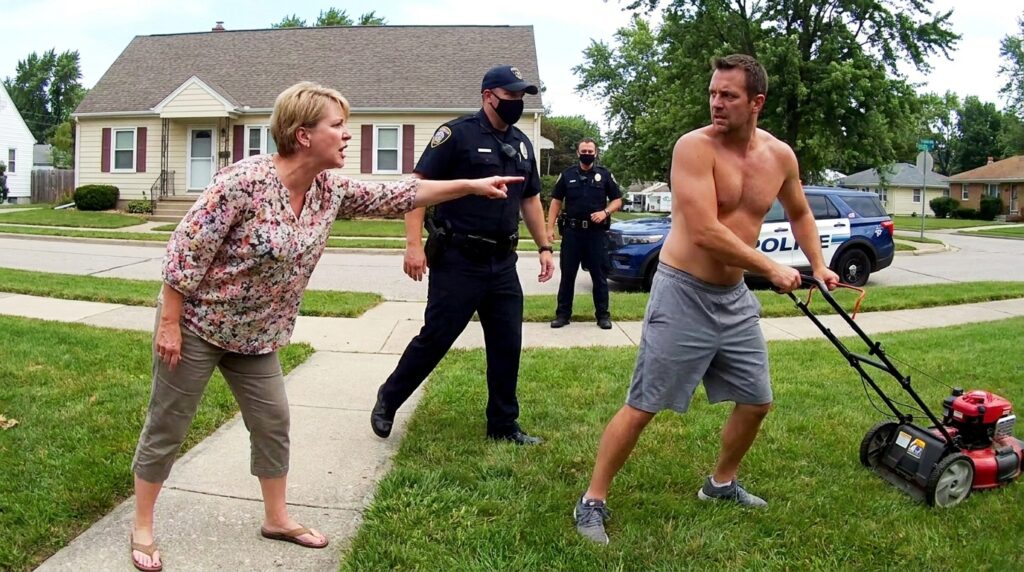
Mark kept his weight locked onto his rear heel, his hands still bridging the weathered rubber handle of the red mower. The engine casing between his boots was radiating a silent, intense heat-ripple that distorted the lower hem of Evelyn’s floral smock across the gap. He watched Miller’s face. The officer’s eyes under the dark visor didn’t widen, but his jaw muscle clamped tight beneath his mask, his skin shifting against the fabric.
“What’s the system showing, Officer?” Evelyn asked. She had moved her orthopedic shoes an inch closer to the curb, her knuckles white against the yellowed corners of her manila folder. “The 1984 platted benchmark explicitly designates that six-foot perimeter as a public right-of-way. The drainage variance hasn’t been dissolved by the municipality.”
Miller turned his shoulder three degrees to the left, using his wide blue torso to completely block her view of the screen. His voice was flat, empty of the local deference she usually extracted from the town hall staff.
“The system is pulling the general registrar’s database from ninety-six, ma’am,” Miller said, his boots grinding a few loose limestone chips into the asphalt. “The server is lagging on the plat verification. Davis, check the regional dispatch log on the dash.”
Officer Davis didn’t answer. He turned on his heel, his heavy leather duty belt creaking as he strode back to the idling patrol car. The door remained open, the interior radio spitting a low, rhythmic pattern of coded static that drifted across the parched front yard.
Mark didn’t drop his gaze to the terminal. He was looking at the bottom margin of the yellow folder in Evelyn’s hands. The blue ink sketch she had displayed earlier was sliding out, and beneath it, tucked tightly against the cardboard backing, lay a thin sheet of waterproof synthetic paper. It was a recent county GIS survey printout, complete with a bright red digital time-stamp from less than three weeks ago. The top of the page was partially folded back, but the bold black text at the header was clearly readable through the glare: Final Boundary Re-Plat & Easement Relinquishment.
The decoy map she had been waving was a dead record. The 1984 plat she kept citing was still on the screen of Miller’s lagging terminal because the county database hadn’t indexed the ninety-six water line modifications into the active public portal yet. She knew the server would display the old lines first. She had planned the entire confrontation around that specific technical delay, using the outdated public map as a shield to freeze Mark’s work and force him to yield the disputed strip before the real boundary could be verified on-site.
“The ninety-six amendment was an internal utility record,” Evelyn said, her voice thinning until it sounded like dry parchment dragging over stone. She didn’t look at the orange marker near Miller’s boot heel. Her head turned toward the porch watchers down the street, her posture stiffening as if she were addressing a full council meeting. “It doesn’t supersede the primary residential deed restrictions. This man is operating a machine without an authorized variance.”
“We’re not looking at a variance anymore, ma’am,” Miller said. He didn’t lift his eyes from the glass pad. A small red indicator light on the top edge of the terminal began to flash in a steady, double-beat pattern, signaling a priority record override from the county clerk’s main office. “The map on the public site is thirty years old. The clerk’s office just pushed the structural amendment to our unit.”
Mark watched the fingers of Evelyn’s left hand twitch against the cardboard cover. She didn’t offer a defense; her shoulder blades simply dropped an inch, her entire frame shrinking slightly under the bright floral smock as the patrol car’s radio suddenly went dead silent.
“Step back onto the concrete walkway, Evelyn,” Miller said, his tone dropping the official title entirely. He shifted his stance, his heavy boot clearing the clover to expose the clean, unweathered blue plastic surveyor’s cap driven straight into the dirt behind the mower. “Don’t touch the folder. We’re going to verify the actual coordinates right here.”
Mark felt the cold steel of the throttle under his thumb. The neighborhood’s silent watch remained fixed, the blinds across the street staying frozen in place as the digital terminal gave a sharp, final chime that signaled the arrival of the absolute truth.