CHAPTER 5: THE INTERVENTION LINE
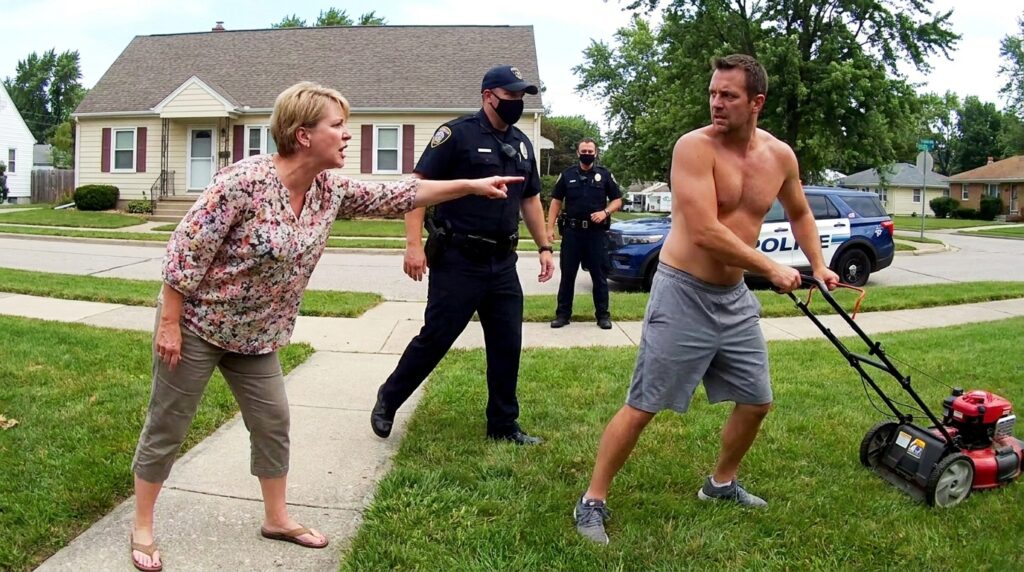
The heavy leather of Officer Miller’s service boots split the space between them with a dull, physical crunch. The scent of hot asphalt mixed instantly with the clean, synthetic tang of laundry starch and the chemical musk of a sweat-soaked uniform vest. He didn’t look at Mark, and he didn’t look at Evelyn. His eyes remained fixed on the lower plane of the yard—the low, rusted survey pin half-strangled by clover and the black rubber wheels of the red walk-behind mower.
Mark felt the air pressure shift as the officer’s wide torso blocked the heat radiating from Evelyn’s floral smock. He didn’t drop his hands from the mower’s rubber grip, but he let his shoulders drop two inches, his spine adjusting to the sudden, authoritative partition of his front lawn.
Officer Miller raised his left hand, his palm flat and dry, pointing directly toward the center of the gap. His voice was clipped, balanced by the rhythmic, low-frequency vibration of the patrol car’s engine idling fifteen feet away.
“Both of you step back,” Miller said, his eyes tracking the narrow line of turf between Mark’s boots and the concrete pavement. “We’re going to sort this out.”
Evelyn didn’t retreat. She maintained her position on the concrete seam, her orthopedic shoes squeaking against the grit as she tilted her chin upward to meet the dark rim of the officer’s cap. Her fingers tightened around the edges of the manila folder until the old cardboard groaned.
“He’s deliberately blocking the municipal walking path, Officer,” she said, her voice dropping into that tight, sharp register that had governed thirty years of neighborhood association hearings. “The machine has been sitting over the easement line for twenty minutes. It’s a civil obstruction, and I have the platted registration to prove it.”
Miller didn’t reach for the folder. He leaned his weight back onto his heels, his heavy duty belt clicking as the leather loops shifted against his hips. He looked down at the mower’s red deck, then at the tiny rusted iron pin embedded in the dirt. Right beside his boot heel, half-buried under a clump of parched dandelion roots, a small circle of bright blue plastic glinted in the sun—a modern, high-visibility surveyor’s cap capping a secondary steel rod. It wasn’t thirty years old. The edges were sharp, unweathered, and clean of the gray limestone dust that coated everything else at the curb.
Mark watched Miller’s eyes drop to the blue plastic cap. The officer didn’t comment on it. He didn’t ask Evelyn why her 1984 map didn’t include the blue marker. Instead, he reached toward the small digital terminal mounted on his belt harness, his thumb tapping the glass screen until the blue light reflected off his sunglasses.
“We don’t arbitrate deed text on the sidewalk, ma’am,” Miller said, his tone flat and empty of any deference to her floral smock. “The county dispatch received a complaint regarding an active property breach. Until I pull the current county parcel registry on the terminal, nobody touches the machine, and nobody crosses the expansion joint.”
Behind him, near the rear door of the cruiser, Officer Davis shifted his stance. His boots remained on the hot asphalt of the street, his eyes tracking the windows of the surrounding houses where three separate sets of blinds had shifted to reveal the pale faces of the neighborhood’s silent watch. The public pressure was live now, a heavy, unblinking circle of attention that pinned all four of them to the tiny strip of grass at the curb.
Mark stood his ground on the turf, his gray shorts catching the low, grease-heavy exhaust from the idling cruiser. He knew the look on Evelyn’s face—it was the calculation of an opponent who had just realized the rules of the table had changed without her consent. She wasn’t looking at the officer anymore; her eyes were locked on the blue plastic cap near his heel, her fingers twitching against the yellow folder as if she wanted to drop it over the marker before anyone else noticed the date stamped into the plastic.
“The 1984 registration is the active civil benchmark,” she whispered, her lips turning gray under the harsh noon sun. “The city clerk hasn’t signed the revision.”
“We’ll see what the server says,” Miller said. He turned his shoulder, blocking her view of the terminal screen as the machine began its slow, cellular handshake with the county records office three miles away.