CHAPTER 3: THE PRECISION LINE
The sun had burned the morning flannel out of the sky by one o’clock, turning the subdivision into a blinding sheet of white concrete and dry, pale dirt. The heat rose off the asphalt in transparent grease-ribbons, distorting the lower frame of Evelyn’s house until the foundation seemed to float an inch above the scorched lawn. Mark didn’t check the sky. His eyes were locked on the thin line where his coarse green weeds met the perfectly square edges of her gray cement.
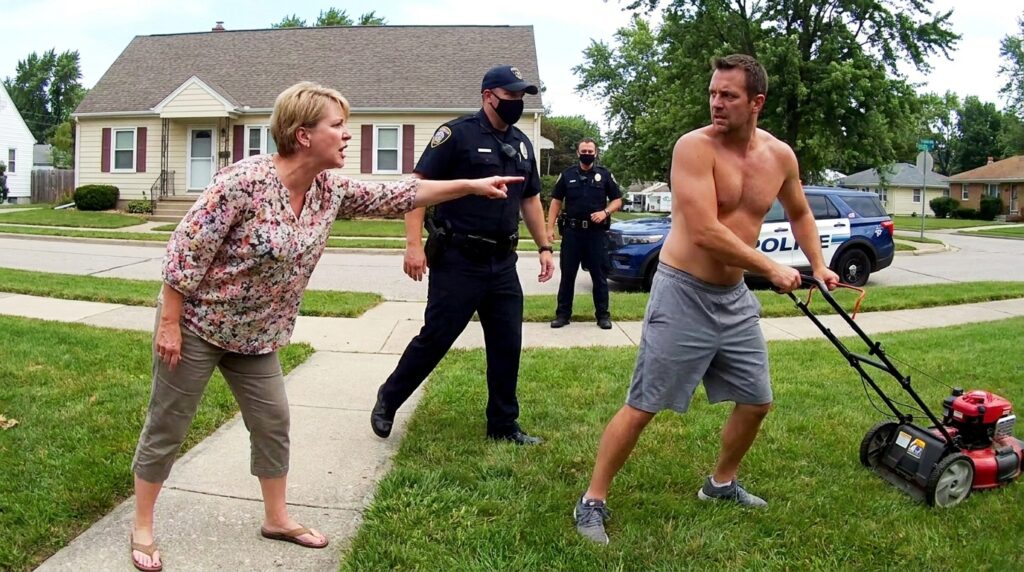
He stood on the parched earth of his own yard, his callused thumb resting on the cold throttle lever of the red mower. The engine was cold now, its cast-iron housing ticking as the metal settled in the heat. Across the boundary seam, the bright pattern of Evelyn’s floral smock seemed almost static against the gray backdrop of her garage door. She hadn’t moved since the mist cleared, her shoulders square, her weight planted entirely on the heels of her heavy shoes.
Between them lay the red lawn mower, its metal frame serving as a low barrier. Mark had stopped the left wheel exactly one inch short of the concrete expansion joint. He knew the legal measurements of his parcel down to the millimeter—he had spent the previous evening reading the county deed under a flickering forty-watt bulb in his kitchen, tracing the coordinates with a pencil tip until the paper wore thin.
Evelyn took two steps forward, her heels grinding a thin layer of limestone dust out of the pavement. The manila folder was still tucked firmly beneath her arm, its bottom corner showing the bright, unweathered edge of a fresh municipal printout. She pointed a short, thick index finger toward the rusted survey pin near the curb, her voice cutting through the heavy hum of distant air conditioners like an old saw through pine.
“You’re tracking grease across the seam again, Mark,” she said, her chest rising under the floral fabric. “The town ordinance is explicit about aesthetic degradation. You have twenty-four hours to scrub the concrete before the administrative assessment is finalized.”
Mark didn’t drop his chin. He let his forearm rest against the worn rubber grip of the mower handle, his knuckles white against the black plastic. The heat was real, pressing down on the back of his neck like a flat iron, but his voice came out flat, level, and dry as the grass beneath his boots.
“I’m just mowing my grass, Evelyn,” he said, keeping his eyes on her glasses. “The pin says the turf is mine. The mower hasn’t touched the gray side.”
“The turf follows the historic easement,” she countered, her hand tightening around the manila folder. The blue ink sketch peeked out from the folder’s mouth, showing the cross-hatched dead zone that cut six feet into his property line. She tapped the cardboard cover with her finger. “I have the 1984 platted maps right here. The town clerk verified the maintenance lanes before they closed the office on Friday. If you don’t pull the machine back past the mailbox line, I have every right to file for a public injunction.”
Mark’s internal calculation didn’t slow. He noticed the slight tremor in her pointing finger—not from fear, but from the raw frustration of an old authority structure slipping out of her grip. He also noticed something else. Beyond her shoulder, tucked into the narrow space between her chain-link fence and her tool locker, a fresh wooden survey stake was driven into the dirt. A bright orange plastic ribbon was knotted around its neck, the plastic pristine and completely free of the sun-bleaching that ruined everything left outdoors for more than a month. It was a professional marker, the kind used by real county survey crews when they laid out a modern tax parcel, not a thirty-year-old historic easement.
He looked back down at her folder. The decoy was right there in her hands—the old, defunct 1984 map she was using to squeeze his space. She was pushing the old code because it was the only document she had that gave her permission to cross his boundary. She needed him to back up, to concede the two inches near the sidewalk seam, because once he did, the historic easement would legally re-establish itself through default usage.
“The 1984 plat was updated when they put the city water lines through in ninety-six, Evelyn,” Mark said, his voice dropping into a transactional rhythm. He didn’t offer a defense; he simply stated the physical fact like he was counting bolts on a cylinder head. “The easement was re-routed to the south ditch lane. This patch belongs to the deed holder.”
Evelyn’s mouth tightened into a thin, bloodless line. She didn’t offer a counter-argument or look at the orange ribbon behind her garage. Instead, she lifted her right hand, her thumb clicking the screen of her phone until the glass reflected the white glare of the sun.
“We’ll let the city code enforcement unit read the coordinates,” she said, her voice dropping into a tight, sharp whisper. “I’ve already logged the complaint. They’re on their way down the avenue now.”
Mark didn’t pull the mower back. He shifted his weight to his heels, his gray shorts catching the low breeze off the pavement as the distant, rising whine of a municipal siren began to cut through the heavy summer air.