CHAPTER 2: THE DEW AND THE RUST
The heavy aluminum flag of the mailbox didn’t drop clean; it ground against its copper rivet with a screech that set Mark’s teeth on edge. The morning humidity had settled over the subdivision like wet flannel, pinning the smell of stagnant ditch-water and hot asphalt to the lawns before the sun could even clear the power lines. Mark reached into the hollow metal tube, his knuckles scraping the rough, pitted zinc interior. His fingers closed on a pulp that had begun to dissolve before it ever met his hand.
It wasn’t a standard bill. The paper was heavy, legal-grade stock, the kind used by the county clerk’s office three miles west, but it hadn’t come through the federal postal system. There was no cancellation stamp, no bar code, no ink-jet tracking lane along the lower margin. It had been slipped past the rubber seal between midnight and dawn, when the only sound on the cul-de-sac was the automatic cycling of Evelyn’s lawn-sprinklers five feet from his boundary stake.
He pulled it into the light. The ink had run along the fibrous grains of the paper, turning the block letters of his name into fuzzy, dark grey caterpillars. It was an unofficial citation—a warning typed on an old IBM Selectric with a dying ribbon, the “e” and the “o” filled in with solid black grease. It cited Municipal Ordinance 404-B: Maintenance and Visual Encroachment of Unimproved Public Rights-of-Way.
Mark leaned his hip against the cedar post of the mailbox, the wood soft and damp against his jeans. He didn’t look back toward her house. Instead, he looked down at the concrete sidewalk seam where his turf met her gray pavement. A single line of dried, orange-brown rust ran from the base of his mailbox post, directly across the concrete expansion joint, terminating at the exact point where Evelyn’s property began. It was the residue of the iron-heavy well water he used for his garden hose, a permanent stain that documented every drop that crossed the line.
The language in the note was clinical, written by someone who had spent thirty years reading code books until their brain thought in sub-paragraphs and indented clauses. It claimed his mailbox post sat two and a half inches inside the municipal easement—an easement that, according to the document, had been granted to the adjoining property owner for “aesthetic buffer maintenance” during the original 1984 platted survey.
Mark’s thumb dug into the soft pulp of the paper, tearing the corner where a hand-drawn diagram had been sketched in blue ballpoint. The ink had bled into a dark smear, but the lines were clear enough: a box representing his lot, a larger box representing hers, and a cross-hatched dead zone that swallowed the entire outer edge of his front lawn. It wasn’t just about an inch of grass anymore. Someone had gone into the old records, or manufactured something that looked like them, to turn his morning chore into a civil violation.
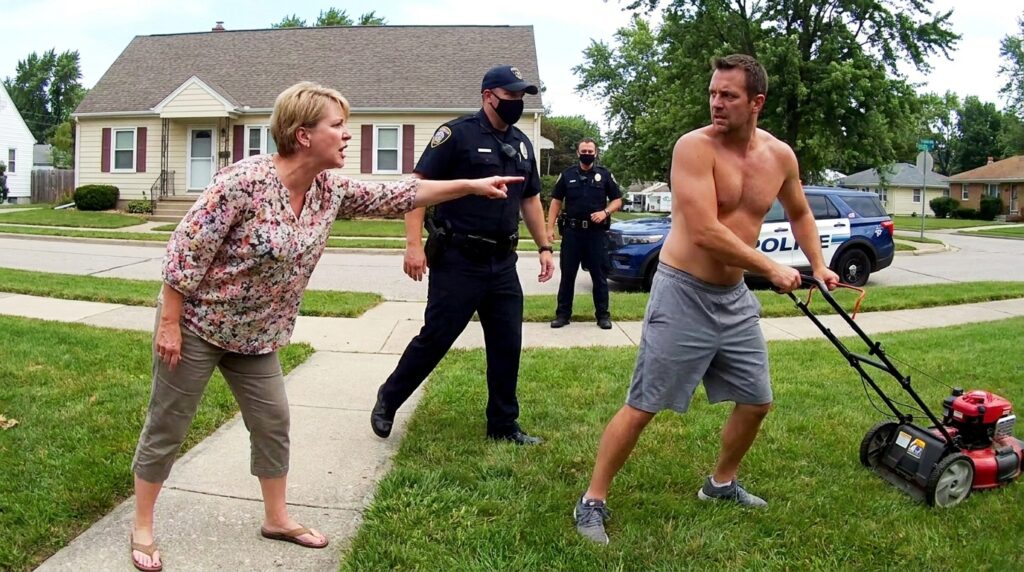
He folded the damp sheet twice, shoving it into the back pocket of his shorts where the grease from the mower handle had already left a dark crescent moon. The metal box of the mower was still warm from yesterday’s run, the scent of parched grass clippings trapped under the deck turning sour in the morning fog. He reached down to check the oil dipstick, his fingers registering the gritty coat of dust that had settled over the yellow plastic cap. The oil was low, dark as molasses, and flecked with microscopic shavings of steel from a cylinder wall that had been scraping against its housing for a decade.
A low, metallic click sounded from across the lawn. It wasn’t the sound of a door opening; it was the distinct latch-snap of a heavy-duty vinyl storage locker—the kind Evelyn kept behind her garage to house her brass edging tools and her collection of orange boundary flags.
Mark didn’t look up from the dipstick. He wiped the steel tongue clean with his bare palm, tracking the clean line of grease against the callused skin of his thumb. He knew the sequence by heart now: the latch, the heavy step of her orthopedic shoes against the gravel, the small, dry cough she used to clear her throat before she reached the edge of the asphalt. Every sound was an anchor, a physical weight pulling him into a defensive circle on a three-quarter-acre lot that was shrinking by the hour.
He inserted the dipstick back into the dark throat of the engine, twisting it until the plastic threads locked against the iron block with a dull, final thud. When he finally straightened his spine, the white morning mist was beginning to lift off the asphalt, revealing the sharp, floral print of her smock standing exactly twenty-four inches behind the rusted iron survey pin.