CHAPTER 6: THE SETTLED PERIMETER
The red bricks did not look like progress anymore; they looked like debris. The silence that settled over Landmark Lane was heavy, filled only with the smell of heat-softened asphalt and the fine, dry dust of crushed mortar settling into the grass. Raymond watched the tailgates of the masonry trucks vanish around the far curve of the cul-de-sac, their diesel rumble fading until the only sound left was the scratch of wind through the dried scrub oak. The neighborhood porches were empty now, the screen doors clicked shut, the temporary spectators retreating into the air-conditioned privacy of their own properties.
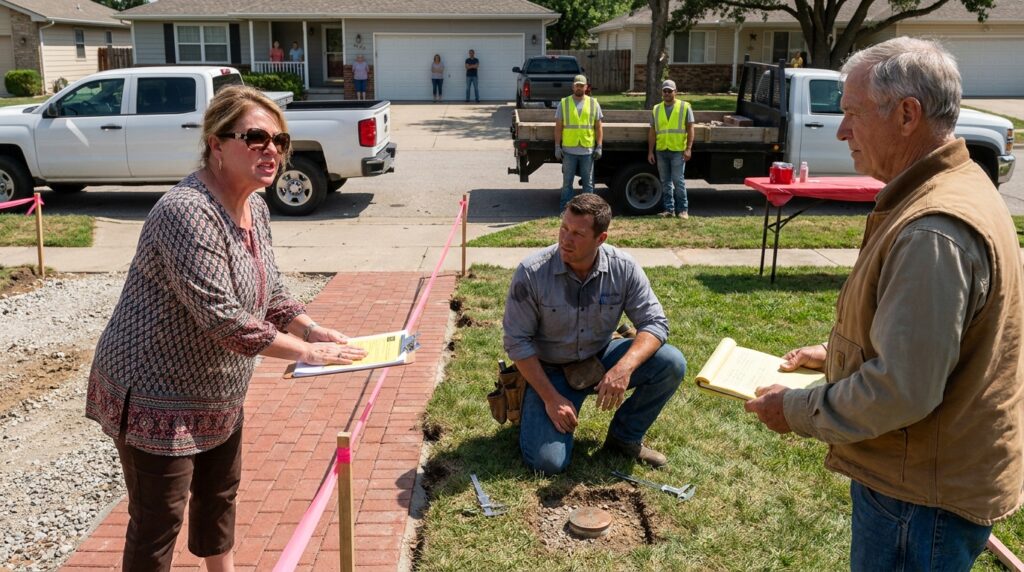
Brenda Gantry remained standing at the margin of the dirt. Her clipboard hung loose from her fingers, the yellow carbon-copy notice pinned beneath the clip fluttering like a broken wing. Without the microphone or the audience, her posture had shrunk, the sharp, linear lines of her tunic looking loose and creased in the unshaded glare. She didn’t look at Raymond. She looked down at the neon-pink survey tape he had driven beside the bedrock anchor, its bright plastic tails snapping in the dry breeze.
“My father planted this grass fifty years ago,” Raymond said, his voice dropping into the quiet, unyielding register of a man closing a field ledger. He didn’t step onto the pavement; he stayed firmly on the side of the baseline. “Tomorrow morning, you’re going to start putting it back exactly the way you found it.”
Brenda didn’t answer. Her jaw moved silently, resetting into a hard, defensive line that carried no more weight. She turned away, her heels catching on the loose sand as she walked toward her SUV, leaving her plastic clipboard on the plastic table next to the sweat-beaded pitchers of warm tea.
Raymond walked down the margin of the trench, his boots heavy and rhythmic against the gravel. He reached into his vest pocket, his calloused fingers wrapping around the cool, oxidized iron of his father’s old plumb bob. The weight of the metal was solid, a permanent balance against the three decades of land shifts and corporate layouts he had measured across the state. The layout was finished. The math had held the line, not through a loud voice or a public vote, but through the simple, unyielding permanence of the coordinate benchmark.
He knelt near the oak tree, pulling the fresh pine stakes out of the earth one by one. The sticky resin stained his palms, but beneath the disturbed loam, his fingers found the deep, compressed indentations where the original split-cedar fence posts had sat for forty years. The soil was cool down there, packed tight with river gravel and root systems that had outlasted three neighborhood development acts.
By noon the following day, the first remediation crew arrived—not Brenda’s laborers, but a bonded municipal contractor dispatched by the code office at the committee’s expense. Raymond stood on the screened porch, his yellow notebook resting on the wooden railing, watching the mini-excavator lift the red blocks out of the lawn and stack them back onto flatbed trailers. The gray sand was scooped clear, replaced by dark, nutrient-rich topsoil hauled in from the valley.
Harrison walked across the Lane later that evening, a worn leather work glove tucked under his arm. He stopped at the property line, his eyes tracking the fresh seed Raymond had scattered across the black dirt. He didn’t offer a defense for the committee; he simply nodded once toward the tree.
“The registry map is locked at the county office now, Raymond,” Harrison said, his voice quiet against the evening cricket chorus. “Thorne entered the permanent baseline into the regional grid this morning. No one’s moving that pin again.”
“The pin never moved, Harrison,” Raymond said, his gaze fixed on the spot where the copper disk rested deep in the stone. “People just forgot how to look for it.”
He stayed on the porch long after Harrison left, watching the sun drop behind the north ridge, casting long, desaturated shadows across the reclaimed perimeter. The white chalk line had completely dissolved into the grass, washed out by the afternoon humidity. The homestead was quiet again, the air smelling of clean earth and damp rye seed. He reached down, setting the iron plumb bob flat onto the wooden table beside his notebook, its pointer aligning perfectly with the gravitational baseline of the ground beneath him. The perimeter was clear, the boundaries were fixed, and the dirt was settled.