
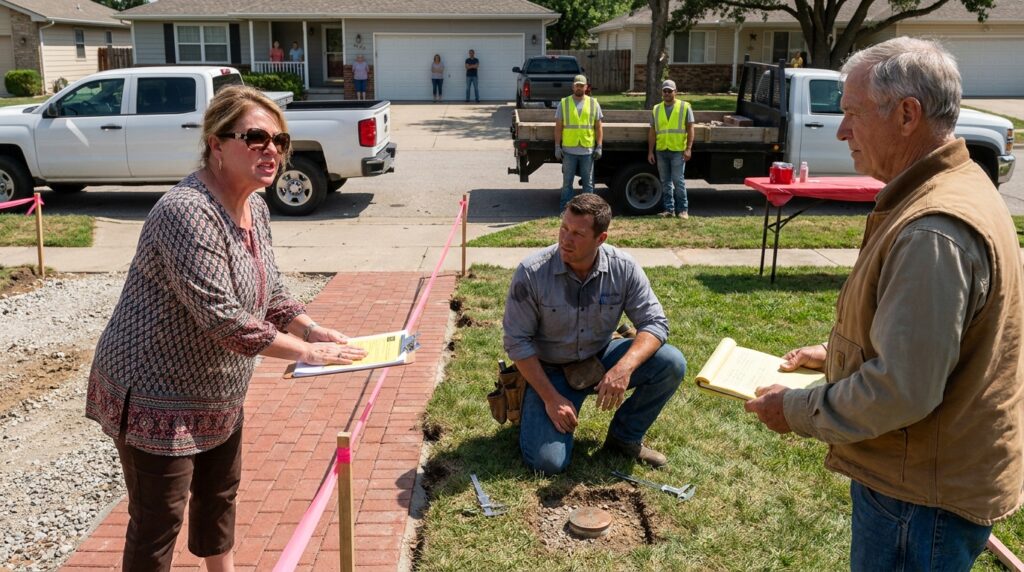
CHAPTER 2: THE PAPER PERIMETER
“A title is only as good as the fence that keeps it clear, Raymond,” Brenda said. She tapped the heavy acrylic edge of her clipboard against the top iron rail of the flatbed truck, a dull, synthetic click that cut through the low idle of the diesel engine. “And right now, your fence is forty years behind the county’s current development schedule.”
Raymond didn’t step back from the white line. The heat was rising from the gravel driveway, thick with the scent of unwashed clay and the sour tang of old grass roots rotting in the sun. He looked down at the spade one of the laborers had left leaning against a pallet of red concrete blocks. The metal was pitted, coated in a fine crust of dried mortar that flaked off under the vibrations of the idling flatbed.
“My father built that fence out of split cedar from the north ridge,” Raymond said, his voice dropping into the quiet, rhythmic register he used when correcting rookie chainmen on a state highway crew. “He drove the corner post six feet down and packed it with river gravel. The county line didn’t change when they poured this asphalt, and it didn’t change when you bought into the block.”
Brenda pulled her sunglasses down an inch, her eyes tracking the worn steel tape rule clipped to his leather belt. “The subdivision act of nineteen-ninety-four gave the civic improvement committee oversight on all uncultivated access lanes connecting to public easements. Look at the ledger, Raymond. It’s right there under Section Four. Your father signed the original plat allowance when the county expanded the cul-de-sac.”
She held out a sheet of sun-baked cardboard backing from her clipboard, where a photocopy of an old deed ledger was pinned under the metal clip. The ink was faded to a dark sepia, the signature at the bottom shaky but familiar. Raymond’s eye didn’t linger on the name. It went straight to the top left margin—to the fine, non-standard serial imprint stamped into the header. It was a five-digit state department code, but the alignment was off by two millimeters, a vertical deviation that usually meant a ledger page had been run through a flatbed press twice after the original registry book was bound.
He reached out, his thumb catching the edge of the paper. The texture was wrong. It had the heavy, textured weight of recent wood pulp, not the smooth, brittle rag paper the county used before the regional survey offices were consolidated in the late seventies.
“This layout shows a twelve-foot right-of-way,” Raymond said, his finger resting on the white border of the copy. “The trench your men are digging is fifteen feet from the curb line. You’re three feet over the margin, even by this ledger.”
Brenda’s jaw tightened, the skin around her mouth resetting into a hard, linear fold. She didn’t look at the paper. She looked past his shoulder, toward the red-brick house at the end of the Lane where two neighbors had stepped onto their porch, their faces obscured by the glare on their screen doors.
“The extra three feet are for the stabilization tier,” she said, her tone clipping the ends of her words. “Standard engineering tolerance for a high-traffic pedestrian corridor. If we don’t finish the base layer before the weekend rain, the drainage shift will wash out your lower ditch line anyway. You should be thanking the committee for covering the masonry cost.”
“I don’t pay taxes on tolerances, Brenda,” Raymond said. He leaned down, picking up a broken piece of the red paver that had crumbled off the pallet. The aggregate inside was coarse sand and cheap river silt, gray and porous. It wasn’t commercial grade; it was the kind of residential surplus sold off by the pallet from warehouse clearings down in the valley. “And I don’t let municipal crews work without a blue-line permit on site.”
He turned away from her before she could reply, his boots crunching loud against the coarse gravel as he walked toward the corner post by the oak tree. The crew leader, a broad-shouldered man with dust caked into the creases of his neck, stopped his shovel mid-swing. He looked at Brenda, then at Raymond, his eyes tracking the yellow field notebook Raymond had pulled from his shirt pocket.
“The work stays active until an official injunction is served, Vance,” Brenda called out behind him, her heels following him down the margin of the yard. “The fine notice is already entered into the neighborhood system. Every hour those men sit idle is another fifty dollars on your account.”
Raymond reached the oak tree. He didn’t look back at her. He knelt in the dry briars, his fingers seeking the cold, hard crown of the underlying bedrock where the original benchmark should have been scored. Instead, his palm struck a raw piece of pine wood—a fresh grade stake driven straight into the soft earth where the iron pin had been pried out. Stamped onto the side of the wood was a serial imprint that didn’t match any state registry he had mapped in thirty years. It was a private land-firm stamp, still sticky with fresh resin.
He pulled the pencil from his ear, his mind already calculating the offset from the highway centerline two hundred yards away. The decoy was simple enough to read—the paperwork looked like a standard easement extension. But the weight of the dirt, the missing iron, and the non-standard stamp on the pine told a different story. The boundary wasn’t being corrected; it was being erased.








