
CHAPTER 4: THE PAVEMENT FEAST
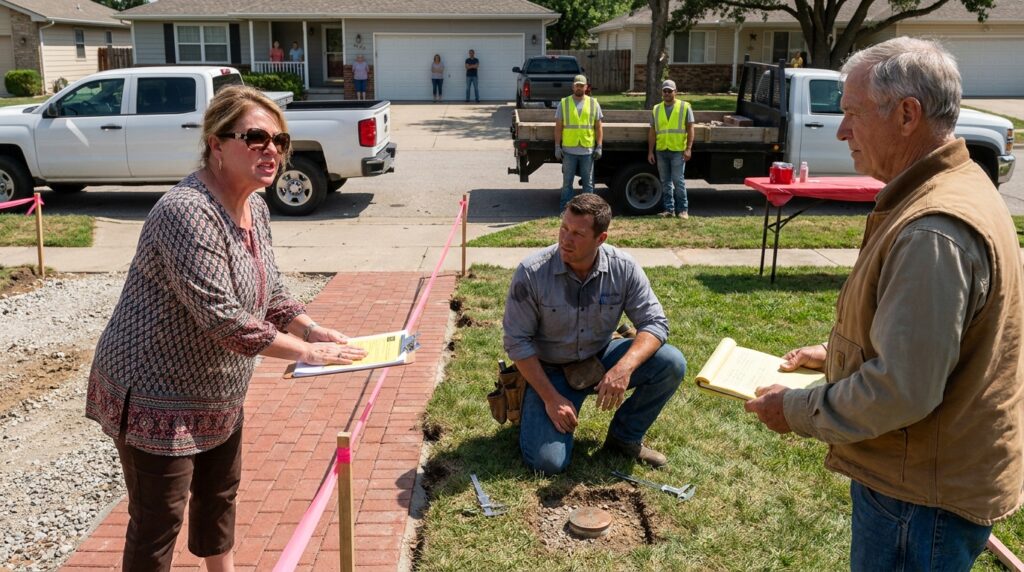
The bass from the portable PA system vibrated straight through the soles of Raymond’s boots before he even crossed the threshold of his screened porch. Brenda hadn’t waited for the mortar to cure. By ten o’clock in the morning, a long folding table covered in thin red plastic had been erected parallel to his ditch line, lined with sweat-beaded pitchers of sweet tea and plates of store-bought cookies. Ten or twelve neighbors from the upper ring of the cul-de-sac stood in small clusters, their conversations swallowed by the hollow, metallic ring of Brenda testing a wireless microphone against her palm.
The trench was gone, replaced by three hundred linear feet of interlocking red pavers that gleamed like fresh meat under the harsh, unshaded morning sun. The crew had worked straight through the dawn, their flatbed truck now empty and parked idling at the curb, its exhaust casting a blue, oily haze over the neighborhood’s pristine green lawns.
Raymond walked down his driveway, his yellow field notebook tucked flat against his ribs under his canvas vest. The crowd didn’t parted for him; they simply froze, their eyes tracking the worn steel measuring tape hanging from his hip like a weapon.
“We owe a debt of gratitude to the preservation committee for securing our neighborhood’s perimeter access,” Brenda’s voice boomed through the speakers, the volume overriding the low chug of the flatbed’s diesel engine. She stood at the head of the path, her patterned tunic fluttering in the hot breeze, her heavy clipboard raised to point directly at Raymond as he reached the white chalk line. “And despite individual resistance to modernization, the structural easement is officially complete.”
A few neighbors offered a scattering of polite applause. Most simply stared, their cups held low, their faces tight with the awkward, transactional silence of people who didn’t want to get caught between a rogue committee chair and a man who spent his life mapping state property lines.
“The easement isn’t completed, Brenda,” Raymond said. He didn’t use the microphone, but his voice carried the flat, practiced weight of an inspector stopping a highway pour. He stopped three feet short of the brick margin. “Because the document you logged in the association ledger yesterday morning isn’t an easement extension at all. It’s a fraudulent municipal zoning waiver.”
The microphone gave a sharp, high-pitched squeal as Brenda lowered it, her sunglasses reflecting the hard line of his jaw. “That document bears the official county clerk’s stamp, Raymond. I suggest you read the public registry before you make accusations that could cost you your title.”
“I did read it,” Raymond said, stepping closer until his boot toe brushed the dry sand between the red pavers. “I pulled the original utility plat from nineteen-eighty-two out of the district basement last night. The county never held the right-of-way here. The state does. The five-digit code you printed on that header belongs to an obsolete water line route that was abandoned thirty years ago. You didn’t expand a public path. You used a dead utility variance to cover the fact that you’re moving the entire tax boundary of this block.”
A murmur broke out among the porch-watchers. A man in the front row, an older resident named Harrison who lived three doors down, lowered his cup and frowned. “What do you mean moving the boundary, Raymond? The committee said this was common land.”
“It’s not common land,” Raymond said, his gaze shifting directly to Brenda, whose knuckles had gone white around the plastic frame of her clipboard. “The ledger entry was a decoy. It was designed to satisfy a standard property check if I contested the path. But it doesn’t change the coordinates. The pine stakes your crew drove yesterday didn’t follow the water line. They match a private land-firm survey that shifts three whole acres of deeded tax parcels away from my lot and directly into the unplatted expansion block behind Brenda’s house.”
Brenda’s face didn’t pale; it hardened into a dark, flush mask of absolute defiance. She stepped off the path, her heels sinking into the loose dirt of his lawn as she pointed the clipboard directly at his chest.
“You’re disrupting a sanctioned community project based on outdated state paperwork, Vance!” she snapped, her microphone voice dropping into a sharp, transactional hiss that only the front row could hear. “The county enforcement office handles local development, not some retired highway chainman with an old notebook. The bricks are set. The access is open. If you touch a single stone on this line, I will have the sheriff remove you for structural vandalism before the sun goes down.”
She turned back to the crowd, her arm flung wide toward the red walkway. “Neighbors, please. Help yourselves to the refreshments. The path is open for use.”
Raymond didn’t step onto the pavers to stop her. He stood perfectly still on his own grass, his hand resting on the heavy steel rule at his belt. He watched Harrison and two others hesitate, then step back toward the street, their phones rising to record the sudden, freezing tension in the air. The decoy had been broken right in front of them, but the absolute final authority hadn’t landed yet. Brenda was doubling down, her false logic holding the line by sheer force of presence, entirely unaware that the white county vehicle he had spent the last four hours coordinating had just turned the corner of Landmark Lane.








