
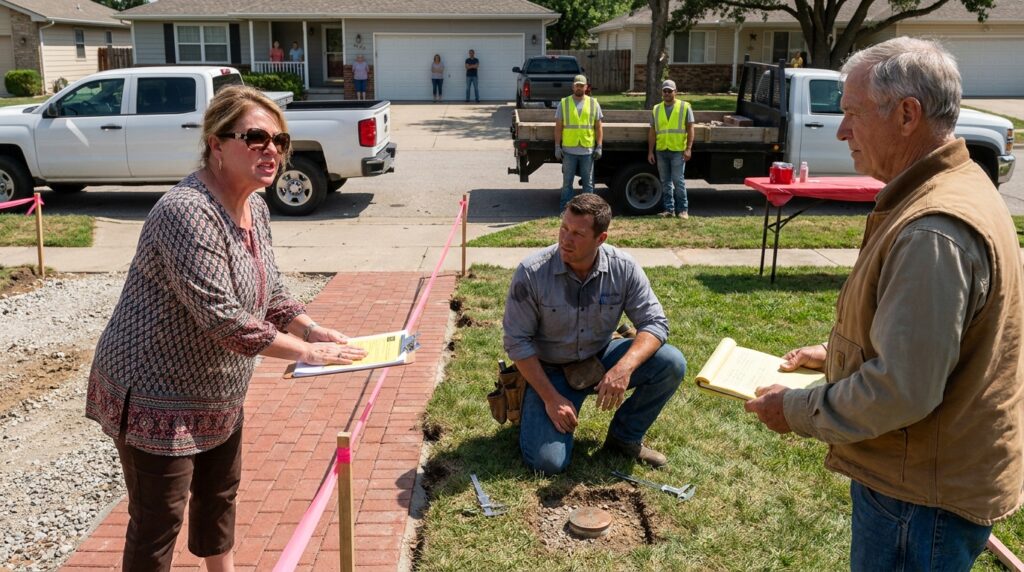
CHAPTER 3: THE MIDNIGHT LINES
“You’re tracking shadows, Raymond,” the text from his former district chainman read on the small, cracked screen of his phone. “The county records office closed their physical books for Landmark Lane back when the state routed Highway Nine around the ridge.”
Raymond shoved the phone back into the pocket of his heavy canvas coat. The night air was thick, carrying the damp, metallic tang of the drainage ditch and the distant, dry rattle of wind through the scrub oak. It was nearly two in the morning. The neighborhood was completely still, the streetlamps casting long, amber blocks of light across the freshly stripped soil of his front yard. The trench dug by Brenda’s crew looked like a raw suture in the dark, cutting an uneven line through the rye grass his father had mowed every Saturday for forty years.
He knelt by the base of the oak tree, the dry weeds scratching loud against his denim jeans. In his left hand, he held a heavy brass flashlight, its lens masked with black tape down to a narrow pencil beam. The light flickered over the raw pine grade stake he had found earlier. Up close, the fresh wood looked stark and artificial against the ancient, weathered root system. Raymond set his yellow field notebook on a flat stone, his fingers tracing the private land-firm stamp impressed into the soft grain.
He didn’t need the total station yet. His hands knew the weight of this dirt, and his eyes had memorized the original blue-line plats before he left the regional office. He reached into his tool vest, pulling out a small folding spade and a weathered iron probe.
He began to dig, his movements small and calculated to avoid throwing loose gravel onto the driveway. The spade struck something hard six inches down—not the crumbling gray aggregate Brenda’s men had dumped, but the cold, unyielding curve of ancient limestone bedrock. He cleared the dirt away with his bare fingers, his nails scraping against the stone until the narrow beam of his flashlight caught the mark.
It was a chiseled cross, worn smooth by decades of ground moisture but still perfectly distinct. Right beside it, stamped into a small copper disk that had been hammered into a fissure, was the state registry number: DOT-1974-B.
Raymond leaned back on his heels, the cold iron probe resting against his knee. His father had stood right here when the county surveyor set that pin. The copper disk was an official state geodetic benchmark, a primary anchor point that could not be altered, moved, or overridden by any municipal subdivision act or neighborhood committee. If Brenda’s path was fifteen feet from the curb, it wasn’t just overlapping a residential easement; it was completely obliterating a protected state survey marker.
He pulled a vintage local utility map from his coat pocket, unfolding the stiff, sun-baked paper across his knees. The map had been pulled from an old metal filing cabinet in the basement of the district office—an obsolete water line route from nineteen-eighty-two that had never been digitized. His finger traced the faded blue ink of the main pipeline. According to the document, the line ran parallel to his fence, but the original right-of-way had been granted exclusively to the state for infrastructure maintenance, explicitly prohibiting any secondary concrete or masonry structures.
A low rustle in the brush made him freeze. Raymond doused the light, his thumb resting flat against the rubber switch.
Through the branches of the scrub oak, he watched a pair of headlights round the far turn of the cul-de-sac. A large black SUV crawled past the driveway, its engine a faint, expensive hum in the quiet. The vehicle slowed near the pallets of red brick, its brake lights casting a long, blood-red glare across the open trench. For three seconds, the vehicle sat idling, the dark tint of the driver’s side window rolled down just two inches.
Raymond didn’t move. He kept his back pressed against the rough bark of the oak, his hand closed tightly around the iron probe. He knew the silhouette of that roofline. He had watched it roll past his porch every afternoon, the deliberate, pacing speed of someone monitoring an investment.
The SUV didn’t park. The window rolled up smoothly, the tires crunching soft against the gravel as it accelerated out of the lane, leaving the scent of high-grade exhaust and warm rubber lingering in the damp air.
Raymond clicked the light back on, his face set. He didn’t look at his phone again. He opened his notebook, his pencil sketching the offset distances from the chiseled cross to the raw edge of the brickwork. The decoy was the photocopied ledger Brenda had flaunted—a clever piece of administrative theatre meant to keep a retired surveyor looking at local bylaws and property disputes. But the physical truth was stamped in copper and chiseled in stone. The layout wasn’t a civic improvement; it was a deliberate, legal erasure of state-protected coordinates designed to shift the entire tax line of the block.
He stood up, his joints popping in the cold silence. He walked toward the porch where his trail camera was hidden in the shadow of the eave, its digital lens tracking the perimeter. Tomorrow, the masonry crew would return to set the final mortar layer. Brenda would have her neighborhood block party, and she would stand right on the white line with her plastic clipboard. Raymond tucked the utility map into his vest, his boots stepping lightly across the gravel. He had the coordinates now, and he knew exactly how much weight the state code carried when the baseline was violated.








