
The Measured Boundary of Legacy and the Inevitable Collapse of False Intentions

CHAPTER 1: THE SHIFTING LINE

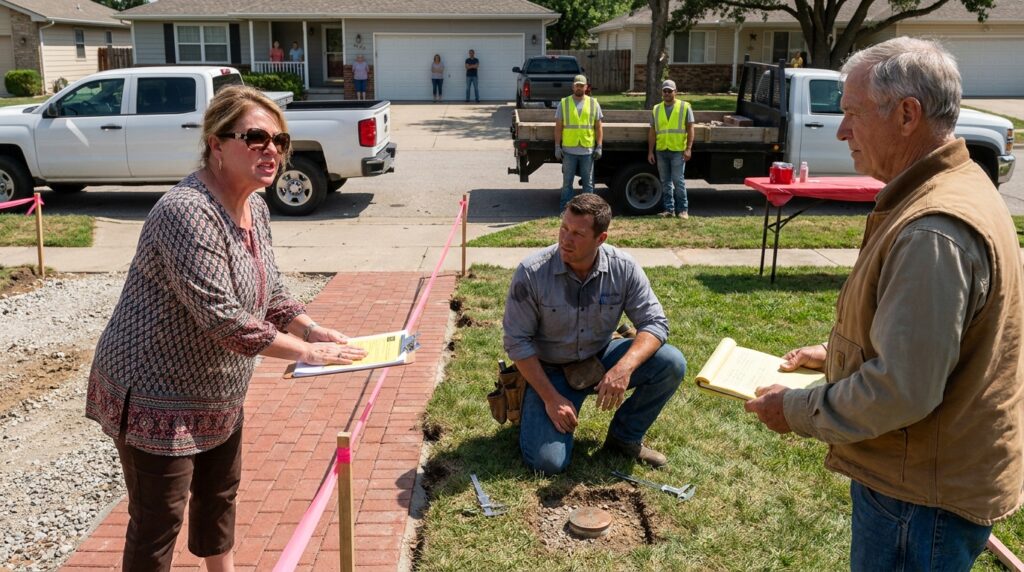
The sound reached him before the old truck cleared the final bend of Landmark Lane. It was the heavy, rhythmic scrape of square-point shovels biting deep into sod, followed by the metallic hiss of dry sand pouring onto packed earth. Raymond Vance shifted down, his calloused palm resting on the worn gear selector as he guided the vehicle past the curb. The air inside the cabin smelled of old tobacco and iron tools, a quiet baseline he had relied on for thirty years while surveying boundaries across the state’s desaturated secondary highways. He had returned to his father’s house looking for that exact stillness—a brief reprieve from the infinite calculations of highway grids and county lines. Instead, he pulled up to a flatbed truck idling hard against the drainage ditch, its bed stacked high with uniform blocks of dark red concrete.

He killed the engine. The truck sputtered into silence, leaving only the abrasive, mechanical sounds of the crew operating on his front lawn. Slices of thick green turf lay rolled back like discarded carpet along the edge of the gravel drive, exposing the damp, dark loam beneath. Four men in bright neon vests moved along a freshly dug trench, their movements synchronized as they leveled a bed of crushed gray stone.

Standing directly behind them at the property line was Brenda Gantry. She held a heavy plastic clipboard against her hip, her thumb pinned against a thick stack of neighborhood association bylaws. Her oversized designer sunglasses caught the sharp glare of the afternoon sun, turning her face into a pair of mirrored shields that gave nothing away. When Raymond’s boots hit the gravel, she didn’t offer a hand or a word of welcome. She simply stepped forward, planting herself squarely on the fresh white chalk line that ran three yards deep into Raymond’s deeded turf.

“Community progress doesn’t halt for an empty lot, Raymond,” Brenda said, her voice carrying the flat, practiced tone of a self-appointed authority used to unmitigated compliance. “The board approved this access path, and you will comply with the new layout.”

Raymond looked down at the chalk line. His gaze tracked the white powder as it cut through the patch of wild clover his father had planted forty years ago to save the soil. He reached into his pocket, his fingers brushing the cool, heavy surface of his father’s old iron plumb bob. He didn’t raise his voice. He didn’t drop his stance.

“The board can vote on whatever they like, Brenda,” Raymond said, his voice flat, steady, and entirely devoid of the anger she was clearly tracking for. “But they don’t own the dirt beneath your shoes.”

Brenda smiled—a sharp, quick gesture that didn’t reach her eyes—and tapped her clipboard against her palm. “The easement revision was settled three months ago while you were out in the western counties. It’s fully legal, Raymond. If you obstruct this work, the daily enforcement fines start at five hundred dollars, enforceable by a lien against the title.”

Raymond didn’t look at the paper she held out. Instead, his eyes dropped to the cornerpost near the old oak tree. The low brush had been hacked away with a machete, and where the original, rusted iron boundary pin should have been buried deep in the earth, there was only a fresh, empty hole in the clay. The raw iron marker that had anchored this lot since the original county platting was gone.

CHAPTER 2: THE PAPER PERIMETER

“A title is only as good as the fence that keeps it clear, Raymond,” Brenda said. She tapped the heavy acrylic edge of her clipboard against the top iron rail of the flatbed truck, a dull, synthetic click that cut through the low idle of the diesel engine. “And right now, your fence is forty years behind the county’s current development schedule.”

Raymond didn’t step back from the white line. The heat was rising from the gravel driveway, thick with the scent of unwashed clay and the sour tang of old grass roots rotting in the sun. He looked down at the spade one of the laborers had left leaning against a pallet of red concrete blocks. The metal was pitted, coated in a fine crust of dried mortar that flaked off under the vibrations of the idling flatbed.

“My father built that fence out of split cedar from the north ridge,” Raymond said, his voice dropping into the quiet, rhythmic register he used when correcting rookie chainmen on a state highway crew. “He drove the corner post six feet down and packed it with river gravel. The county line didn’t change when they poured this asphalt, and it didn’t change when you bought into the block.”

Brenda pulled her sunglasses down an inch, her eyes tracking the worn steel tape rule clipped to his leather belt. “The subdivision act of nineteen-ninety-four gave the civic improvement committee oversight on all uncultivated access lanes connecting to public easements. Look at the ledger, Raymond. It’s right there under Section Four. Your father signed the original plat allowance when the county expanded the cul-de-sac.”

She held out a sheet of sun-baked cardboard backing from her clipboard, where a photocopy of an old deed ledger was pinned under the metal clip. The ink was faded to a dark sepia, the signature at the bottom shaky but familiar. Raymond’s eye didn’t linger on the name. It went straight to the top left margin—to the fine, non-standard serial imprint stamped into the header. It was a five-digit state department code, but the alignment was off by two millimeters, a vertical deviation that usually meant a ledger page had been run through a flatbed press twice after the original registry book was bound.

He reached out, his thumb catching the edge of the paper. The texture was wrong. It had the heavy, textured weight of recent wood pulp, not the smooth, brittle rag paper the county used before the regional survey offices were consolidated in the late seventies.

“This layout shows a twelve-foot right-of-way,” Raymond said, his finger resting on the white border of the copy. “The trench your men are digging is fifteen feet from the curb line. You’re three feet over the margin, even by this ledger.”

Brenda’s jaw tightened, the skin around her mouth resetting into a hard, linear fold. She didn’t look at the paper. She looked past his shoulder, toward the red-brick house at the end of the Lane where two neighbors had stepped onto their porch, their faces obscured by the glare on their screen doors.

“The extra three feet are for the stabilization tier,” she said, her tone clipping the ends of her words. “Standard engineering tolerance for a high-traffic pedestrian corridor. If we don’t finish the base layer before the weekend rain, the drainage shift will wash out your lower ditch line anyway. You should be thanking the committee for covering the masonry cost.”

“I don’t pay taxes on tolerances, Brenda,” Raymond said. He leaned down, picking up a broken piece of the red paver that had crumbled off the pallet. The aggregate inside was coarse sand and cheap river silt, gray and porous. It wasn’t commercial grade; it was the kind of residential surplus sold off by the pallet from warehouse clearings down in the valley. “And I don’t let municipal crews work without a blue-line permit on site.”

He turned away from her before she could reply, his boots crunching loud against the coarse gravel as he walked toward the corner post by the oak tree. The crew leader, a broad-shouldered man with dust caked into the creases of his neck, stopped his shovel mid-swing. He looked at Brenda, then at Raymond, his eyes tracking the yellow field notebook Raymond had pulled from his shirt pocket.

“The work stays active until an official injunction is served, Vance,” Brenda called out behind him, her heels following him down the margin of the yard. “The fine notice is already entered into the neighborhood system. Every hour those men sit idle is another fifty dollars on your account.”

Raymond reached the oak tree. He didn’t look back at her. He knelt in the dry briars, his fingers seeking the cold, hard crown of the underlying bedrock where the original benchmark should have been scored. Instead, his palm struck a raw piece of pine wood—a fresh grade stake driven straight into the soft earth where the iron pin had been pried out. Stamped onto the side of the wood was a serial imprint that didn’t match any state registry he had mapped in thirty years. It was a private land-firm stamp, still sticky with fresh resin.

He pulled the pencil from his ear, his mind already calculating the offset from the highway centerline two hundred yards away. The decoy was simple enough to read—the paperwork looked like a standard easement extension. But the weight of the dirt, the missing iron, and the non-standard stamp on the pine told a different story. The boundary wasn’t being corrected; it was being erased.

CHAPTER 3: THE MIDNIGHT LINES

“You’re tracking shadows, Raymond,” the text from his former district chainman read on the small, cracked screen of his phone. “The county records office closed their physical books for Landmark Lane back when the state routed Highway Nine around the ridge.”

Raymond shoved the phone back into the pocket of his heavy canvas coat. The night air was thick, carrying the damp, metallic tang of the drainage ditch and the distant, dry rattle of wind through the scrub oak. It was nearly two in the morning. The neighborhood was completely still, the streetlamps casting long, amber blocks of light across the freshly stripped soil of his front yard. The trench dug by Brenda’s crew looked like a raw suture in the dark, cutting an uneven line through the rye grass his father had mowed every Saturday for forty years.

He knelt by the base of the oak tree, the dry weeds scratching loud against his denim jeans. In his left hand, he held a heavy brass flashlight, its lens masked with black tape down to a narrow pencil beam. The light flickered over the raw pine grade stake he had found earlier. Up close, the fresh wood looked stark and artificial against the ancient, weathered root system. Raymond set his yellow field notebook on a flat stone, his fingers tracing the private land-firm stamp impressed into the soft grain.

He didn’t need the total station yet. His hands knew the weight of this dirt, and his eyes had memorized the original blue-line plats before he left the regional office. He reached into his tool vest, pulling out a small folding spade and a weathered iron probe.

He began to dig, his movements small and calculated to avoid throwing loose gravel onto the driveway. The spade struck something hard six inches down—not the crumbling gray aggregate Brenda’s men had dumped, but the cold, unyielding curve of ancient limestone bedrock. He cleared the dirt away with his bare fingers, his nails scraping against the stone until the narrow beam of his flashlight caught the mark.

It was a chiseled cross, worn smooth by decades of ground moisture but still perfectly distinct. Right beside it, stamped into a small copper disk that had been hammered into a fissure, was the state registry number: DOT-1974-B.

Raymond leaned back on his heels, the cold iron probe resting against his knee. His father had stood right here when the county surveyor set that pin. The copper disk was an official state geodetic benchmark, a primary anchor point that could not be altered, moved, or overridden by any municipal subdivision act or neighborhood committee. If Brenda’s path was fifteen feet from the curb, it wasn’t just overlapping a residential easement; it was completely obliterating a protected state survey marker.

He pulled a vintage local utility map from his coat pocket, unfolding the stiff, sun-baked paper across his knees. The map had been pulled from an old metal filing cabinet in the basement of the district office—an obsolete water line route from nineteen-eighty-two that had never been digitized. His finger traced the faded blue ink of the main pipeline. According to the document, the line ran parallel to his fence, but the original right-of-way had been granted exclusively to the state for infrastructure maintenance, explicitly prohibiting any secondary concrete or masonry structures.

A low rustle in the brush made him freeze. Raymond doused the light, his thumb resting flat against the rubber switch.

Through the branches of the scrub oak, he watched a pair of headlights round the far turn of the cul-de-sac. A large black SUV crawled past the driveway, its engine a faint, expensive hum in the quiet. The vehicle slowed near the pallets of red brick, its brake lights casting a long, blood-red glare across the open trench. For three seconds, the vehicle sat idling, the dark tint of the driver’s side window rolled down just two inches.

Raymond didn’t move. He kept his back pressed against the rough bark of the oak, his hand closed tightly around the iron probe. He knew the silhouette of that roofline. He had watched it roll past his porch every afternoon, the deliberate, pacing speed of someone monitoring an investment.

The SUV didn’t park. The window rolled up smoothly, the tires crunching soft against the gravel as it accelerated out of the lane, leaving the scent of high-grade exhaust and warm rubber lingering in the damp air.

Raymond clicked the light back on, his face set. He didn’t look at his phone again. He opened his notebook, his pencil sketching the offset distances from the chiseled cross to the raw edge of the brickwork. The decoy was the photocopied ledger Brenda had flaunted—a clever piece of administrative theatre meant to keep a retired surveyor looking at local bylaws and property disputes. But the physical truth was stamped in copper and chiseled in stone. The layout wasn’t a civic improvement; it was a deliberate, legal erasure of state-protected coordinates designed to shift the entire tax line of the block.

He stood up, his joints popping in the cold silence. He walked toward the porch where his trail camera was hidden in the shadow of the eave, its digital lens tracking the perimeter. Tomorrow, the masonry crew would return to set the final mortar layer. Brenda would have her neighborhood block party, and she would stand right on the white line with her plastic clipboard. Raymond tucked the utility map into his vest, his boots stepping lightly across the gravel. He had the coordinates now, and he knew exactly how much weight the state code carried when the baseline was violated.

CHAPTER 4: THE PAVEMENT FEAST

The bass from the portable PA system vibrated straight through the soles of Raymond’s boots before he even crossed the threshold of his screened porch. Brenda hadn’t waited for the mortar to cure. By ten o’clock in the morning, a long folding table covered in thin red plastic had been erected parallel to his ditch line, lined with sweat-beaded pitchers of sweet tea and plates of store-bought cookies. Ten or twelve neighbors from the upper ring of the cul-de-sac stood in small clusters, their conversations swallowed by the hollow, metallic ring of Brenda testing a wireless microphone against her palm.

The trench was gone, replaced by three hundred linear feet of interlocking red pavers that gleamed like fresh meat under the harsh, unshaded morning sun. The crew had worked straight through the dawn, their flatbed truck now empty and parked idling at the curb, its exhaust casting a blue, oily haze over the neighborhood’s pristine green lawns.

Raymond walked down his driveway, his yellow field notebook tucked flat against his ribs under his canvas vest. The crowd didn’t parted for him; they simply froze, their eyes tracking the worn steel measuring tape hanging from his hip like a weapon.

“We owe a debt of gratitude to the preservation committee for securing our neighborhood’s perimeter access,” Brenda’s voice boomed through the speakers, the volume overriding the low chug of the flatbed’s diesel engine. She stood at the head of the path, her patterned tunic fluttering in the hot breeze, her heavy clipboard raised to point directly at Raymond as he reached the white chalk line. “And despite individual resistance to modernization, the structural easement is officially complete.”

A few neighbors offered a scattering of polite applause. Most simply stared, their cups held low, their faces tight with the awkward, transactional silence of people who didn’t want to get caught between a rogue committee chair and a man who spent his life mapping state property lines.

“The easement isn’t completed, Brenda,” Raymond said. He didn’t use the microphone, but his voice carried the flat, practiced weight of an inspector stopping a highway pour. He stopped three feet short of the brick margin. “Because the document you logged in the association ledger yesterday morning isn’t an easement extension at all. It’s a fraudulent municipal zoning waiver.”

The microphone gave a sharp, high-pitched squeal as Brenda lowered it, her sunglasses reflecting the hard line of his jaw. “That document bears the official county clerk’s stamp, Raymond. I suggest you read the public registry before you make accusations that could cost you your title.”

“I did read it,” Raymond said, stepping closer until his boot toe brushed the dry sand between the red pavers. “I pulled the original utility plat from nineteen-eighty-two out of the district basement last night. The county never held the right-of-way here. The state does. The five-digit code you printed on that header belongs to an obsolete water line route that was abandoned thirty years ago. You didn’t expand a public path. You used a dead utility variance to cover the fact that you’re moving the entire tax boundary of this block.”

A murmur broke out among the porch-watchers. A man in the front row, an older resident named Harrison who lived three doors down, lowered his cup and frowned. “What do you mean moving the boundary, Raymond? The committee said this was common land.”

“It’s not common land,” Raymond said, his gaze shifting directly to Brenda, whose knuckles had gone white around the plastic frame of her clipboard. “The ledger entry was a decoy. It was designed to satisfy a standard property check if I contested the path. But it doesn’t change the coordinates. The pine stakes your crew drove yesterday didn’t follow the water line. They match a private land-firm survey that shifts three whole acres of deeded tax parcels away from my lot and directly into the unplatted expansion block behind Brenda’s house.”

Brenda’s face didn’t pale; it hardened into a dark, flush mask of absolute defiance. She stepped off the path, her heels sinking into the loose dirt of his lawn as she pointed the clipboard directly at his chest.

“You’re disrupting a sanctioned community project based on outdated state paperwork, Vance!” she snapped, her microphone voice dropping into a sharp, transactional hiss that only the front row could hear. “The county enforcement office handles local development, not some retired highway chainman with an old notebook. The bricks are set. The access is open. If you touch a single stone on this line, I will have the sheriff remove you for structural vandalism before the sun goes down.”

She turned back to the crowd, her arm flung wide toward the red walkway. “Neighbors, please. Help yourselves to the refreshments. The path is open for use.”

Raymond didn’t step onto the pavers to stop her. He stood perfectly still on his own grass, his hand resting on the heavy steel rule at his belt. He watched Harrison and two others hesitate, then step back toward the street, their phones rising to record the sudden, freezing tension in the air. The decoy had been broken right in front of them, but the absolute final authority hadn’t landed yet. Brenda was doubling down, her false logic holding the line by sheer force of presence, entirely unaware that the white county vehicle he had spent the last four hours coordinating had just turned the corner of Landmark Lane.

CHAPTER 5: THE BOUNDARY ENFORCED

“Engine off,” the driver of the white Ford F-250 muttered as he swung his door open against the dry grass of the shoulder. The door panel bore the matte-black emblem of the County Code Enforcement Office, the paint pitted from gravel roads. Marcus Thorne stepped out, his uniform shirt dark with sweat under the arms, a heavy leather tool belt sagging against his right hip. He didn’t look at the pitcher of sweet tea or the folding table. His eyes went directly to the fresh red bricks slicing three yards into the dirt, then down to the neon-pink surveyor’s tape Raymond had driven beside the oak tree.

The portable PA system gave a dull hum as Brenda stepped in front of the speaker, her plastic clipboard held like a breastplate.

“Officer Thorne,” Brenda said, her voice dropping the microphone glare but keeping the sharp, clipped authority of the committee chair. “We called your office three days ago to log the utility variance layout. The project is fully compliant under the municipal residential code. This resident is simply weaponizing outdated state DOT plats to delay a safety corridor.”

Thorne didn’t reply right away. He walked to the edge of the brick tier, the dust from the sand bed rising around his heavy work boots. He reached into his pocket and pulled out a pair of steel calipers and a metal clipboard of his own, unhooking a thick stack of certified county parcel sheets.

“The variance you logged yesterday morning was for a closed lateral pipe line, Mrs. Gantry,” Thorne said, his voice flat, dry, and entirely transactional. He didn’t look up at her. He knelt on the red pavers, his fingers clearing away the loose aggregate until he reached the cold copper disk hammer-set into the limestone. “This marker right here is a primary state geodetic benchmark. It’s been on the master grid since nineteen-seventy-four. You can’t run a neighborhood variance across a state baseline without a governor’s public works exemption.”

Raymond stood three feet back on his own grass, his calloused hands resting flat inside the pockets of his canvas vest. His fingers remained wrapped around his father’s old iron plumb bob, the cool weight grounding him against the sudden, collective intake of breath from the porch-watchers.

“This is a certified state survey, and that crew is currently standing three yards inside a private boundary,” Raymond said, his voice level, carrying no personal anger, only the cold permanence of the math. “Stop digging, or you’re paying for the damages out of your own pocket.”

Brenda’s fingers tightened until the acrylic edge of her clipboard groaned. “The neighborhood board represents seventy-three percent of the block’s voting acreage, Marcus. We restructured the cul-de-sac entry to preserve the communal view line. The county clerk stamped the ledger page herself.”

“The clerk stamped a filing receipt, Brenda, not a title transfer,” Thorne said. He stood up, his joints popping in the dry heat. He turned toward the masonry crew leader, who had already dropped his level back into his wooden tool chest. “Pack it up. Drop the tools. If these machines are still on the private side of these pink markers in ten minutes, I’m locking the flatbed under a Class Three structural violation.”

The four laborers didn’t look at Brenda. They moved in silence, their heavy leather gloves scraping against the raw concrete blocks as they began stacking the surplus pavers back onto the flatbed’s wooden pallet. The loud ring of the metal tailgates slamming shut cut through the neighborhood like an iron gate dropping down.

Harrison, the older resident from three doors down, stepped off the curb, his phone still raised, his face dark with sudden realization. “Brenda, the committee used the drainage fund to buy these bricks. You said the county gave us the land behind the fence.”

“The land behind the fence belongs to the unplatted municipal reserve,” Brenda snapped, her voice cracking as the mirrored sunglasses slipped down her nose. “We were absorbing the margin to secure the corridor before the valley developers bought the ridge. It was for the valuation of the whole block!”

“It was to clear the tax map for your own lot expansion, Brenda,” Raymond said. He pulled the yellow field notebook from his pocket, opening it to the sketch he had verified at midnight. He didn’t pass it to her. He held it so Thorne could see the exact cross-reference marks. “The decoy was the utility ledger. But the secondary anchors show the true line. The private land-firm stamp on those pine stakes belongs to the same surveyor who handled your home addition five years ago. You didn’t move the path for the neighborhood. You moved the path so your lot would clear the required twenty-foot setback from the new park road.”

Thorne took the notebook, his eyes scanning Raymond’s neat, graphite calculations. He nodded once, a brief, functional movement of his chin. He pulled a thick pad of yellow carbon-copy violation notices from his belt, his pen scratching loud against the paper.

“Illegal structural alteration of a state-protected perimeter,” Thorne read aloud as he tore the top sheet off. The paper made a sharp, dry rip in the silence. He stepped across the red bricks and pressed the carbon copy directly against the center of Brenda’s plastic clipboard. “Demolition notice is active as of twelve noon today. You have forty-eight hours to clear the masonry and restore the grade to the nineteen-seventy-four baseline, or the county works department clears it at the committee chair’s personal expense.”

The neighbors backed away from the table, their steps quiet against the gravel. Harrison turned his back entirely, walking toward his own porch with his phone held low. The portable PA system gave one final, high-pitched pop before the crew leader yanked the power cord from the generator, dropping the entire cul-de-sac into a sudden, absolute silence. Brenda stood entirely alone on the edge of the trench, her fingers trembling against the yellow carbon paper, her authority crumbling into the coarse sand at her feet.

CHAPTER 6: THE SETTLED PERIMETER

The red bricks did not look like progress anymore; they looked like debris. The silence that settled over Landmark Lane was heavy, filled only with the smell of heat-softened asphalt and the fine, dry dust of crushed mortar settling into the grass. Raymond watched the tailgates of the masonry trucks vanish around the far curve of the cul-de-sac, their diesel rumble fading until the only sound left was the scratch of wind through the dried scrub oak. The neighborhood porches were empty now, the screen doors clicked shut, the temporary spectators retreating into the air-conditioned privacy of their own properties.

Brenda Gantry remained standing at the margin of the dirt. Her clipboard hung loose from her fingers, the yellow carbon-copy notice pinned beneath the clip fluttering like a broken wing. Without the microphone or the audience, her posture had shrunk, the sharp, linear lines of her tunic looking loose and creased in the unshaded glare. She didn’t look at Raymond. She looked down at the neon-pink survey tape he had driven beside the bedrock anchor, its bright plastic tails snapping in the dry breeze.

“My father planted this grass fifty years ago,” Raymond said, his voice dropping into the quiet, unyielding register of a man closing a field ledger. He didn’t step onto the pavement; he stayed firmly on the side of the baseline. “Tomorrow morning, you’re going to start putting it back exactly the way you found it.”

Brenda didn’t answer. Her jaw moved silently, resetting into a hard, defensive line that carried no more weight. She turned away, her heels catching on the loose sand as she walked toward her SUV, leaving her plastic clipboard on the plastic table next to the sweat-beaded pitchers of warm tea.

Raymond walked down the margin of the trench, his boots heavy and rhythmic against the gravel. He reached into his vest pocket, his calloused fingers wrapping around the cool, oxidized iron of his father’s old plumb bob. The weight of the metal was solid, a permanent balance against the three decades of land shifts and corporate layouts he had measured across the state. The layout was finished. The math had held the line, not through a loud voice or a public vote, but through the simple, unyielding permanence of the coordinate benchmark.

He knelt near the oak tree, pulling the fresh pine stakes out of the earth one by one. The sticky resin stained his palms, but beneath the disturbed loam, his fingers found the deep, compressed indentations where the original split-cedar fence posts had sat for forty years. The soil was cool down there, packed tight with river gravel and root systems that had outlasted three neighborhood development acts.

By noon the following day, the first remediation crew arrived—not Brenda’s laborers, but a bonded municipal contractor dispatched by the code office at the committee’s expense. Raymond stood on the screened porch, his yellow notebook resting on the wooden railing, watching the mini-excavator lift the red blocks out of the lawn and stack them back onto flatbed trailers. The gray sand was scooped clear, replaced by dark, nutrient-rich topsoil hauled in from the valley.

Harrison walked across the Lane later that evening, a worn leather work glove tucked under his arm. He stopped at the property line, his eyes tracking the fresh seed Raymond had scattered across the black dirt. He didn’t offer a defense for the committee; he simply nodded once toward the tree.

“The registry map is locked at the county office now, Raymond,” Harrison said, his voice quiet against the evening cricket chorus. “Thorne entered the permanent baseline into the regional grid this morning. No one’s moving that pin again.”

“The pin never moved, Harrison,” Raymond said, his gaze fixed on the spot where the copper disk rested deep in the stone. “People just forgot how to look for it.”

He stayed on the porch long after Harrison left, watching the sun drop behind the north ridge, casting long, desaturated shadows across the reclaimed perimeter. The white chalk line had completely dissolved into the grass, washed out by the afternoon humidity. The homestead was quiet again, the air smelling of clean earth and damp rye seed. He reached down, setting the iron plumb bob flat onto the wooden table beside his notebook, its pointer aligning perfectly with the gravitational baseline of the ground beneath him. The perimeter was clear, the boundaries were fixed, and the dirt was settled.

Similar Posts

Leave a Reply

Your email address will not be published. Required fields are marked *






